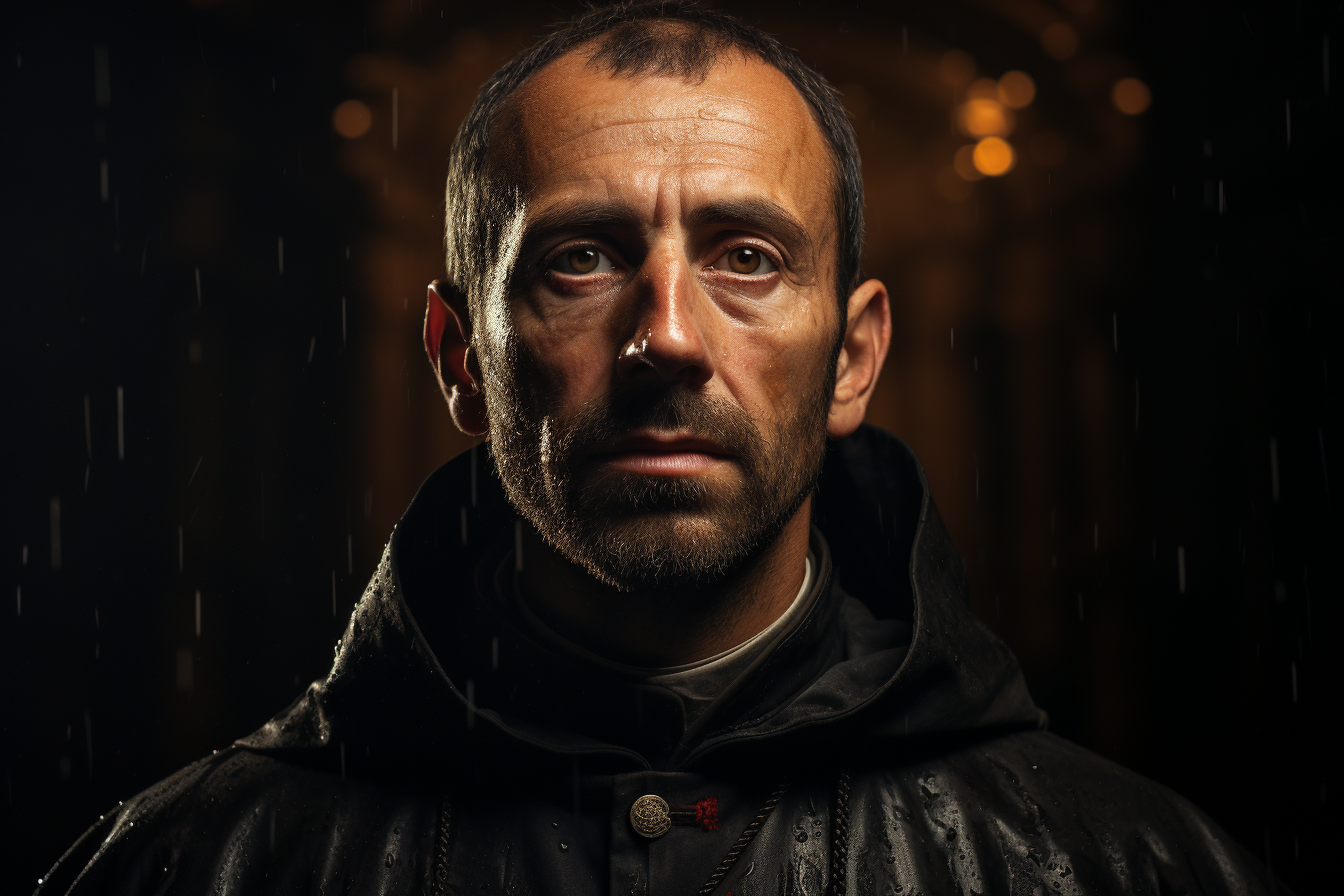
St. Peter Claver

Saint Peter Claver: A Life of Compassion and Devotion

When they lived:

St. Peter Claver, a man of great compassion and devotion, lived during the late 16th and early 17th centuries. He was born on June 26, 1580, in Verdu, Catalonia, Spain, and spent the majority of his life in the vibrant port city of Cartagena, Colombia.

Where they lived:

Cartagena, a bustling Caribbean seaport, was a melting pot of cultures during St. Peter Claver’s time. The city’s vibrant atmosphere and diverse population inspired him to dedicate his life to serving those in need, especially the marginalized and oppressed.

Notable world events during the time of their life:

  1. The Age of Exploration (1492 – late 17th century): This era marked a period of significant global exploration and discovery. In 1492, Christopher Columbus reached the Americas, opening up a new world of opportunities and challenges. St. Peter Claver’s hometown of Cartagena became a crucial hub for trade and interaction between Europe and the Americas, exposing him to a diverse range of cultures and peoples.
  2. The Thirty Years’ War (1618 – 1648): During St. Peter Claver’s life, Europe was embroiled in a devastating conflict known as the Thirty Years’ War. This war, which began in the Holy Roman Empire and spread across Europe, resulted in widespread destruction and loss of life. Despite the distance from the epicenter of the conflict, its impact was felt even in Cartagena, influencing the city’s dynamics and challenges.
  3. The Scientific Revolution (17th century): The time when St. Peter Claver lived was marked by a flourishing period of scientific discoveries and advancements. Visionaries like Galileo Galilei, Johannes Kepler, and René Descartes were revolutionizing the way humanity understood the natural world. While St. Peter Claver’s life was dedicated to spiritual matters, he undoubtedly lived in a world experiencing remarkable scientific progress.

Their patronage:

St. Peter Claver is recognized as the patron saint of slaves, African missions, and interracial justice. His deep empathy for the African slaves brought to the Americas led him to devote his life to their service, providing them with spiritual comfort, medical care, and advocacy for their rights. His unwavering dedication to those who suffered under the brutal conditions of slavery earned him the title of “Slave of the Slaves.”

Service to the Enslaved

The slaves were brought in by the mine owners from Angola and the Congo. Slavery was also a profitable business then, and a lot of it was being brought in. Claver’s predecessor, Alonso de Sandoval, inspired and mentored Claver, and he had also devoted himself to serving slaves for the forty years that he worked before the arrival of Claver to continue his work. Sandoval deemed St. Peter Claver an apt pupil.

St. Peter Claver would board the ships that brought in the slaves as soon as they docked, and he would treat and minister to the slaves. Even though the conditions in the ships were undesirable, he would get in and attend to the badly treated. Because the ships were often filled to capacity, it was often difficult to move around, but he did not give up.

Even after the slaves left the ships, he would join them to provide medicine and food. He used interpreters and pictures to give basic instructions. St. Peter Claver considered the slaves fellow Christians, and he encouraged others to do the same.

When he was not with the slaves, St. Peter Claver would travel to plantations to give spiritual consolation to the slaves. He would baptize them as well as make follow-ups to ensure that, as Christians, they received their Christian and civil rights. He avoided the hospitality of planters and overseers and preferred to lodge in the slave quarters.

St. Peter Claver’s efforts were not in vain, as the slaves’ situations slowly improved. He became a moral force, the Apostle of Cartagena.St. Peter Claver comforting a group of slaves

Other Acts of Service

St. Peter Claver did not only preach to the slaves; he also preached in the city square to sailors and traders, as well as baptizing them. He would also return to follow up on those he had baptized.

Even though he preached to the slaves, he also ministered to the souls of the well-to-do members of society, traders, and visitors to Cartagena, even if they were Muslims. He condemned criminals and spiritually prepared them for death. He also frequented the city hospitals.

St. Peter Claver wore a cloak, and he would lend it to anyone who needed it.

Illness and death

In his last years, he was very ill and could not even leave his room. He was not well for four years, and he was neglected and forgotten, physically abused, and starved by an ex-slave who had been hired to take care of him. He, however, never complained about his treatment. He died on September 8, 1654.

Even though some city magistrates considered him a nuisance when he was alive, when he died, they ordered a public funeral at the persistent advocacy of the slaves, and he was buried with pomp and ceremony.

His body is preserved and venerated in the church of the Jesuit residence, now renamed in his honor.

Legacy

He is the patron saint of slaves, seafarers, and the Republic of Columbia.

He was canonized in 1888, and his feast day is on the 9th of September.

The Congress of the Republic of Colombia declared September 9 as Human Rights National Day in his honor.

Many organizations, missions, parishes, religious congregations, schools, and hospitals bear the name of St. Peter Claver.

5 Interesting Facts About St. Peter Claver

  1. It is estimated that he baptized around 300,000 and heard
    confessions of over 5,000 slaves per year.
  2. St. Peter Claver signed his final profession document in Latin.
    as Peter Claver, servant of the Ethiopians forever.
  3. It was believed that whoever wore St. Peter Claver’s cloak
    earned a lifetime of health and was cured of all diseases.
  4. In his final years, when he was being ill-treated, he accepted
    it as a just punishment for his sins.
  5. When he died, many people forced themselves into his room.
    stripping away anything that serves as a relic.

Prayer to St. Peter Claver

O God, who made Saint Peter Claver a slave of slaves and strengthened him with wonderful charity and patience as he came to their help, grant, through his intercession, that, seeking the things of Jesus Christ, we may love our neighbor in deeds and in truth. Through our Lord Jesus Christ, your Son, who lives and reigns with you in the unity of the Holy Spirit, one God, forever and ever Amen.


St. Genevieve

When She Lived:

Saint Genevieve was born around 422 AD and died in 512 AD. She lived during the late Roman Empire and the early years of the Frankish Kingdom.

Where She Lived:

Saint Genevieve lived in Paris, France. She is considered the patron saint of the city and is closely associated with its history.

Notable World Events During Her Time:

  • The Fall of the Western Roman Empire (476 AD): Saint Genevieve witnessed the decline and eventual fall of the Western Roman Empire, marking a significant shift in the political and cultural landscape of Europe.
  • The Clovis I Conversion (496 AD): Clovis I, the King of the Franks, converted to Christianity, marking a pivotal moment in the spread of Christianity among the Germanic tribes and the establishment of the Frankish Kingdom. This event had a profound impact on the religious and political developments in the region.
  • The Council of Ephesus (431 AD): This major ecumenical council of the early Christian Church addressed theological issues, including the nature of Christ. It had far-reaching consequences for the development of Christian doctrine and the shaping of the Church.
  • The Rule of Attila the Hun (434-453 AD): The time when Saint Genevieve lived saw the rise and fall of Attila the Hun, who led a series of invasions in Europe. This event impacted the political stability and migration patterns in the region.

Her Patronage:

Saint Genevieve is the patron saint of Paris, France. She is also invoked for her protection against disasters, plagues, and natural calamities. Additionally, she is recognized as the patron saint of women, students, and those in need.

Saint Genevieve is an intriguing historical figure, and her life intersected with a period of significant transformation in Europe, marked by the decline of the Roman Empire, the spread of Christianity among the Germanic tribes, and the formation of early medieval kingdoms. Her connection to Paris and her reputation as a protector against various challenges make her a compelling subject for exploration.

Life and Works

Saint Genevieve is one of the most respected and influential women in the history of Paris and Religion. Venerated a Patron Saint of Paris, A status promoted by Clotilde, Saint Genevieve is celebrated by the Roman Catholic and Eastern Orthodox religions.

She is most popularly revered for her role in saving her city, Paris, from the clutches of one of the evilest men in history, Attila the Hun.

A normal peasant girl, Saint Genevieve was born in 422 in Nanterre,Paris, where she led a normal life as a child. The first marked change for her began at the young age of 7 when she first met Saint Germanus, the Bishop of Auxerre, who was passing through on a sojourn to Britain. On sighting her amongst the crowd of people who gathered to listen to him, he foretold her future as a devotee, and she immediately communicated her wish to dedicate her life to God and the Christian religion.

Saint Genevieve was consecrated to God as a virgin, promising to avoid vanity. She immersed herself in prayers, intense fasts, teaching, and preaching. At the age of 15, after the death of her parents, Saint Genevieve went to live with their godmother, Lutetia, in Lutetia, Paris.

There, she began her charitable work by rendering help to the needy. Her piety, charity, and devotion to religion got her recognized and endeared her to lots of people.

Through it all, she remained dedicated to the mortification of the flesh by abstaining from various acts and breaking her long fasts only two days a week. She continued this over the years, getting both love and animosity from people in the city.

She loved God, and in return, she exhibited divine intervention. She was known to perform miracles and receive visions of angels and saints. This further caused her to be criticized until her enemies decided to end it all by drowning her in a lake. She was saved by the timely intervention of Saint Germanus, who then appointed her to lead all consecrated virgins in the church.St. Genevieve having a heartfelt conversation with St Germanus

It was in that period that Attila the Hun was on a rampage of seizing towns and waging war on every city he could reach. When he finally arrived in Paris to wage war, every Parisian was prepared to run for cover. Saint Genevieve, however, urged them all to stay behind, pray, and fast for God’s intervention. She told them to rest assured that they were going to be safe.

And they were. It is widely believed that it was Saint Genevieve’s prayers that saved the city from Attila’s scourge.

In 464, During Childeric’s siege and the Famine, Saint Genevieve was able to pass through blockades into Troyes, bringing back bags of corn to the people. She had a great effect on the Pagan Childeric, who respected her wish for him to release his prisoners of war.

Saint Genevieve adored Saint Denis, a Christian Martyr, and harbored a wish to build a chapel in his honor. She honored this wish, and the chapel became a favorite choice for pilgrims.

The year of Saint Genevieve’s death is stated to be between 502 and 512. Even after her death, her relics were cherished and claimed to have carried out miracles.

5 Interesting Facts About St. Genevieve

  • Did you know that Saint Genevieve is often depicted holding a lamp?
    candle? Apart from her being depicted holding a book, torch, or
    loaf of bread, Saint Genoese is often seen in artworks holding a
    lit candle with the devil leering at her from behind.
  • Did you know that Saint Germanus gifted Saint Genevieve a medal with
    a crucifix in remembrance of her consecration? It was most prized.
    possession, and she kept this medal until her death.
  • Saint Genevieve was instructed to never wear any other kind of
    jewelry. This instruction was given to her by Saint Germanus after
    her consecration so that she might do away with vanity.
  • Did you know that Saint Genevieve liked to go and pray in Church at
    night by the light of a candle? On one of such occasions, her
    candle was blown out. It is widely believed that the devil blew out
    her candle in order to scare her.
  • Did you know that Saint Genevieve was a vegetarian? She never ate.
    meat and only broke her fast on Sundays and Thursdays.

Prayer to St. Genevieve

Saint Genevieve, you who by the days before, through penance and prayer, ensured the protection of Paris, intercede near God for us, for our country, and for the devoted Christian hearts. You who cured the sick and fed the hungry, obtain the light of God and make us stronger to reject temptation. You who had the concern of the poor, protect the sick, the abandoned, and the unemployed. You who resisted the armies and encouraged the besieged, give us the direction for truth and justice. You, who through the centuries never ceased taking care of your people, help us to keep the teachings of our Lord Jesus Christ. May your example be an encouragement to always seek God and serve him through our brothers and sisters. Amen.

St. Adelard

St. Adelard of Corbie

When they lived: St. Adelard of Corbie, also known as Adalard the Younger, lived from around 751 to 826 AD.

Where they lived: St. Adelard was born in the Frankish Kingdom, which is now modern-day France. He spent most of his life in the region of Picardy and later became the abbot of the renowned monastery of Corbie, situated near the Somme River.

Notable world events during the time of their life:

  • Carolingian Renaissance (8th and 9th centuries): St. Adelard lived during the period known as the Carolingian Renaissance, which was a revival of learning and culture in the Frankish Kingdom under the rule of Charlemagne and his successors. This era witnessed significant advancements in arts, literature, and education.
  • Viking Raids and Invasions: During St. Adelard’s lifetime, Europe faced the threat of Viking raids and invasions. Norse seafarers launched plundering attacks on various coastal areas, causing widespread fear and instability.
  • Charlemagne’s Reign (768-814 AD): St. Adelard lived during the reign of Charlemagne, also known as Charles the Great. Charlemagne was a prominent ruler of the Carolingian Empire and played a vital role in the unification and expansion of Western Europe.
  • Islamic Golden Age (8th to 14th centuries): While St. Adelard resided in Europe, the Islamic world experienced its golden age, characterized by remarkable achievements in science, mathematics, medicine, philosophy, and the arts. Scholars from the Islamic empire made significant contributions to human knowledge during this time.
  • The Great Schism (1054 AD): Although St. Adelard did not live to see it, one of the significant events that occurred after his lifetime was the Great Schism in 1054 AD. This event marked the formal split between the Eastern Orthodox Church and the Roman Catholic Church, resulting in the formation of two distinct Christian traditions.

Their patronage: St. Adelard is considered the patron saint of gardeners and agricultural workers. According to legend, he was known for his deep reverence for nature and gardens, and it is said that his prayers were particularly effective in ensuring bountiful harvests and protection against crop failures. As such, farmers and those who work the land often seek his intercession for blessings on their crops and livelihoods.

St. Adelard gardening in the monastery

Early Life

Saint Adelard, sometimes called Saint Adalard of Corbie, was born in Huise around 751 A.D.

He was said to be of noble descent. Saint Adelard was the son of Charles Martel, and King Pepin the Short was his uncle. He was also called the first cousin of Charlemagne.

Saint Adelard grew up amidst royalty. As a child, he received the finest things in life.

Adelard received his primary education at the Court of Charlemagne, which was located in Aachen. After his initial education, at a very young age, he was appointed Count of the Palace.

Saint Adelard was 20 when he joined the monastery in Corbie, Picardy, around 772 A.D. The monastery had been pioneered by Queen Bathild in 662.

While he enjoyed serving at the monastery, he continued to crave seclusion. This caused him to travel to Monte Cassino.

After living in Monte Cassino for a while, his cousin Charlemagne ordered him to return home to Corbie. At Corbie, he was made Abbot.

Dedication and Devotion

While still serving as abbot, Saint Adelard was appointed prime minister by Charlemagne’s son, Lord Pepin. Pepin was at that time the King of Italy in the Carolingian Empire.

Saint Adelard continued to shuffle between serving as Abbot of his monastery and Prime minister. While in power, he took part in sittings to discuss the state of the military and the government. He wasn’t just passionate about the church; he loved his city as a whole.

Before Lord Pepin died in Milan in the year 810, he put his son Bernardin Adelard in his trust. Bernard, at that time, was just 12 years old.

Seven years later, in 817, Bernard got ready to take the throne. Emperor Louis the Debonair, also called Louis the Pious at that time, was Lord Bernard’s rival.

Suspecting that Saint Adelard was in alliance with Bernard, Emperor Louis had Adelard banished to an island in modern Noirmoutier. As a result, Wala, who was Adelard’s brother, became a monk at Corbie.

Saint Adelard was in exile for five years before Emperor Louis realized that he had made a mistake. Sorry for the costly mistake, he had Saint-Adelard found, brought bark to Corbie, and made him one of his chief executive officers.

Legacy

Back in good graces with the Emperor, Saint Adelard established several hospitals. These went a long way in ensuring that the occurringsicknesses were controlled in Corbie.

In 822, Adelarde cofounded Corvey Abbey in Westphalia.

Death and Canonization

Saint Adelard spent his days establishing health institutions and monasteries. He was a highly respected man who put the needs of the people before his own.

In the year 826, Saint Adelard was said to have been traveling to Corbie when he fell sick around the 22nd of December. He continued to fight for his health, but he died on the 2nd of January of the following year.

Saint Adelard was said to have died around 3 p.m. He was said to have been about 73 years old.

Even in death, Saint Adelard was said to have been a bearer of miracles. His relics were claimed to have healed the sick, the blind, and the deaf. The relics were, however, transported to an unknown location in 1026.

Saint Adelarde was canonized in 1026 by Pope John XIX. He is celebrated in the Roman Catholic Church on January 2.

5 Interesting Facts About St. Adelard

  1. Did you know that Saint Adelard is the patron Saint of churches and
    towns in France?
  2. Did you know that Saint Adelard’s abbey extends across the bishopric?
    of Paderborn and the duchy of Brunswick?
  3. Did you know that Saint Adelard is considered the patron saint of
    against fever and typhoid?
  4. Did you know that Saint Adelard is depicted as an abbot gardening?
    with his crown on the floor near him?
  5. Did you know some of Saint Adelard’s writings are considered
    important for the Church?

St. John the Apostle

St. John the Apostle

When they lived: St. John the Apostle, also known as John the Evangelist, lived during the 1st century AD.

Where they lived: St. John the Apostle lived in various locations throughout his life, primarily in the region of the eastern Mediterranean, including places like Galilee and Ephesus.

Notable world events during the time of their life:

  • The Destruction of the Second Temple (70 AD): One of the most significant events during John’s life was the destruction of the Second Temple in Jerusalem by the Roman Empire. This event reshaped the religious landscape of Judaism and had far-reaching consequences for the Jewish community.
  • The Great Fire of Rome (64 AD): In 64 AD, a devastating fire broke out in Rome, causing widespread destruction. Emperor Nero was accused of playing the lyre while the city burned. This event led to the persecution of Christians, and some accounts suggest that John may have faced hardship during this time.
  • The Life of Jesus Christ: St. John was one of the twelve apostles of Jesus Christ and witnessed several pivotal moments in his life, including the Transfiguration, the Last Supper, the Crucifixion, and the Resurrection. His gospel writings offer unique insights into these events and the teachings of Jesus.
  • The Pax Romana: During John’s life, the Roman Empire experienced a period of relative peace and stability known as the Pax Romana. This time allowed for cultural exchange, trade, and the spread of ideas across various regions.
  • Emergence of Roman Colosseum (80 AD): Although the construction of the Roman Colosseum was completed after John’s death, its construction began during his lifetime. The Colosseum became an iconic symbol of Roman engineering and entertainment, hosting various events, including gladiator fights and public spectacles.

Their patronage: St. John the Apostle is considered the patron saint of various groups and causes, including theologians, writers, publishers, and those struggling with burns or poisonings. He is also regarded as a patron for protection against various spiritual and physical dangers.

Small Details of His Life

Jesus chose the Twelve Apostles as his companions and friends on the journey. This journey was not only a literal and physical journey from place to place. It was also a journey during which they learned who Jesus was, grew in their faith, and were prepared for the great mission ahead. They serve as our guides to help us know the Lord Jesus—to know Him, to love Him, and to have faith in Him.

There are no records of the early life of St. John the Apostle. The Gospels, however, provide us with important details about his life. John was the son of Zebedee and the brother of James the Greater. They were mending their nets on the shore of Lake Tiberias when Jesus came and called him and his brother (see Matthew 4:21 and Mark 1:19). His name appears in the lists of the apostles found in the Gospels. According to tradition, John is the “disciple whom Jesus loved” in the Fourth Gospel, which is attributed to him.

Belonging to Jesus’ Circle of Friends

John belonged to what is called the “Apostolic College”. He was always among the small group, comprising him, Peter, and James, which Jesus took with Him on specific occasions. He was present when Jesus entered Peter’s house in Capernaum and cured his mother-in-law (see Mark 1:29), when Jesus went to the house of the synagogue leader Jairus, whose daughter He brought back to life (see Mark 5:37), and he followed Him when Jesus went up to the mountain for His Transfiguration (see Mark 9:2). Hence, John belonged to the circle of Jesus’ closest companions.

John was beside Jesus on the Mount of Olives when Jesus spoke of the end of the city and of the world (see Mark 13:3). He was close to Jesus in the Garden of Gethsemane when He prayed to the Father before His Passion (see Mark 13:33). Shortly before the Passover, Jesus sent him and Peter to prepare the room for the Last Supper (see Luke 22:8). John was the only apostle, together with Mary, who stood at the foot of Jesus’ cross on Golgotha (see John 19:26). Lastly, he witnessed both the empty tomb and the presence of the Risen Christ Himself (see John 20:2; 21:7).

John’s prominent position in the group makes it somewhat easier to comprehend the initiative taken by his mother one day. She approached Jesus and asked Him if her two sons, John and James, could sit one on His left and the other on His right in the kingdom (see Matthew 20:20–21). Jesus, in turn, asked whether they were ready to drink the cup He was about to drink, to which they responded affirmatively. Jesus, however, explained to them that He had come to serve and not to be served and that anyone who wishes to be the greatest among them should serve.

John after the Resurrection

Days after Jesus’ Resurrection, we could find “the sons of Zebedee” together with Peter and some other disciples on a night when they had nothing for a catch. After the intervention of a man walking along the shore, they had a miraculous catch, and the first to recognize the man was “the disciple whom Jesus loved”, telling Peter, “It is the Lord!” (John 21:7).

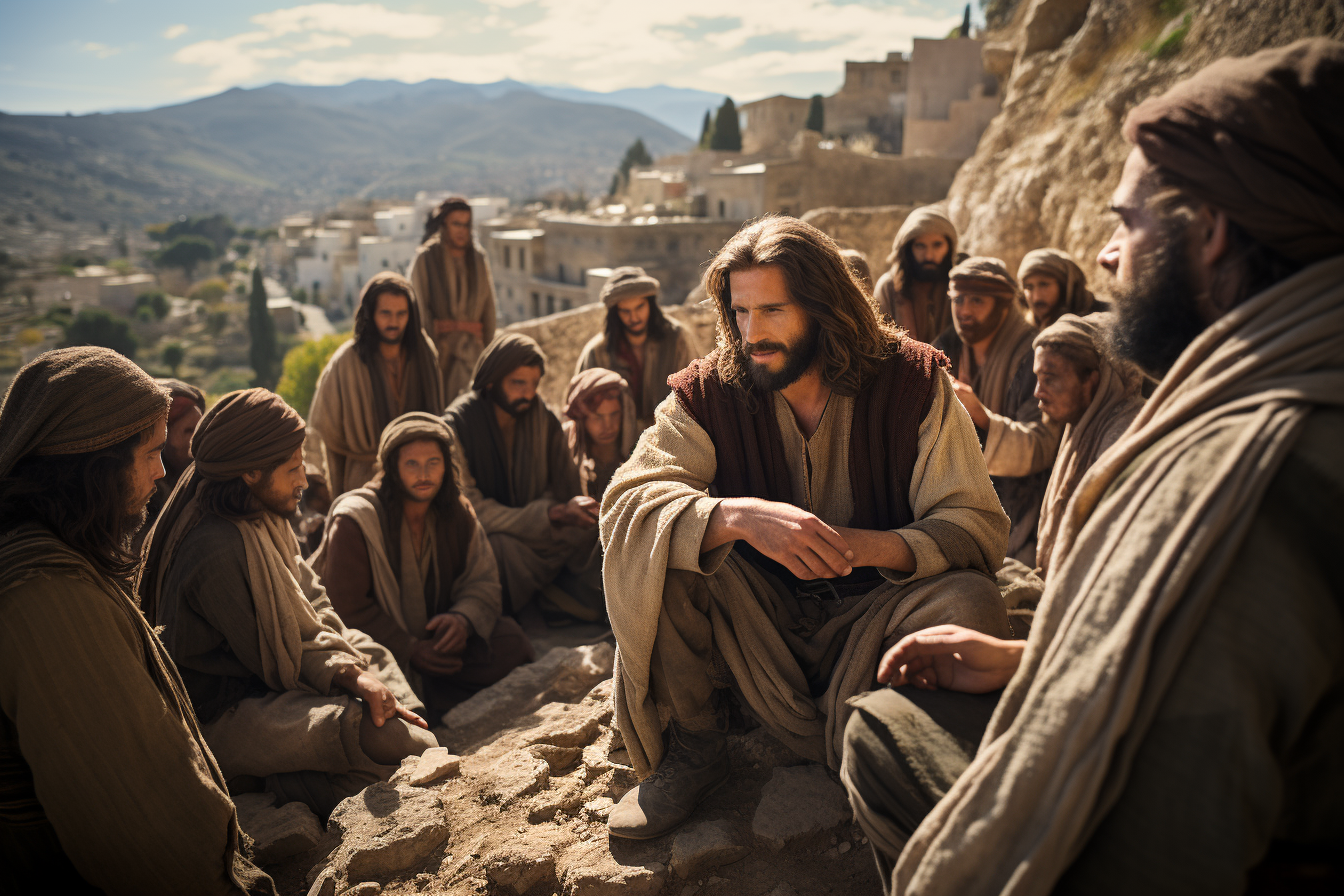
In the Church of Jerusalem, John served as the supervisor of the first group of Christians. Paul listed him among those whom he called “pillars” of the community. In the Acts of the Apostles, he was with Peter when they went to the Temple and prayed (see Acts 3:1–4, 11) and appeared before the Sanhedrin to witness to their faith in the Lord Jesus (see Acts 4:13–19). He, together with Peter, was sent to Jerusalem to strengthen the people in Samaria who had accepted the faith and pray for them that they might receive the Holy Spirit (see Acts 8:14–15).St. John the Apostle preaching to a group of people

Aside from his version of the gospel, John also wrote three epistles and was believed to be the author of the Book of Revelation. Tradition and stories say that during a persecution, John was arrested and sentenced to death. He was thrown into a pot of boiling oil, but he was left unharmed, without even a single mark on his skin. The emperor then exiled him to an island called Patmos, where he lived to a very old age and died around the year 100. His feast day is on December 27.

Five Interesting Facts About St. John the Apostle

  1. St. John the Apostle was the only apostle who did not die a martyr’s death. It is traditionally believed that he was also the youngest of the apostles and outlived them.
  2. Tradition says that since St. John the Apostle lived in Ephesus after the Resurrection, the Blessed Mother lived with him, and her Assumption took place there as well.
  3. In Christian art, the Gospel according to John is depicted by an eagle, symbolizing “the height he rose to in his Gospel.”
  4. St. John the Apostle is the patron saint of love, loyalty, friendships, and authors.
  5. The Gospel according to John uses the most metaphors for Jesus, particularly the “I am” sayings of Jesus.

Prayer to St. John the Apostle

O God, who through the blessed Apostle John has unlocked for us the secrets of your Word, grant, we pray, that we may grasp with proper understanding what he has so marvelously brought to our ears. Through our Lord Jesus Christ, your Son, who lives and reigns with you in the unity of the Holy Spirit, one God, for ever and ever Amen.

Bl. Odilia Baumgarten


Bl. Odilia Baumgarten – A Remarkable Life

When She Lived:

Blessed Odilia Baumgarten, also known as Sister Maria Teresa of the Heart of Jesus, lived from December 20, 1853, to April 9, 1926.

Where She Lived:

Blessed Odilia Baumgarten was born in Günzburg, Bavaria, which is now part of Germany. She spent most of her life in Europe, particularly in the areas of Germany and Switzerland.

Notable World Events During Her Life:

  • Franco-Prussian War (1870-1871): This war between France and the Kingdom of Prussia (later becoming part of Germany) had a significant impact on Europe’s political landscape. The war resulted in the unification of Germany under Prussian leadership and the establishment of the German Empire.
  • Invention of the Telephone (1876): Alexander Graham Bell’s invention of the telephone revolutionized communication, paving the way for a global telecommunications network and connecting people across vast distances.
  • Women’s Suffrage Movement: During Blessed Odilia’s lifetime, the women’s suffrage movement was gaining momentum in various parts of the world. Notably, New Zealand became the first country to grant women the right to vote in national elections in 1893, setting a significant precedent for other nations.
  • Einstein’s Theory of Relativity (1905): Albert Einstein’s groundbreaking theory of special relativity, published in 1905, revolutionized the understanding of time, space, and gravity, laying the foundation for modern physics.
  • World War I (1914-1918): The First World War was one of the most devastating conflicts in history, involving numerous countries and resulting in millions of casualties. It profoundly impacted society, politics, and international relations.
  • Russian Revolution (1917): The Russian Revolution brought about the fall of the Russian monarchy and the rise of communism, leading to significant changes in the geopolitical landscape and the spread of socialist ideologies.

Patronage:

Blessed Odilia Baumgarten is the patroness of expectant mothers, difficult marriages, and victims of abuse. Her life was marked by compassion and dedication to the suffering, making her an inspiring figure for those facing challenges in these areas.

Early Life

There is little known about Blessed Odilia Baumgarten. What little is known often associates her with Blessed Marie-Anne Vayo.

History records that Odilia Baumgarten was born in Gordrexang, Eastern France. She was born on November 15, 1750.

Her family was a lowly family of millers. The Baumgartens lived a very simple life.

As a child, Odilia’s father then told her stories about how the church was found by Saint Vincent. These stories often amused Odilia and shepromised herself to serve God all her life.

Years later, Odilia Baumgarten discovered the community of the Daughters of Mercy. She first met them in Vic-Sur-Seille, and she sought to live how they lived. Although lacking financially to some extent, she loved how the Daughters of Mercy helped the poor.

Dedication and Devotion

On August 4, 1774, Odilia joined the society of the Daughters of Mercy in Brest, Paris. She was just 24 years old.

There, she spent time understanding their lifestyle. It was probably during this period that she met

After staying with the congregation for a while, Odilia was dischargedto Angers, Western France, to help take care of victims of the plagues in a hospital called Saint-Jean.

While serving in Angers, the French Revolution broke out. This marked the beginning of the persecution of Christians in 1789.

Christians were reported to the authorities, arrested, tortured, and punished. Citizens were expected to not only denounce their faith in Christ but also denounce their faith in the Church and even the pope.

People who defected from these instructions were stripped of their property, banished, or even killed. The government sought to dissolve not only religious institutions but also religion-backed institutions, including the hospital ministry of the Daughters of Mercy.

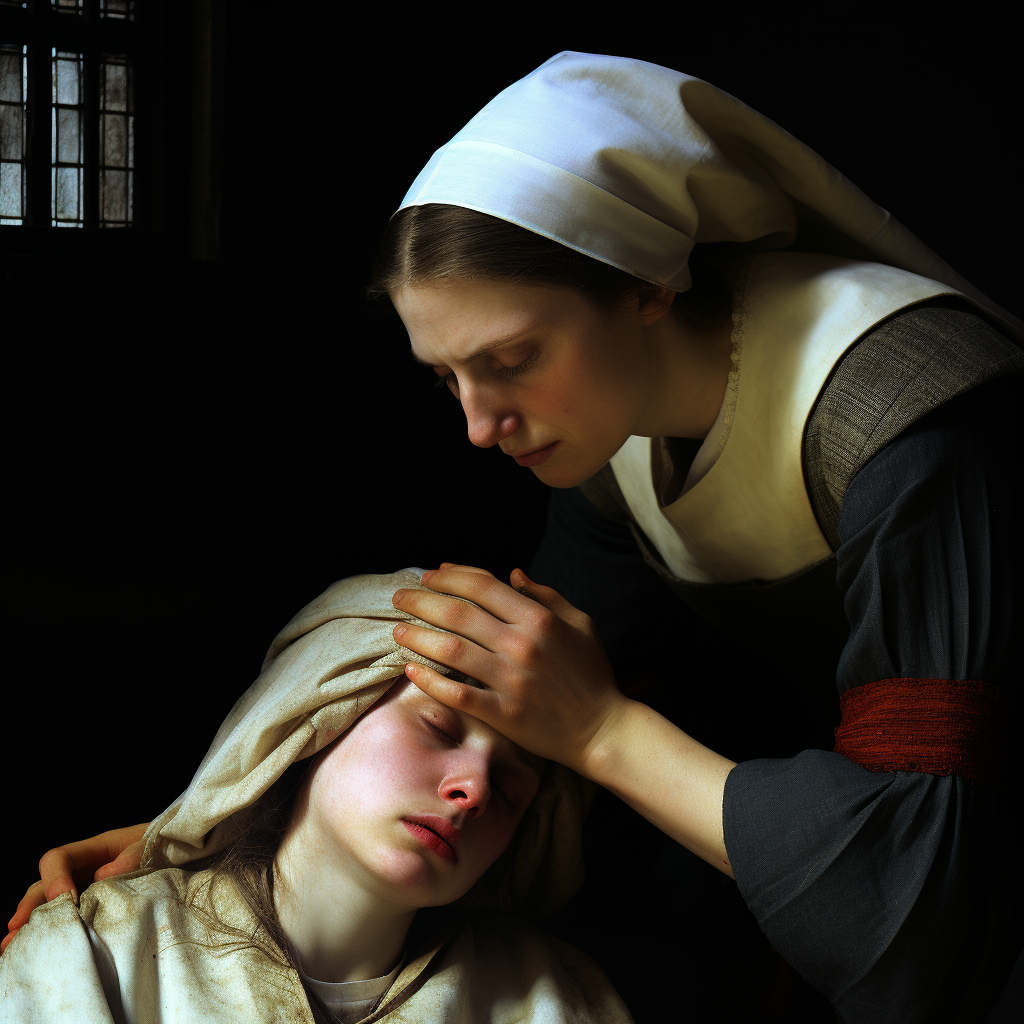
While many of the institutions shrank in fear, the Superioress of the Daughters of Mercy community encouraged the sisters to continue to serve God through the sick. She encouraged them to have faith in God and not be intimidated by the acts of men.Bl. Odilia Baumgarten caring for a sick woman

In order to frustrate the sisters, the Jacob Democratic Party of France tried to make all members of the Daughters of Mercy community take an oath to denounce their faith in public.

All the sisters, however, refused to take the oath and were immediately rounded up and arrested. On January 19, 1794, when Odilia Baumgarten was 43, she and all her sisters in faith were arrested.

They were held and tortured for data. On the 1st of February in the same year, they were taken to the public library along with other erring individuals.

Death and Canonization

On the 1st day of February 1784, Blessed Odilia Baumgarten was shot and killed in Avrillé, Maine-et-Loire, France.

She died, like many others that day, for her staunch belief in God and the Church.

Blessed Odilia Baumgarten was consecrated by Pope John Paul II on February 19, 1984. She is remembered by the Church on January 2.

5 Interesting Facts About Blessed Odilia Baumgarten

  1. Did you know that Blessed Odilia Baumgarten was a part of the
    Society of Saint Vincent de Paul?
  2. Did you know that Blessed Odilia Baumgarten died a virgin?
  3. Did you know that Odilia Baumgarten has not been named Patron saint?
    by anyone?
  4. Did you know that Blessed Odilia Baumgarten is named after a Catholic
    liturgy?
  5. Did you know that Blessed Odilia Baumgarten was one of the 99 martyrs of
    the French Revolution to be blessed by Pope Saint John Paul II?

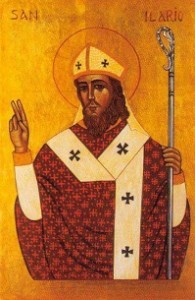
St. Hilary of Arles

When they lived: St. Hilary of Arles, also known as Saint Hilarius, lived during the late 4th century. He was born around 401 AD and died in 449 AD.

Where they lived: St. Hilary of Arles lived in the city of Arles, which was an important center in the Roman province of Gallia Narbonensis (modern-day southern France).

Notable world events during the time of their life:

  • The Fall of the Western Roman Empire (476 AD): St. Hilary lived through the declining years of the Western Roman Empire, which eventually fell in 476 AD. This event marked the end of ancient Roman rule in the western part of the empire.
  • The Council of Ephesus (431 AD): The Council of Ephesus was a significant event in early Christian history, dealing with the theological issues of the nature of Christ. St. Hilary, being a bishop, would have been aware of the debates and implications of this council.
  • The Life and Teachings of St. Augustine (354-430 AD): St. Augustine of Hippo, one of the most influential early Christian theologians, lived during a significant portion of St. Hilary’s life. Augustine’s works on theology and philosophy had a lasting impact on the Christian Church.
  • The Decline of the Western Roman Empire and Barbarian Invasions: The late 4th and early 5th centuries were marked by the decline of the Western Roman Empire, with various barbarian tribes, such as the Visigoths and Vandals, invading Roman territories.
  • The Development of Early Christian Monasticism: During St. Hilary’s lifetime, the practice of Christian monasticism was gaining traction. Monastic communities were being established, contributing to the spread of Christianity and the development of spiritual practices.

Their patronage: St. Hilary of Arles is the patron saint of the city of Arles and is venerated as a protector against snake bites. His feast day is celebrated on January 14th.

St. Hilary’s life is fascinating due to his presence during a period of significant transition in both the Roman Empire and early Christianity. His role as a bishop in Arles allowed him to witness and participate in important ecclesiastical discussions, and his association with the city and his patronage against snake bites adds unique and intriguing facets to his story.

Young Hilary

Hilary was born probably in 401 AD, in the early fifth century, into an an aristocratic family in Gaul, Lorraine, today’s present-day France. The name Hilary means cheerful.’

As per a boy born into a household of standing like his, he had an excellent education. His study covered liberal arts, polite learning, eloquence, and philosophy.

We could all agree that he had the good things of life that nobility could provide. At an early stage of his life, he wasn’t interested in religion. He had yet to encounter God or his faithfulness. It appeared he would be pursuing a path in the secular profession.

This was until his path crossed with that of his kinsman, Honoratus.

The God-Experience

Honoratus had abandoned the country in search of Christ in solitude. He had founded a great monastery on the Isle of Lerins. He had loved Hilary as his friend and strongly wanted to help his friend break the chains and charms of the deceitful world into which he was deeply plunged.

Honoratus sought out Hilary to show him the light of Jesus, but Hilary had a rebellious soul toward the gospel. Therefore, Honoratus went to God in prayer. It was stated that he had said to him, “I will obtain of God what you will not grant me.”

Internal conflict arose in Hilary after Honoratus, his friend, had departed. He felt God’s mercy calling out to him. Three days later, he went searching for his friend, a changed man.

No doubt was left in anyone who met him that the young man had decided to save his soul. Everything about him was different, inward and outward. His words, looks, character, humility, and patience reflect the virtues of purity.

Hilary went home and sold his estate and assets to his brother. He distributed all he had made from the sale to charity and made his way to the Abbey of Lerins, where he joined the monastic life of prayer and contemplation.

Bishop of Arles

Honoratus was appointed Bishop of Arles in 426, while Hilary remained at the monastery in Lerins. Honoratus himself went to fetch Hilary when she refused to join him at Arles, preferring the solitude of life as an amonk.

Honoratus passed on in 429, and Hilary set out on his way back to the Abbey of Lerins. He was apprehended by the local faithful in Arles to succeed his kinsman. Many have heard and seen his devotion to God and helping the poor.

Just at 29, Hilary became the Bishop of Arles. The youthful bishop worked with so much vigor. He introduced many reforms in the church, assisted in many councils, strengthened discipline in local churches, continued in his work for the poor, built many monasteries, and lived with few possessions.

Too Hasty?

His zeal to get things done correctly got the young bishop into trouble. He had deposed the bishop of Besancon, Chelidonus, for neglecting his priorities. Also, on the accusation that the bishop had married a widow and sentenced people to death while he was a magistrate before his ordination, These irregularities were grounds for disqualification from the holy order.

His action was said to be outside his jurisdiction. He had also replaced Projectus, a sick bishop in his province, with another, while the former was not dead.

His intentions might have been right, but his actions were hasty. Following an appeal to Pope Leo, the Pope reversed his actions. He further denied him his metropolitan rights but did not remove him from his position as a bishop.

Throughout his ordeal, Hilary exhibited great humility and was patient. He never stopped working for the common good.

Call to Glory

Exhausted by the life of austerity and constant labor, Hilary, the bishop of Arles, joined the good Lord on the 5th of May, 449. He was 48.

Hillary’s name later entered the Roman Martyrology.

5 Interesting Facts About St. Hilary of Arles

  1. Are you aware that Hilary did manual labor to earn money for the
    poor, even as a Bishop? He was compassionate, even to a fault.
  2. His methods of ecclesiastical decision-making were questioned but never
    his faith or holiness.
  3. Hilary traveled everywhere on foot and was always dressed simply. He
    was very detached from material concerns.
  4. He was obedient while facing sanctions from the Pope and never
    neglected his duties.
  5. Mercy or keeping the rule—which do you think should come first?
    Hilary sold sacred vessels and church properties for ransom.
    captives. He chose mercy.

Prayer to St. Hilary of Arles

There is no official prayer for Saint Hilary of Arles.

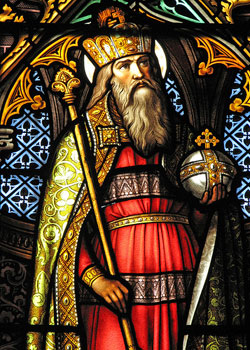
St. Henry


Saint Henry II

When they lived:

Saint Henry II, also known as Henry II, Holy Roman Emperor, lived from May 6, 973, to July 13, 1024. He was a significant figure in the medieval period.

Where they lived:

Henry II lived primarily in the Holy Roman Empire, which encompassed parts of modern-day Germany, Austria, Italy, and Czech Republic. His influence extended over much of Central Europe.

Notable world events during the time of their life:

  1. The Battle of Clontarf (1014): This pivotal battle in Ireland saw the forces of Brian Boru, the High King of Ireland, face off against the Norse-Gaelic army and marked a turning point in Irish history, reducing the influence of Viking powers in the region.
  2. The Great Schism (1054): Although this event happened after Henry II’s death, the tensions leading to the split between the Eastern and Western Christian Churches were growing during his time. This schism eventually resulted in the creation of the Eastern Orthodox Church.
  3. The Investiture Controversy: This conflict between the Holy Roman Emperors and the Papacy, particularly during the reign of Pope Gregory VII (Hildebrand), had a significant impact on the power dynamics between secular and religious authorities in medieval Europe. It highlighted the struggle for control over ecclesiastical appointments and had broader implications for the separation of church and state.
  4. The Viking Age (8th to 11th centuries): Although the height of Viking raids and conquests was earlier, the aftermath of their activities, including the establishment of settlements and trade routes, influenced the political and cultural landscape of Europe during Henry II’s time.
  5. Advancements in Scholarship: The medieval period was marked by a resurgence of learning, and notable scholars like Gerbert of Aurillac (Pope Sylvester II) were influential in reintroducing scientific knowledge and fostering intellectual growth during this era.

Their patronage:

Saint Henry II is a patron saint of the childless, of the handicapped, and of those who have lost parents. His devotion to justice, charity, and the welfare of his people makes him an inspiring figure for those seeking guidance in their personal challenges and seeking the well-being of their communities. His legacy also serves as a reminder of the important role that leaders can play in promoting social justice and religious tolerance.

Early Life

The story is about a rare occasion in history where an emperor achieved sainthood. Born on May 6, 972, to  Henry the Duke of Bavaria and Gisela, daughter of Conrad, king of Burgundy, in Bavaria, Germany,

St. Henry, also known as Henry 11 (second), received an excellent and spiritual education from his wealthy nobility under St. Wolfgang, bishop of Ratisbon at Hildesheim, at a very young age. During his years of formation, he learned more about God and developed personal devotion.

St. Henry was to succeed his father as Duke of Bavaria when he died in 995. He had wanted a quiet life of devotion in service to God, but the circumstances of his life had a different path for him.

Journey to Leadership

In the year 1002, six years after St. Henry became the Duke of Bavaria, his cousin Otto 11, the King of Germany, suddenly died from a severe fever at the young age of 21, leaving no child behind as he was yet to be married.

With no clear line of succession in place caused by Otto’s sudden death and the lack of an heir, Germany found itself in a leadership crisis with many contenders vying to be the next king of Germany. Among the powerful contenders were; Count Ezzo of Lotharingia, Duke Herman 11 ofSwabia, Margraue Eckard 1 of Meissen.

After a protracted battle for the next king, St. Henry, supported by the Bishop of Augsburg, succeeded his cousin King Otto 11 as the new king of Germany.

Becoming an Emperor

St. Henry, guided by eternal truth and daily meditation practice, was not carried away by the power and dignity of his position as king. In all things, he sought the greater glory of God and was most watchful over the welfare of the church. His zeal for the maintenance of ecclesiastical discipline in the church was unrivaled.

Henry’s fame spread at home and abroad, and so his humility. He gained several victories over his enemies but used them with great moderation and clemency. On February 14, 1014, Pope Benedict V crowned him emperor of the Holy Roman Empire. St. Henry traveled to Rome, Italy, where he received the imperial crown at the Pope’s hands.

Fatherhood and Legacy

St. Henry got married to his wife, Cunegunda, the daughter of Palatine Siegfried of Luxembourg, in 999. Both didn’t aspire to it, but because their parents wanted it, it is a duty for a duke to be married equally to another powerful family.

St. Henry and his wife Cunegunda, also a saint, in mutual agreement, took the vow of perpetual chastity and never consummated their marriage, thus never having a child. It was unheard of that a legally married noble couple would choose not to have a child but live out the rest of their days in dedication to the service of God despite their marital and positional responsibilities.

St. Henry made numerous pious foundations; he gave liberally to holy institutions and founded and built the cathedral of Bamberg in 1006, dedicated by Pope Benedict V111 in 1020. St. Henry’s humility and spirit of justice were equal to his zeal for religion.

Death

Like all mortals, St. Henry departed the earth after being ill for awhile in the year 1024 at the age of 52. St. Henry’s death occurred in Göttingen, Germany. Pope Eugene 111 canonized him in 1146, 112 years after his death. His feast day is July 13.

St. Henry is known as the patron of the childless, of Dukes, of the handicapped, those rejected by the religious order, and Benedictine oblates.

References:

[http://www.sainthenrys.org/CatholicChurch/StHenr]{.ul}y

[https://en.wikipedia.org/wiki/Cunigunde_of_Luxembourg]{.ul}

[https://www.amazon.com/Lives-Saints-Every-Day-Year/dp/B000HTMSTK]{.ul}

5 Interesting Facts About St. Henry

  1. St. Henry was the only Holy Roman Emperor to become a saint. Indeed,
    He was a different kind of emperor.
  2. St. Henry was a king that had a king (how else would you explain his
    obedience to God and the church?
  3. Did you know that St. Henry and his wife, St. Cunegunda, hold the
    only imperial couple ever canonized?
  4. If you didn’t know, the Ottoman Empire ended with St. Henry. He was
    the last king of the Ottoman Empire, Germany
  5. The saint’s humility is top-notch. He once cast himself at the feet of
    of Herebert, Bishop of Cologne, and begged his pardon for treating
    him with coldness over a misunderstanding.

Prayer to St. Henry

Lord, You filled saint Henry with your love and raised him from the cares of an earthly kingdom to eternal happiness in heaven in the midst of the changes of this world. May his prayers keep us free from sin and help us on our way towards you through Jesus Christ, your son, who lives and reigns with you in the unity of the Holy Spirit, one God forever and ever.

Source:[https://prayers4reparation.wordpress.com/2013/08/31/prayer-to-saint-henry/]{.ul}

St. Gregory Nazianzus

When they lived: St. Gregory Nazianzus, also known as Gregory the Theologian, was born around 329 AD and passed away on January 25, 390 AD. He lived during the latter part of the 4th century.

Where they lived: Gregory Nazianzus was born in Arianzus, a small village near Nazianzus (modern-day Nenizi in Turkey). He spent significant parts of his life in various cities of the Eastern Roman Empire, including Constantinople (modern-day Istanbul).

Notable world events during the time of their life:

  • Council of Nicaea (325 AD): The first ecumenical council that aimed to address various theological disputes, resulting in the Nicene Creed, which clarified the orthodox Christian beliefs about the nature of the Trinity and the divinity of Jesus Christ.
  • Emperor Constantine’s Conversion (312 AD): Constantine the Great’s conversion to Christianity and his Edict of Milan in 313 AD, which granted religious tolerance to Christians in the Roman Empire, significantly impacting the growth of Christianity.
  • Fall of the Western Roman Empire (476 AD): Although after Gregory’s death, this event marked a significant turning point in the history of the Roman Empire, leading to the ultimate decline of the Western Roman Empire.
  • Pagan Philosophical Revival: During Gregory’s time, there was a resurgence of interest in pagan philosophy, particularly Neoplatonism, which influenced intellectual discourse and challenged early Christian thinkers.

Their patronage: St. Gregory Nazianzus is renowned as one of the Cappadocian Fathers, along with St. Basil the Great and St. Gregory of Nyssa. He is a patron saint of theologians, preachers, and those seeking understanding of the deep theological aspects of the Christian faith. His profound contributions to the development of Trinitarian theology and his eloquent writings on faith and ethics continue to inspire scholars, clergy, and seekers of spiritual wisdom.

St. Gregory Nazianzus’ life journey, spanning a time of theological debates, the spread of Christianity, and the blending of diverse philosophical ideas, offers a fascinating glimpse into the rich tapestry of the early Christian Church amidst the complexities of the late Roman Empire. His dedication to faith, reason, and the pursuit of divine truths makes him a compelling figure in the history of Christian thought.

Early Life

Saint Gregory of Nazianzus is also called Gregory Nazianzen or Gregory the Theologian in some parts of history.

He was born in the year 328 A.D. in Arianzus, Cappadocia. His place of birth has been traced to a family estate in Karbala, on the outskirts of Arianzus.

His parents were Greek people named Nonna and Gregory. They were wealthy Christians who raised Gregory in the way of the Catholics.

However, It had not always been so. Gregory Senior had not always been a Christian. Nonna had converted her husband from Hypsistarii to Christianity. Hypsistarians were people in a sect that combined pagan views with Judaism.

After Gregory Senior became a Christian in 325 A.D., he was appointed bishop of Nazianzus around 329. After Saint Gregory was born, he was raised in Christian ways and sent to the best schools that his father could afford.

Gregory and his brother Caesarius received their initial education at home from their uncle Amphylokhios. After this, Saint Gregory continued to study advanced rhetoric and philosophy in cities like Nazianzus, Caesarea, Alexandria, and Athens.

In all these cities, he studied extensively.

While traveling to Athens by sea, Saint Gregory’s ship was hit by a storm. Afraid, Gregory went to his knees and prayed to God for safety. He promised that he would dedicate the rest of his life to him if he survived that ordeal.

Dedication and Devotion

He arrived in Athens safely. While there, he became friends with a fellow student and Saint, Saint Basil of Caesarea. He also met Flavius Claudius Julianus, who would go on to become Emperor Julian.

In Athens, Saint Gregory took an interest not only in theology but also in writings that concerned rhetoricians like Himerius and Proaeresius.

It is also debated whether Saint Gregory might have been baptized in Athens.

Saint Gregory traveled back to Nazianzus circa 361. Back in Nazianzus, he was appointed a minister upon his father’s wish. It is said that Saint Gregory was skeptical, but in a bid to assist his father, who was bishop, and the people, he agreed.

Saint Gregory was said to have traveled to Annesi for the preparation of this new authority. There, he learned about asceticism and spent his time praying and meditating.

The next year, Saint Gregory returned to take up the seat. While in power, he was put in the middle of a clash between local Christian communities. His father had been accused of heresy.

Saint Gregory was instrumental in settling the theological differences. It was at this time that Gregory’s acquaintance, Emperor Julius, had proclaimed war on Christianity.

This caused Gregory to pen letters that he called Invectives Against Julian between the years 362 and 363. Seeing his rebel, Emperor Julian began to actively seek to persecute Gregory.

Before he could act on his threats, the Emperor passed away.

In the years to come, Saint Gregory invested his time and energy in not only preaching the gospel but also fighting the Arian heresy.

In 370, Saint Gregory was appointed Bishop of Caesarea in Cappadocia. Two years later, he was made Bishop of Sasima by Saint Basil.

Some parts of history claim that Saint Gregory accepted this bishopric once again due to the insistence of his father. Due to this behavior, Saint Gregory might have been uninterested in his diocese.

Towards the end of 372, Saint Gregory got his wish and traveled back down to Nazianzus to help his father with his diocese. After his father died, he donated his property to the needy.

Legacy

Around 379, Saint Gregory was sent to Constantinople to start a campaign to make the Nicene theory popular. There, his cousin Theodosia provides him with a residence.

The residence was made into a church named Anastasia. From this little space, Saint Gregory touched a lot of lives and converted many.

Anastasia grew in size and popularity. This caused Saint Gregory’s enemies to get agitated. On the Easter vigil of the year 379 A.D., the Arians attacked the church. This was a plan helped by Gregory’s close alliance with Maximus the Cynic.

The attack left Saint Gregory injured and some ministers killed. Afraid, Gregory fled his seat, which was then taken over by Maximus.

Bewildered by the betrayal, Saint Gregory resigned office. This led to a chain of events that left Gregory criticized and Maximus impeached.

Around 380, Saint Gregory was once again made Bishop.

Not only was he a devout Christian, but Saint Gregory also made huge contributions to theology through his books. His books, letters, epitaphs, and poems are all recognized as big parts of theology.

Death and Canonization

Although his life was marred by challenges and tough decisions, Saint Gregory was a highly respected man. He was instrumental in the fight for religion and the health of the Catholic Church.

Saint Gregory retired to Arianzus for six years. He spent his time in solitude, writing about his spiritual journey and the sickness that awaited him.

While the exact date of his death is unknown, it is guessed that Saint Gregory died on the 25th of January, 390 A.D.

He is celebrated by the Roman Catholic Church on January 2.

5 Interesting Facts About St. Gregory Nazianzus

  • Did you know that Saint Gregory is remembered as the “Trinitarian Theologian”?
  • Did you know that Saint Gregory was initially bullied into being registered by his Father? He was forced to become a minister to take up solitude.
  • Did you know that Saint Gregory refused to be called a bishop while serving his dying father in Nazianzus?
  • Did you know that after Saint Basil died, Saint Gregory wrote a series of condolence letters in his memory? The letters survived until today.
  • Did you know that Saint Gregory not only supported the Nicene Creed but also cataphatic theology and Pneumatology?

Prayer to St. Gregory Nazianzus

O All-Transcendent God (and what other name could describe you? ), what words can hymn Your praises? No word does You justice. What mind can probe Your secret? No mind can encompass You. You are alone beyond the power of speech, yet all that we say stems from You. You are alone beyond the power of thought, yet all that we can conceive springs from You. All things proclaim you—those endowed with reason and those bereft of it. All the expectations and pain of the world coalesce in You. All things utter a prayer to You—a silent hymn composed by You. You sustain everything that exists, and all things move together according to Your orders. You are the goal of all that exists. You are one and You are all, yet You are none of the things that exist, neither a part nor the whole. You can avail Yourself of any name; how shall I call you the only unnameable? All-transcendent God!

Source: https://www.catholicdoors.com/prayers/novenas/p03975.htm

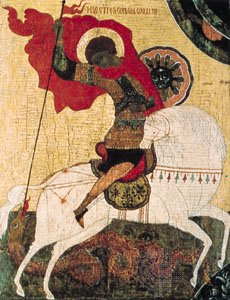
St. George

When They Lived

St. George is believed to have lived during the late 3rd century to early 4th century, around 270–303 AD. The exact dates are uncertain due to the historical nature of the figure.

Where They Lived

St. George’s traditional association is with the city of Lydda in Roman Palestine, which is modern-day Lod in Israel. However, his veneration spread throughout the Christian world.

Notable World Events During Their Time

  • Diocletian’s Persecution: St. George lived during a time when the Roman Empire, under Emperor Diocletian, launched one of the most severe persecutions against Christians, known as the Diocletianic Persecution (303–311 AD).
  • Battle of Milvian Bridge: In 312 AD, Constantine the Great, who later converted to Christianity, won a crucial battle at the Milvian Bridge, which marked a turning point in the history of the Roman Empire and had significant implications for the spread of Christianity.
  • Edict of Milan: In 313 AD, the Edict of Milan, issued by Constantine and his co-emperor Licinius, granted religious tolerance to all religions within the Roman Empire, effectively ending the persecution of Christians.
  • Development of Early Christian Doctrine: During St. George’s time, significant theological debates and the development of early Christian doctrine were taking place, laying the foundation for the future structure of the Christian Church.

Their Patronage

St. George is the legendary dragon-slaying saint and is widely known as the patron saint of several things, including:

  • Soldiers: St. George’s legendary courage and chivalry have made him a symbol of bravery and protection for soldiers.
  • England: St. George is the patron saint of England, and his emblem, a red cross on a white background (St. George’s Cross), is a prominent symbol in English culture.
  • Scouts: Many scouting organizations around the world have adopted St. George as their patron saint, emphasizing the values of honor and service.
  • Farmers and Agricultural Workers: In some regions, St. George’s feast day is associated with the beginning of the agricultural season.

The Saint of Legends and Stories

One of the objects of a vast amount of imagination is St. George. The life of this saint is surrounded by various stories and legends. The Catholic Church adheres to this saint’s memory and the inspiration and lessons he brings.

St. George was born around the 3rd century in Cappadocia, modern-day Turkey, to a Cappadocian father and a Palestinian mother of noble rank. After the death of his father, he moved to Palestine with his mother. Popular legends say that he was a knight. However, it is more likely that he was an officer in the Roman army. By his late 20s, he had become a Tribunus and served as an imperial guard for the Emperor at Nicomedia.

A Brave Soldier of Christ

During George’s service in the Roman army, Diocletian became emperor. In 303, Emperor Diocletian, who hated Christians, issued a decree that every Christian the army passed would be arrested. He also ordered that every other soldier offer a sacrifice to the Roman gods. George, who was a faithful Christian then, refused to obey the emperor’s order. He even told Diocletian about his firm conviction. The emperor was enraged; however, he greatly valued his friendship with George’s father.

In an effort to save George, the Emperor Diocletian tried to convert him and persuade him to believe in the Roman gods. He also offered him money, land, and slaves in exchange for offering a sacrifice to the Roman gods. These and many other offers were refused by George.

After exhausting all possible options, the Emperor ordered the execution of George. George gave his money to the poor in view of his death. He was sent to undergo several sessions of cruel torture. He was lacerated on a wheel of swords and required resuscitation three times. Despite the painful torture, George did not turn from God. Finally, after many tortures he endured, George was decapitated before Nicomedia’s outer wall.

Another Story of His Martyrdom

Another account of the martyrdom of St. George is in Eusebius´ Ecclesiastical History, which relates that when the emperor Diocletian issued an edict “to tear down the churches to the foundations and to destroy the Sacred Scriptures by fire… a certain man, of no mean origin, but highly esteemed for his temporal dignities, stimulated by a divine zeal, and excited by an ardent faith, took it as it was openly placed and posted up for public inspection, and tore it to shreds as a most profane and wicked act.” This act of intransigence and holy audacity enraged the emperor, who had the man tortured and killed. This man “of no mean origin”, i.e., of nobility, has been identified by more than one ancient source, including Eusebius, as St. George, though most modern historians of the period state that this is unlikely.

George’s body was sent to Lydda, her mother’s native land, for burial. Many other Christians went to honor George as a martyr. His feast day is April 23.

5 Interesting Facts About St. George

  • St. George is commonly depicted in art slaying a dragon, a story that made him popular. A dragon (most probably a crocodile) was terrorizing the land, and to appease the dragon, the townspeople fed it sheep and then human beings chosen by lot. Unfortunately, the king’s daughter was chosen to be served to the dragon, but St. George came along and slew the dragon, and he was offered anything he wanted for killing it. He refused all the king’s offers, but George made him promise to build churches, honor the priests, and help the poor.
  • St. George is the patron saint of England and Georgia and is venerated as one of the 14 Auxiliary Saints or Holy Helpers. With him were Saints Blase, Erasmus, Pantaleon, Vitus, Christopher, Denis, Cyriacus, Acacius, Eustace, Giles, Margaret, Barbara, and Catherine.
  • St. George stands out among other saints and legends because he is known and revered by both Muslims and Christians.
  • In Egypt, the Coptic Orthodox Church of Alexandria calls St. George the “Prince of Martyrs” and celebrates him on May 1. There is a second celebration on November 17 in honor of the first church dedicated to him.
  • In Bulgaria, St. George’s feast day is celebrated on May 6 with the slaughter and roasting of a lamb.

Prayer to St. George

Extolling Your might, O Lord, we humbly implore You that, as Saint George imitated the Passion of the Lord, he may lend us ready help in our weakness. Through our Lord Jesus Christ, Your Son, who lives and reigns with You in the unity of the Holy Spirit,God, for ever and ever Amen.

St. Francis of Paola

When they lived:

St. Francis of Paola, also known as Francis of Paola, was born on March 27, 1416, in Paola, a small town in Calabria, Italy. He lived during the late Middle Ages and the early Renaissance period.

Where they lived:

St. Francis of Paola spent much of his life in Italy, particularly in the region of Calabria. He founded the Order of Minims, a religious order focused on asceticism and humility, which gained prominence during his lifetime and beyond.

Notable world events during the time of their life:

  • Fall of Constantinople (1453): St. Francis of Paola witnessed the pivotal moment in world history when the Byzantine Empire fell to the Ottoman Turks, leading to significant geopolitical shifts and influencing the Renaissance in Europe.
  • Invention of the Printing Press (c. 1440s): The advent of Johannes Gutenberg’s movable-type printing press revolutionized communication, making information more accessible and accelerating the spread of ideas, including religious ones, across Europe.
  • European Exploration (late 15th century): During St. Francis of Paola’s later years, Christopher Columbus embarked on his historic voyage to the Americas in 1492, marking the beginning of European exploration and the expansion of the known world.
  • Italian Renaissance: St. Francis of Paola lived through the height of the Italian Renaissance, a period of remarkable artistic, cultural, and intellectual achievements. Notable figures like Leonardo da Vinci, Michelangelo, and Raphael were active during this time.

Their patronage:

St. Francis of Paola is renowned as the patron saint of mariners, sailors, and naval officers. This patronage is especially fascinating considering his humble origins in a small Italian town. He is also invoked for those seeking help in overcoming difficult or challenging circumstances, reflecting his own life of austerity and reliance on faith.

The Brotherhood

When St. Francis of Paola was thirteen years old, he joined the friary of the Franciscan order. This was after he had a vision of a Franciscan friar, and this was also to fulfill the vow that was made by his parents when he was ill.

After a year, he had completed his training, and with his parents, they went on a pilgrimage to Assisi in Rome and other places of devotion.

When they returned to Paola, he secured himself in a cave on his father’s estate and lived there in solitude; however, he later found an even more secluded cave on the sea coast where he lived, giving himself to prayer and solitude.

In 1435, two followers joined him in his retreat, and as a way of accommodating them, he had three cells and a chapel built. This was the beginning of a new order with humility as the hallmark of their brotherhood.

This brotherhood abstained from meat and any animal-derived foods. They also vowed poverty, obedience, and chastity. They adopted a life of extraordinary severity, living unknown and hidden from the world, and they thought it was a necessary means for spiritual growth. They also aimed at reviving the practice of fasting during Lent, which many had stopped practicing.

The number of his disciples gradually increased to about 1454, and St. Francis built a large monastery and church. When this church was being built, a lot of people were moved, such that even the nobles joined and carried stones for the building.

In 1474, he was permitted by Pope Sixtus IV to write a rule for his community and to assume the title of Hermits of St. Francis, which was later changed to Minims by Pope Alexander VI.

The Works

St. Francis also performed many miracles as answers to the people’s prayers, and this increased the people’s devotion. At one point, King Louis XI of France was ill, and he requested that St. Francis of Paola come and pray for him, but he initially refused, only to agree after being ordered by the Pope.

On his way to the king, he cured many who were sick of the plague. He was with the king until his death and became the tutor to the King’s heir. This new king, King Charles VIII, built two monasteries for the monks. This king held St. Francis in high esteem, as did his predecessor.

The king would not permit St. Francis to return to Italy because he did not want to lose his counsel and direction.

It is also believed that St. Francis of Paola had the gift of prophecy, which he foretold to several people. He also predicted a lot of events, including the capture of Otranto by the Ottoman Turks.

St. Francis of Paola is also said to have performed a lot of miracles, including using his cloak as a sail when he was refused passage by a boatman. He is also believed to have prayed for his nephew when he died, and the boy’s life was restored.

The Love for Animals

He is also reported to be compassionate towards animals and would occasionally give life to animals that would have been killed to be eaten. He at one point raised his pet lamb from the dead after it was killed for consumption. What is more fascinating is that the lamb had been eaten already, and he just went to the fire furnace where the fleece and bones had been thrown and called the pet’s name. The lamb then came out of the fire untouched.

At one point, one of the friars got a fish from the pond and had already prepared it, which was now in the frying pan, when St. Francis noticed that it was missing. He sent someone to go and get the fish, and the friar threw the fish on the ground, breaking it into pieces. St. Francis took the pieces and threw them into the water. He prayed, and the fish was restored to life.

Even after the deaths of animals, he continued to call them by their names, as he believed that they continued to exist even after their deaths.

The Legacy

St. Francis of Paola is considered the patron saint of boatmen, mariners, and naval officers. His liturgical feast day is celebrated on April 2nd, which is the day of his death.

St. Francis was canonized for his humility and discernment.

He founded several new monasteries in Calabria and Sicily.

He also established monasteries for nuns and the third order for people.

5 Interesting Facts About St. Francis of Paola

  • St. Francis of Paola had his first followers before he was 20.
    years old.
  • He lived in solitude in a cave on the coast for six years.
  • Relied exclusively on alms for survival.
  • St. Francis of Paola did not respect anyone based solely on their
    worldly rank, as at one point he rebuked the king.
  • St. Francis of Paola was never officially ordained as a priest.

Prayer to St. Francis of Paola

O most Holy Saint Francis, God gives wisdom to the simple and makes the wisest child wise. Pray that He grants me this reward He promises to the humble through your intercession. Help me always to make a good examination of my conscience and confession. Amen.