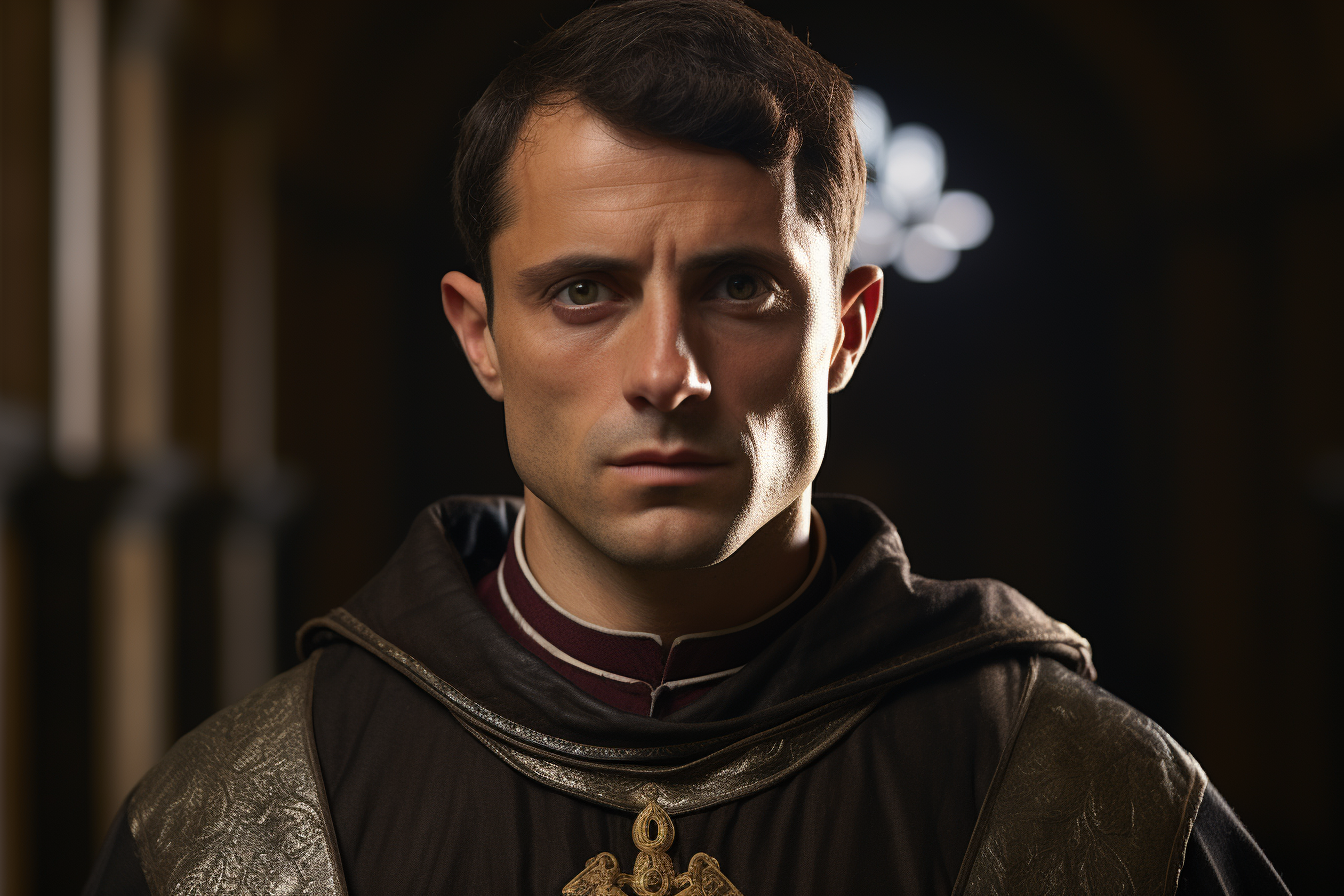
St. Martin of Tours


St. Martin of Tours

When they lived:

St. Martin of Tours, also known as Martin the Merciful or Martin of Tours, lived from AD 316 to AD 397.

Where they lived:

St. Martin of Tours was born in Sabaria, Pannonia (modern-day Szombathely, Hungary), and he spent much of his life in what is now France.

Notable world events during the time of their life:

  • Roman Empire’s Decline: During St. Martin’s life, the Roman Empire was experiencing significant political, economic, and military challenges, leading to its eventual decline and fragmentation.
  • Barbarian Invasions: The 4th century was marked by numerous invasions of barbarian tribes into the Roman Empire, which further weakened its borders and contributed to its eventual collapse.
  • Edict of Milan: In AD 313, the Edict of Milan was issued, granting religious tolerance to Christians within the Roman Empire, significantly improving the situation for Christians like St. Martin.
  • Council of Nicaea: In AD 325, the First Council of Nicaea was convened, addressing theological disputes and leading to the formulation of the Nicene Creed, which remains an essential statement of Christian faith.
  • Life of St. Augustine: St. Augustine of Hippo, one of the most influential Christian theologians, lived during the same time as St. Martin. His works profoundly impacted Christian philosophy and doctrine.
  • Fall of Rome: After St. Martin’s death, the Western Roman Empire faced further turmoil and eventually fell in AD 476, marking the end of ancient Rome.

Patronage:

St. Martin of Tours is the patron saint of several diverse causes, including soldiers, conscientious objectors, beggars, tailors, winemakers, geese, and the country of France. His life as a soldier-turned-bishop, his acts of compassion, and his dedication to serving the poor and marginalized have inspired people from various walks of life to seek his intercession.


A Soldier of Christ

Martin was born to pagan parents in modern-day Hungary around the year 316. His family left that region when his father, who was a military official of the Roman Empire, was sent to Italy. Though his parents were pagans, Martin had an attraction to the Christian faith, which, in 313, had become legal throughout the empire.

However, when he was fifteen years old, Martin was forced to serve in the army. During that time, he became a catechumen and received religious instruction. He was baptized at the age of eighteen. It was said that while he was serving in the Roman army, he lived more like a monk than a soldier. He even considered becoming a hermit in the desert.
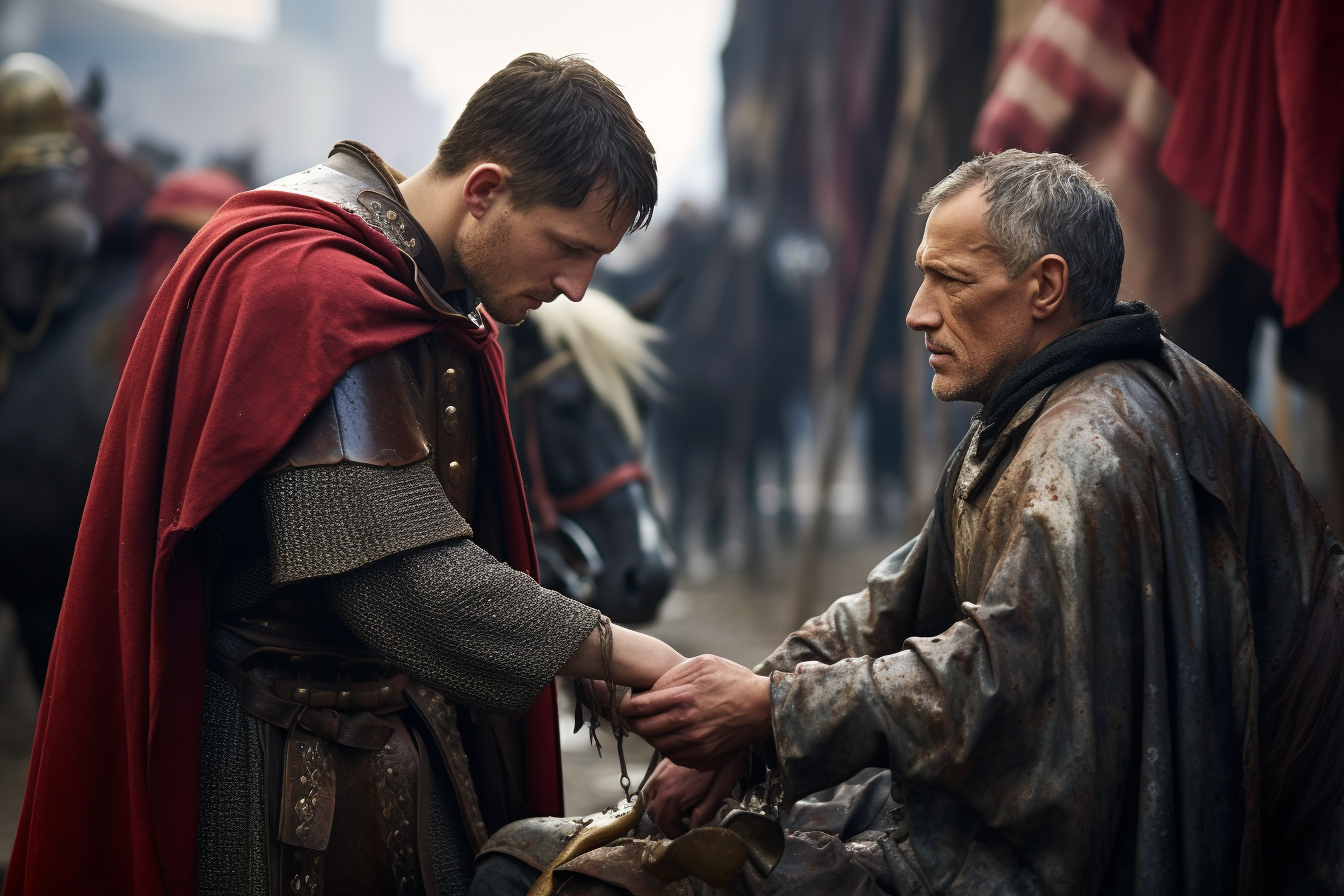
St. Martin of Tours helping a poor man while serving in the military.

When he was twenty-three, he refused a war bonus and told his commander that he refused to fight because he wanted to become a soldier of Christ. After great difficulties, Martin was discharged from his duties and went to be a disciple of St. Hilary of Poitiers.

The Reluctant Bishop

Martin was ordained an exorcist and worked with great zeal and dedication against the Arians. He eventually became a monk, living first in Milan and later on on a small island. In 360, when St. Hilary was reinstated to his see after his exile, Martin returned to France and founded what may have been the first French monastery near Poitiers on a piece of land granted to him by St. Hilary. He lived there for ten years, formed his disciples, and preached throughout the countryside.

However, the people of Tours insisted that he leave the monastery to become their bishop. Martin had not wanted to become a bishop. He hesitantly allowed himself to be consecrated bishop. Once he transferred to Tours, he continued to live as a monk, dressed plainly, and had no personal possessions. He traveled throughout the diocese, from which he is said to have driven out pagan practices.

The Shepherd Has Left His Flock

Even in his twilight years, Martin continued to live a life of austerity and was focused on the care of souls. His biographer and disciple, Sulpicius Severus, noted that Martin helped all people with their intellectual, moral, and spiritual dilemmas. He also helped a lot of laypeople discover their calling to the consecrated life of poverty, chastity, and obedience.

Martin foresaw his own death and told his disciples about it. But when his last illness came upon him during a pastoral journey, the bishop felt uncertain about leaving his people. “Lord, if I am still necessary to thy people, I refuse no labor. Thy holy will be done,” he prayed. He developed a fever but did not sleep, passing his last several nights in the presence of God in prayer.

In 397, Martin died in France at the age of 8. At his request, he was buried in a cemetery with the poorest of the poor. Soon, pilgrims traveled to his grave at Tours. Today in many countries in Europe, St. Martin’s feast day is celebrated widely. His feast day is November 11.

Five Interesting Facts About St. Martin of Tours

  1. St. Martin of Tours is the patron saint of France, the father of monasticism in Gaul (France), and the first great leader of Western monasticism.
  2. St. Martin of Tours became renowned for raising two people from the dead through his prayers.
  3. One day, when St. Martin of Tours was not yet baptized, while he was on horseback in Amiens, Gaul, St. Martin of Tours encountered a beggar, freezing and without warm clothing. St. Martin stopped, cut his own cloak in half, and gave it to the beggar. That night, he had a vision of Jesus wearing the cloak that he gave to the beggar and saying, “Martin, a catechumen, has clothed Me with this garment.”
  4. During the Medieval Ages, St. Martin’s cloak (cappa) became a relic that French kings would take into battle. The person whose job it was to care for the cloak was often a priest, and he was called a “cappellani”. It is from this that the word “chaplain” was derived.
  5. St. Martin of Tours became a bishop because he was tricked! A wealthy citizen of Tours claimed that his wife was ill and asked for Martin. Tricked by this ruse, Martin went to the city, where he was declared bishop by popular acclamation.

Prayer to St. Martin of Tours

O God, who is glorified in the Bishop Saint Martin both by his life and death, make new, we pray, the wonders of your grace in our hearts, that neither death nor life may separate us from your love. Through our Lord Jesus Christ, your Son, who lives and reigns with you in the unity of the Holy Spirit, one God, for ever and ever Amen.
St. Cornelius

St. Cornelius – A Pillar of Faith Amidst Worldly Turmoil

When they lived:

St. Cornelius lived during the tumultuous and transformative era of the third century. Born in 200 AD, his life spanned
through a period of immense challenges and profound changes in the Roman Empire.

Where they lived:

St. Cornelius resided in the city of Rome, which was not only the capital of the Roman Empire but also the heart of
the Christian community during his time.

Notable world events during the time of their life:

  1. The Crisis of the Third Century (235-284 AD): During this time, the Roman Empire faced an
    unprecedented series of crises, including political instability, economic downturns, and external invasions.
    These challenges deeply affected the lives of people in the empire, providing a backdrop of chaos against
    which St. Cornelius’ faith and leadership would shine.
  2. The Rise of Christianity: The third century saw Christianity steadily gaining popularity and
    recognition in the Roman Empire. St. Cornelius was a prominent figure in the early Christian Church, playing a
    vital role in its growth during this crucial period.
  3. Birth of Aurelian Wall (271 AD): Emperor Aurelian initiated the construction of the famous
    Aurelian Wall around Rome. The wall served as a protective barrier against invading forces and marked a
    significant architectural feat of the time.
  4. The Great Persecution (303-311 AD): During the reign of Emperor Diocletian, Christians faced
    severe persecution. St. Cornelius courageously led the Christian community, ensuring the strength and
    resilience of the faith during this trying period.
  5. The Edict of Milan (313 AD): Emperor Constantine’s Edict of Milan marked a monumental shift in
    Roman policy towards Christianity, granting religious tolerance and ending the persecution of Christians.
    This decree played a pivotal role in the establishment of Christianity as a recognized and eventually
    dominant religion in the empire.
  6. The Founding of Constantinople (330 AD): Constantine the Great, who became the first Christian
    Roman Emperor, established Constantinople (modern-day Istanbul) as the new capital of the Roman Empire. This
    shift in power significantly impacted the course of Christianity and the Roman Empire’s history.

Their patronage:

St. Cornelius is venerated as the patron saint of perseverance, leadership, and compassion. He is especially revered
among Catholics and Christians for his unwavering dedication to the faith during a time of immense adversity and
uncertainty. As a symbol of steadfastness in the face of persecution, St. Cornelius serves as an inspiration to
individuals navigating challenging circumstances in their lives, regardless of their religious affiliations. His
life and legacy continue to be celebrated, reminding us that faith and determination can shine brightly even in
the darkest of times.

Church Persecution

Emperor Decius, who ruled from 249 to 251 AD, was responsible for Christian persecution. Initially, it was just sporadic, but from January 250 on, he ordered all citizens to perform a religious sacrifice in the presence of commissioners; otherwise, they would face death. This resulted in the deaths of many Christians who had refused, and there were also others who took part in order to save their lives.

It was after this incident that there were two schools of thought with regard to those who had stopped practicing Christianity during those times of persecution.

During the times of church persecution, it was not possible to elect a successor, and the papal seat was vacant for a year. During these times, the church was under the leadership of various priests, including Novatian. When Decius left Rome to fight the invading Goths, the church seized the opportunity, and they elected Cornelius as the new Pope in March 251.

Conflict in the Church

There were conflicts over how the repentant church members who used to practice pagan sacrifices to protect themselves during times of persecution could be readmitted to the church. St. Cornelius was for the idea that these repentant people should be restored to communion with the church after varying forms of penance.

This was, however, not what the Novationists (those led by Novatian, who was a priest in a Roman diocese) believed; they strongly believed that those who failed to maintain their confession should never be received again into communion with the church, even if they repented. The Novatians were also for the idea that idolatry was unpardonable and the church had no authority to forgive it, with only God having that authority.

Even after St. Cornelius was ordained as pope, those who supported Novatian did not acknowledge him, and they even consecrated Novatian as abbot. Both parties sent letters to other bishops seeking support and recognition. St. Cornelius had the support of many bishops, yet Novatian had the support of minority clergymen and laymen.

This disagreement resulted in a rift in the church, which became widespread as each side worked towards gathering support. Even though St. Cornelius held a synod of 60 bishops, which is an assembly of clergymen, and he managed to excommunicate the Novatian, the controversy regarding these lapsed members continued for years.

Church persecution resumed in 251 under Emperor Trebonianus Gallus, who was the successor to Decius. This unrest resulted in St. Cornelius being sent into exile in Centumcellae, Italy, and he died there in 253. There are accounts that state that he was beheaded on the 14th of September, even though initial reports stated that he died from the hardships of being exiled.

St. Cornelius Preaching at Pope

Legacy

St. Cornelius was venerated as one of the Four Holy Marshals in the Rhineland during the Middle Ages. His saint’s day is celebrated on September 16.

He is the patron of earache, epilepsy, fever, twitching, and also of cattle, domestic animals, earache sufferers, epileptics, and the town of Kornelimünster, Germany, where his head is enshrined.

5 Interesting Facts About St. Cornelius

  1. There were at least 50 000 Christians in Rome during St. Cornelius’
    time as a pope.
  2. St. Cornelius is not buried in the chapel of the popes but in a
    nearby catacomb.
  3. The letters that Cornelius sent while he was in exile are all
    written in colloquial Latin.
  4. His remains miraculously consented to the marriage of two lovers.
    after the bride’s father had said he would only allow them to get
    married if Pope Cornelius agreed.
  5. There is a legend that there were pagan soldiers who were chasing
    him, and he turned them into stones.

Prayer to St. Cornelius

God our Father,in Saints Cornelius and Cyprian, you have given your people an inspiring example of dedication to the pastoral ministry and a constant witness to Christ in their suffering. May their prayers and faith give us courage to work for the unity of your church. Amen.

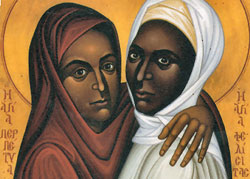
Sts. Perpetua and Felicity

When they lived:

Sts. Perpetua and Felicity lived during the early years of the 3rd century AD, around 203-206 AD.

Where they lived:

They lived in Carthage, a prominent city in the Roman province of Africa (modern-day Tunisia), which was a thriving center of culture and commerce during that era.

Notable world events during the time of their life:

  • The Severan Dynasty: During their lifetime, the Roman Empire was under the rule of the Severan dynasty. This period saw significant political and military developments, including the expansion of the Roman Empire’s eastern territories.
  • Persecution of Christians: Sts. Perpetua and Felicity lived during a time when the Roman Empire sporadically persecuted Christians. The reasons for this persecution varied, but it marked a significant challenge for early Christians and is central to their story.
  • Scientific Advancements: The 3rd century was a time of growth in various fields of knowledge. Galen, a famous physician, was active during this era and made substantial contributions to the field of medicine.
  • Crisis of the Third Century: This period witnessed a series of crises in the Roman Empire, including economic instability, military conflicts, and political turmoil. It set the stage for the eventual division of the empire into the Eastern and Western Roman Empires.
  • Emergence of New Philosophical Schools: In the intellectual sphere, philosophers like Plotinus were developing new schools of thought, such as Neoplatonism, which would have a lasting impact on Western philosophy.
  • Cultural Flourishing: Despite the challenges, the 3rd century also witnessed the continuation of classical art, literature, and culture. The works of notable figures like Origen, a Christian theologian, and Tertullian, a prolific early Christian writer, added to the cultural landscape.

Their Patronage:

Sts. Perpetua and Felicity are revered as patron saints of a variety of causes, each with its unique and inspiring symbolism:

  • Martyrs and Persecuted Christians: They are foremost patron saints of martyrs and persecuted Christians, symbolizing unwavering faith and courage in the face of adversity.
  • Mothers and Pregnant Women: St. Felicity is especially invoked by expectant mothers, symbolizing the strength of motherhood and the protective care of God during pregnancy.
  • Nursing Mothers: St. Perpetua is associated with nursing mothers, highlighting her role as a spiritual mother to her fellow Christians and her dedication to nurturing faith.
  • Catechumens and Converts: They are also patrons of catechumens, those undergoing religious instruction, and converts to Christianity. Their story of conversion and martyrdom serves as an inspiration to those on their journey to faith.

The story of Sts. Perpetua and Felicity is a timeless tale of faith, resilience, and the triumph of the human spirit, set against the backdrop of a tumultuous period in history. Their patronage continues to inspire individuals facing various challenges and seeking spiritual guidance today.

Called by What They Are, Christians

There are no existing records about the birth and early lives of these holy and courageous women. However, tradition and some writings, especially the diary of no less than Perpetua herself, depict the exemplary lives of these two martyrs. Perpetua was a young, beautiful, and well-educated noblewoman from Carthage in North Africa. She was the mother of an infant son and a chronicler of the persecution of Christians by Emperor Septimus Severus. Perpetua’s mother was a Christian and her father a pagan.

In spite of the dangers of persecution and death, Perpetua, Felicity, a slave woman who was pregnant at the time, and three other companions, Revocatus, Secundulus, and Saturninus, refused to deny and renounce their Christian faith. Because of this, all of them were arrested and imprisoned. Before their arrest, Perpetua and Felicity had been studying the Scriptures and getting ready to be baptized. Inside the prison, they were baptized by their teacher, who was also arrested and imprisoned with them. Inspired by their steadfast faith, their prison warden was converted to it.

A few days before the games began, Felicity gave birth to a daughter. While waiting for the verdict, Perpetua wrote what would be called “The Diary of Perpetua” later on. The day before the games, Perpetua’s record of her trial and imprisonment ended. She wrote: “Of what was done in the games themselves, let him write who will.” An eyewitness finished this diary.

Joyful Christians, Glorious Martyrs

Perpetua and Felicity were sentenced to death as punishment for professing the name of Christ and refusing to renounce the Christian faith. Despite the impending death they were about to face, they remained serene in the face of their fate, filled with God’s peace in their hearts. Perpetua and Felicity were thrown into an arena of wild animals. However, they were not killed. In order to satisfy the bloodthirsty audience, the emperor Severus commanded that they be put to death by the sword. Let us read a portion of the revered From the story of the death of the holy martyrs of Carthage (from the Office of Readings, Memorial of Sts. Perpetua and Felicity):

“The day of the martyrs’ victory dawned. They marched from their cells into the amphitheater, as if into heaven, with cheerful looks and graceful bearing. If they trembled, it was for joy and not for fear.

Perpetua was the first to be thrown down, and she fell prostrate. She got up and, seeing that Felicity was prostrate, went over and reached out her hand to her and lifted her up. Both stood up together.

There, Perpetua was welcomed by a catechumen named Rusticus. Rousing herself as if from sleep (so deeply had she been in spiritual ecstasy), she began to look around. To everyone’s amazement, she said, “When are we going to be led to the beast?” When she heard that it had already happened, she did not at first believe it until she saw the marks of violence on her body and her clothing. Then she beckoned to her brother and the catechumen and addressed them in these words: ‘Stand firm in faith, love one another, and do not be tempted to do anything wrong because of our sufferings.’…

The people, however, had demanded that the martyrs be led to the middle of the amphitheater. They wanted to see the sword thrust into the bodies of the victims, so that their eyes might share in the slaughter. Without being asked, they went where the people wanted them to go, but first they kissed one another to complete their witness with the customary kiss of peace.

The others stood motionless and received the deathblow in silence, especially Saturus, who had gone up first and was first to die; he was helping Perpetua. But Perpetua, so that she might experience the pain more deeply, rejoiced over her broken body and guided the shaking hand of the inexperienced gladiator to her throat. Such a woman, one before whom the unclean spirit trembled, could perhaps not have been killed had she herself not willed it.

Bravest and happiest martyrs! You were called and chosen for the glory of our Lord Jesus Christ.”

Indeed, they gave profound witness to what they were—Christians—even until the last minute. Their birth into eternal life was in the year 203. Their feast day is March 7.

5 Interesting Facts About Sts. Perpetua and Felicity

  • Sts. Perpetua and Felicity are the patron saints of mothers, expectant mothers, ranchers, and butchers.
  • The names of Sts. Perpetua and Felicity are mentioned in the Roman Canon (Eucharistic Prayer I).
  • The day before their deaths, Perpetua had a vision of a golden ladder reaching up to heaven, with various weapons on the side and a dragon below. Perpetua climbed the ladder and reached the top, where she saw a beautiful garden and a tall man milking sheep. The man welcomed her and gave her some of the curds from the milk.
  • Sts. Perpetua and Felicity are venerated not just in the Roman Catholic Church but also in Eastern Orthodox Churches, Oriental Orthodox Churches, the Anglican Communion, and the Lutheran Church.
  • A magnificent basilica was later erected over the tomb of the martyrs in Carthage, where an ancient inscription bearing the names of Perpetua and Felicity has been found.

Prayer to Sts. Perpetua and Felicity

O God, at the urging of whose love the Martyrs Saints Perpetua and Felicity defied their persecutors and overcame the torment of death, grant, we ask, by their prayers, that we may ever grow in your love. Through our Lord Jesus Christ, your Son, who lives and reigns with you in the unity of the Holy Spirit, one God, for ever and ever Amen.
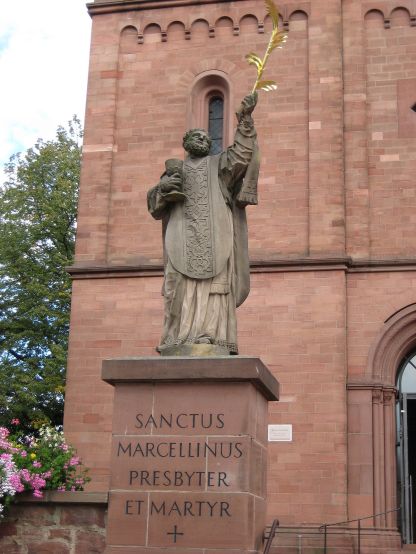
Sts. Marcellinus and Peter

When they lived:

Sts. Marcellinus and Peter lived during the early Christian era, specifically in the 3rd century AD.

Where they lived:

They lived in Rome, Italy, which was the center of the Roman Empire during their time.

Notable world events during the time of their life:

  • Persecution of Christians: One of the most significant events during their time was the widespread persecution of Christians under the Roman Emperor Diocletian. This was a time of great suffering for Christians, and Sts. Marcellinus and Peter were among those who faced persecution for their faith.
  • The Crisis of the Third Century: The Roman Empire was in a state of crisis during this period, marked by political instability, economic decline, and military conflicts. This turbulent era had a profound impact on the lives of Marcellinus and Peter as they navigated the challenges faced by the early Christian community.
  • Growth of Christianity: Despite the persecution, Christianity continued to grow during the 3rd century. The faith attracted followers from various walks of life, including intellectuals and common people, making it a significant religious and social movement of the time.
  • Scientific Advancements: While not directly related to Marcellinus and Peter, the 3rd century witnessed some scientific advancements. Figures like Galen, a prominent physician, and Ptolemy, an astronomer, made notable contributions to their respective fields during this period.
  • Crisis of the Roman Economy: The 3rd century also saw economic turmoil in the Roman Empire, marked by hyperinflation and financial crises. This had far-reaching consequences for the Roman society and the lives of its inhabitants.
  • Emergence of New Philosophical Movements: Philosophical schools like Neoplatonism gained popularity during this time, influencing the intellectual climate of the Roman world.

Their Patronage:

Sts. Marcellinus and Peter are the patron saints of those who suffer from plagues and infectious diseases. Their association with healing and protection against pandemics is particularly relevant in the context of recent global health crises. Many believers turn to their intercession during times of illness and uncertainty, seeking their guidance and protection.

Their story, living in a time of religious persecution and turmoil, yet remaining steadfast in their faith, serves as an inspirational example for many Christians today. Their patronage reminds us of the enduring power of faith and the hope for healing in the face of adversity.

Bound by the Same Faith

Every June 12, the Catholic Church celebrates two distinctive individuals who are called by the same faith. Although no existing records detail these two saints’ early lives, it is evident that the church revered them.

Marcellinus was a priest, and Peter was an exorcist. Both are said to be fourth-century Roman saints who were murdered during the Diocletian persecution in Rome about 304 AD.

These two saints paid the price for their faith in God.

Following the decree issued by Emperor Diocletian in Rome against Christians and clergy, Marcellinus and Peter, just like many other martyrs, faced the emperor’s wrath for rejecting the Roman gods and fetish practices.

Freedom in Prison

Marcellinus and Peter were identified as Christians and were arrested and locked up in prison. However, the saints saw their imprisonment as another opportunity to evangelize and win souls for God. Their bodies were caged by the walls of the prison, but not their spirits. They were free in mind.

According to hagiography (writing or biographies on the lives of saints), Marcelinus and Peter, while in prison, converted their jailer, Arthemius, his wife, and daughter Paulina. Tradition holds that Peter freed Pauline, the jailer’s daughter, from demonic possession. Having been born witnesses to the Lord’s wonders, the family became Christians and were baptized by the clergyman Marcellinus still at the prison. Think of the Biblical Apostle Paul, Acts 16:25–40.

Their passion and faith in God strengthened other converts who were also in prison. They were made to appear before Severus, a magistrate determined to carry out the emperor’s decree against Christians. Marcellinus testified courageously and was tortured for that.

Marcellus was scourged, stripped of his clothes, starved, and left in a dark cell filled with broken bottles. Peter was also questioned and returned to the cell.

Still, none of them would denounce their faith.

Unmarked Grave

Pope Damascus I had said he heard of the story of Marcellinus and Peteras, a boy, from their executioner, who later became a Christian.

Plans were made to secretly execute and bury Marcellus and Peter. This is to keep the Christians from venerating their bodies and praying at their graves. Both men were marched to a forest later identified as Silva Nigra, about three miles from Rome.

They were ordered to clear a spot overgrown with thorns, brambles, and briers at the place of execution. This was an order they were too eager to oblige. At that very spot, they were beheaded and buried. Their grave was unknown until…

Discovery of the Saints

Proverbs 16:9: Man plans, but God directs.’ Marcellinus and Peter lay in an unmarked grave till the time willed by divine Providence had come for these martyrs to be known and revered.

Guided by divine revelation, a devout woman named Lucillia was led to the unknown graves of Marcellus and Peter. Aided by another woman,Firmina, these two women recovered the bodies of Marcellinus and Peter and had them appropriately buried.

These saints were buried beside the body of St. Tirburtius on the Van Labicana, known today as the Catacombs of Marcellinus and Peter.

Pope Damascus I, who was already a great devotee of these two saints, wrote an epitaph to adorn their graves. The veneration of the saints started in the early church. There is a church in Imbersago, in the province of Lecco, Italy, dedicated to them.

5 Interesting Facts About Sts. Marcellinus and Peter

  • Marcellus and Peter are among the saints named in the traditional
    Eucharistic Prayer of the Church, The Roman Canon
  • If you’re still in doubt, no place should be a barrier to doing
    God’s work; look up to Marcellinus and Peter. Even in prison, they
    evangelized and won souls for God.
  • Math 5:14 You’re the light of the world. Marcellinus and Peter
    became a light to their executioner, who later converted to
    Christianity after their deaths because of their strong faith in
    God. Be the Light.
  • Heard of God’s perfect timing? Their grave was destined to become
    oblivion by their executioners, but God’s time willed that the
    Body parts should be revered.
  • According to the passion of Christ performed in Holy Week,
    the 6th century, the jailer and his family, who were converted by
    Marcellinus and Peter also suffered martyrdom. Artemius was
    beheaded, and his wife and daughter were buried alive under a pile of
    stones.

Prayer to Sts. Marcellinus and Peter

O God, you surround and protect us by the glorious confession of your holy martyrs, Sts. Marcelinus and Peter. Help us to profit from their example and be supported by their prayers. Amen.

Source: Roman Misaal

Sts. Joachim and Anne

When they lived:

Saints Joachim and Anne, the parents of the Virgin Mary and the grandparents of Jesus Christ, are believed to have lived in the 1st century BCE or early 1st century CE.

Where they lived:

Tradition places their home in Nazareth, a small town in the Galilee region of ancient Israel.

Notable world events during the time of their life:

  • Roman Occupation of Judea: The Roman occupation of Judea played a crucial role in the life of the Holy Family.
  • Herod the Great’s Reign: Herod’s rule as the King of Judea had a significant impact on the region, including religious and political developments.
  • Cultural and Religious Diversity: The region was marked by diverse cultures and religious beliefs, influencing the religious milieu.
  • Hellenistic Influence: Hellenistic culture continued to shape the Eastern Mediterranean, affecting the intellectual and philosophical climate.
  • Birth of Jesus: While not during their lifetime, their story is closely connected to the birth of Jesus, a pivotal event in world history.

Their Patronage:

Saints Joachim and Anne are patrons of several important aspects of Christian life and family:

  • Patron Saints of Grandparents: They are revered as the patron saints of grandparents, emphasizing the importance of intergenerational love and wisdom.
  • Patron Saints of Infertility and Childless Couples: Their story symbolizes hope for couples struggling with infertility.
  • Patron Saints of Christian Parenting: Their virtuous lives as parents make them symbols of ideal Christian parenting.

Saints Joachim and Anne’s story reflects universal themes of hope, faith, and the enduring importance of family bonds.

The Grandparents of Jesus

The names of the parents of the Blessed Virgin Mary are not found anywhere in the Bible. What we now know about the grandparents of Jesus came down through tradition and the stories people told about them. Interestingly, the majority of what we know about them came from the 2nd century manuscript Protoevangelium of James and the 3rd century Evangelium de nativitate Mariae, or the “Gospel of the Nativity of Mary”. Both documents mentioned the names Joachim and Anne as the parents of Mary, the mother of Jesus.

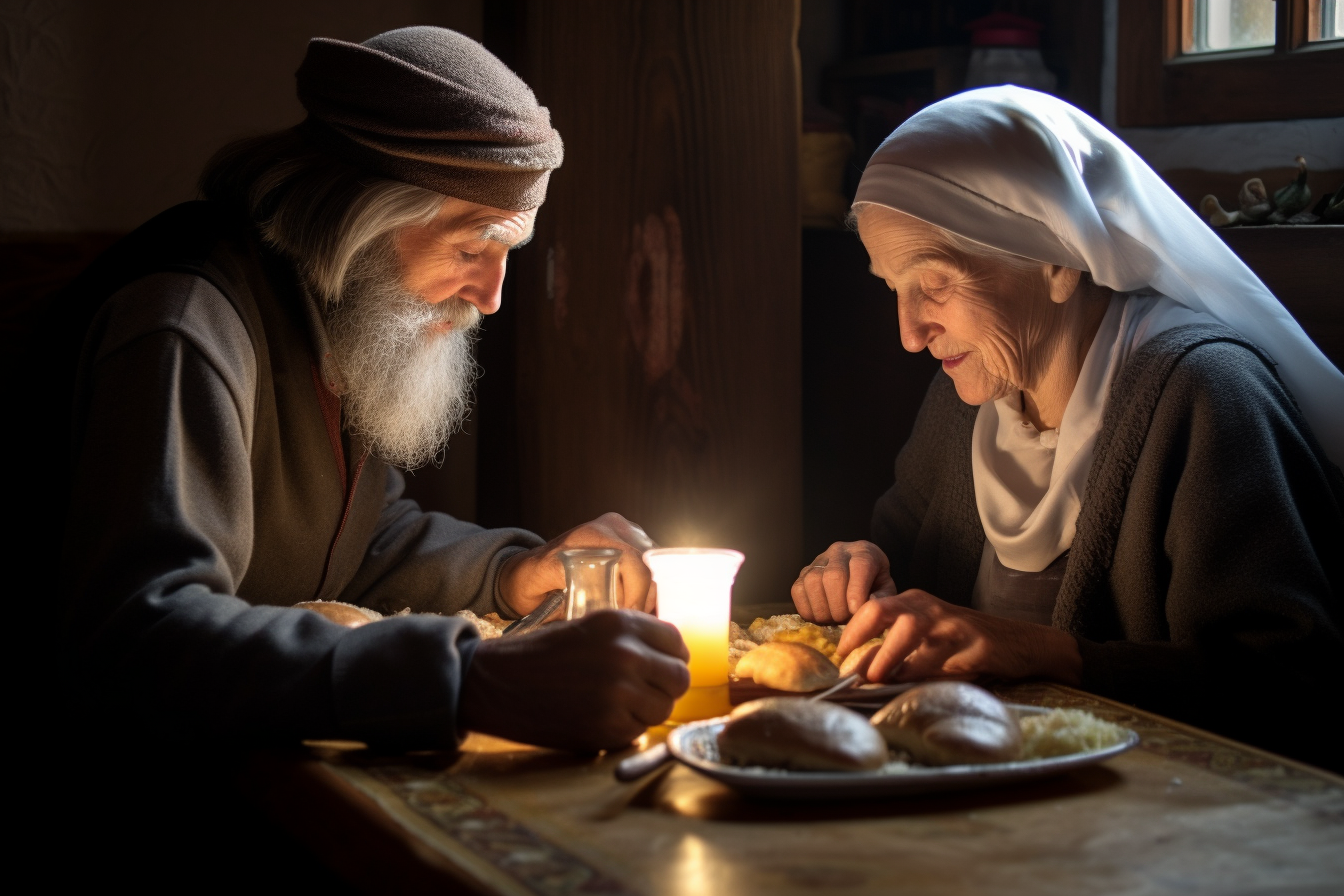
Sts. Joachim and Anne eating a meal by candlelight

According to these non-canonical sources, Anne was a native of Bethlehem, Judea. She was married to Joachim. They lived a devout and wealthy life in Nazareth. As such, they were respected members of the Jewish community. However, despite such a good situation, they had no children. Joachim was reproached at the Temple because of his sterility. He retreated into the countryside to pray and fast. On the other hand, Anne, grieved by her husband’s disappearance and her barrenness, solemnly vowed to God that if they were given a child, she would dedicate it to the Lord’s service.

The Promise Fulfilled

Joachim and Anne both received the vision of an angel. The heavenly messenger announced that Anne would conceive and bear a most wondrous child. The couple rejoiced at the birth of their long-awaited daughter. They named the child Mary. When Mary was three years old, in fulfillment of Anne’s promise, Joachim and Anne brought the child to the Temple in Jerusalem. There, they left Mary to be brought up and serve the Lord. This story startlingly parallels the Old Testament account of the barren Hannah and her conception of Samuel (see 1 Samuel 1), who later became a prophet.

The Church honors Joachim and Anne as saints. The beautiful shrine of St. Anne de Beaupré in Quebec, Canada, is devoted to St. Anne. In the Middle Ages, numerous churches, chapels, and confraternities were dedicated to her honor. There is a church for St. Anne in Jerusalem. It is believed that this church was built on the site of Sts. Joachim and Anne’s home when they lived in Jerusalem. Their feast day is observed on July 26.

World Day for Grandparents and the Elderly

On January 31, 2021, the Holy Father, Pope Francis, announced the institution of World Day for Grandparents and the Elderly. This will take place annually on the fourth Sunday of July, close to the feast of Sts. Joachim and Anne, the grandparents of Jesus. The Pope said he instituted the World Day of Grandparents and the Elderly because “grandparents are often forgotten, and we forget this wealth of preserving roots and passing on” what the elderly have received.

Five Interesting Facts About Sts. Joachim and Anne

  • Sts. Joachim and Anne are the patron saints of grandparents and infertile couples.
  • According to later legends, Joachim died shortly after Mary’s birth, and Anne, encouraged by the Holy Spirit, remarried. Some traditions hold that Anne, in her alleged subsequent marriages, became the grandmother of the Apostles John and James (sons of Zebedee), Simon, Jude, and James the Less (son of Alphaeus), as well as of James, “the Lord’s brother.”
  • The Protoevangelium of James became the foundation for establishing the liturgical feasts of the Nativity of the Virgin Mary on September 8 and the Immaculate Conception of the Blessed Virgin Mary on December 8.
  • The dedication of Mary at the Temple became so important in Church doctrine that by 1585, Pope Sixtus V included in the Western Church calendar the liturgical feast of the Presentation of the Virgin Mary, celebrated every November 21.
  • In the early 8th century, Pope Constantine probably introduced her devotion to Rome, while Joachim’s cult was introduced in the West in the 15th century.

Prayer to Sts. Joachim and Anne

O Lord, God of our Fathers,who bestowed on Saints Joachim and Anne this grace, that of them should be born the Mother of your incarnate Son,grant, through the prayers of both, that we may attain the salvation you have promised to your people. Through our Lord Jesus Christ, your Son, who lives and reigns with you in the unity of the Holy Spirit,God, for ever and ever

St. Wolfgang

When They Lived:

St. Wolfgang was born around the year 934 and passed away in 994. He lived during the tumultuous transition period between the Early and High Middle Ages, a time characterized by great changes in Europe.

Where They Lived:

St. Wolfgang’s life unfolded primarily in the heart of Europe, within the region that is now modern-day Austria. His most significant contributions occurred in the eastern parts of the Holy Roman Empire, which included areas such as Bavaria and the Salzkammergut region, nestled amidst the breathtaking Austrian Alps.

Notable World Events During the Time of Their Life:

  • Viking Raids (Late 9th – Early 11th Century): St. Wolfgang lived in an age when Viking raids were widespread across Europe. These fearsome Norse warriors terrorized coastal regions and navigated inland waterways, leaving a significant impact on the political and social landscapes of the time.
  • Magyar Invasions (9th-10th Century): The Magyars, a nomadic people from the east, launched invasions into Europe during St. Wolfgang’s lifetime. These invasions played a crucial role in shaping the geopolitical boundaries of Europe.
  • Ottonian Renaissance (10th Century): St. Wolfgang’s life coincided with the Ottonian Renaissance, a cultural revival fostered by the Holy Roman Emperors of the Ottonian dynasty. This period witnessed the promotion of arts, architecture, and education, contributing to the preservation and transmission of knowledge.
  • Foundation of the Holy Roman Empire (962 AD): In 962 AD, Pope John XII crowned Otto I as the Holy Roman Emperor. This event marked the beginning of the Holy Roman Empire, which would dominate Central Europe for centuries and greatly influence St. Wolfgang’s life.
  • Scientific Advancements: Although not directly related to St. Wolfgang, the 10th century saw advancements in fields like astronomy, mathematics, and medicine in the Islamic world, laying the groundwork for future scientific developments in Europe.
  • Rise of Monasticism: During St. Wolfgang’s time, monasticism and the founding of monastic orders played a pivotal role in both religious and intellectual life. This environment likely influenced his own spiritual journey.

Their Patronage:

St. Wolfgang is revered as the patron saint of many causes, making him a figure of great significance to a wide range of individuals:

  • Patron of Sailors and Mariners: St. Wolfgang’s association with water, particularly through the miracle of taming the Wolfgangsee lake, led to his patronage of sailors and those who navigate the seas.
  • Patron of Spouses and Expectant Mothers: St. Wolfgang’s compassionate nature extends to families, as he is often invoked to protect spouses and expectant mothers during childbirth.
  • Patron of Loggers and Woodworkers: His connection to the dense Alpine forests in Austria has made him a patron for those involved in logging and woodworking.
  • Patron Against Paralysis and Strokes: St. Wolfgang’s intercession is sought by those afflicted with paralysis and strokes, reflecting his miraculous healing abilities.

St. Wolfgang’s life, set against the backdrop of an ever-changing Europe, demonstrates the interplay of faith, nature, and human progress in a pivotal period of history. His multifaceted patronage continues to inspire and protect people from diverse walks of life.

Early Life

Saint Wolfgang of Regensburg was born around 934 A.D. He was said to have come from a family in historic Southwestern Germany. He was noble, as his family was said to be from a line of Swabian counts.

He was home-schooled by the clergy until the age of 7. He then decided he wanted to wander down the path of spirituality. He chose to attend the popular monastic institution at Reichenau Abbey.

At the monastery, he became friends with Henry of Babenberg, whose brother was Bishop Poppo. After their friendship kicked off, Saint Wolfgang followed Henry to Würzburg.

At Würzburg, Henry and Wolfgang attended a cathedral educational institution where they were tutored by a great man called Stephen of Novara.

They went their separate ways for a while. Years later, around 956, Henry was appointed Archbishop of Trier. He then invited Wolfgang to lecture at the Cathedral School of Trier.

While acting as a tutor, Saint Wolfgang continued to work to improve the archdiocese. While in Trier, Saint Wolfgang joined Saint Maximin’s Abbey. There he met Saint Romuald.

While in the monastery, Saint Wolfgang was deeply influenced by the great men he met. He began to exhibit an interest in the ascetic lifestyle.

After his friend, Archbishop Henry, passed away circa 964, Saint Wolfgang joined the Benedictine order in Switzerland. In 968, at the Abbey of Maria Einsiedeln, he was appointed priest by Saint Ulrich.

Dedication and devotion

During that time, war broke out between the Hungarians and Lechfeld. The Hungarians lost and decided to live in Pannonia.

However, the Hungarians, who were pagans, decided not to convert to Christianity.

Worried that they might make trouble for his people, Emperor Otto the Great and Saint Ulrich were sent to minister to the Hungarians.

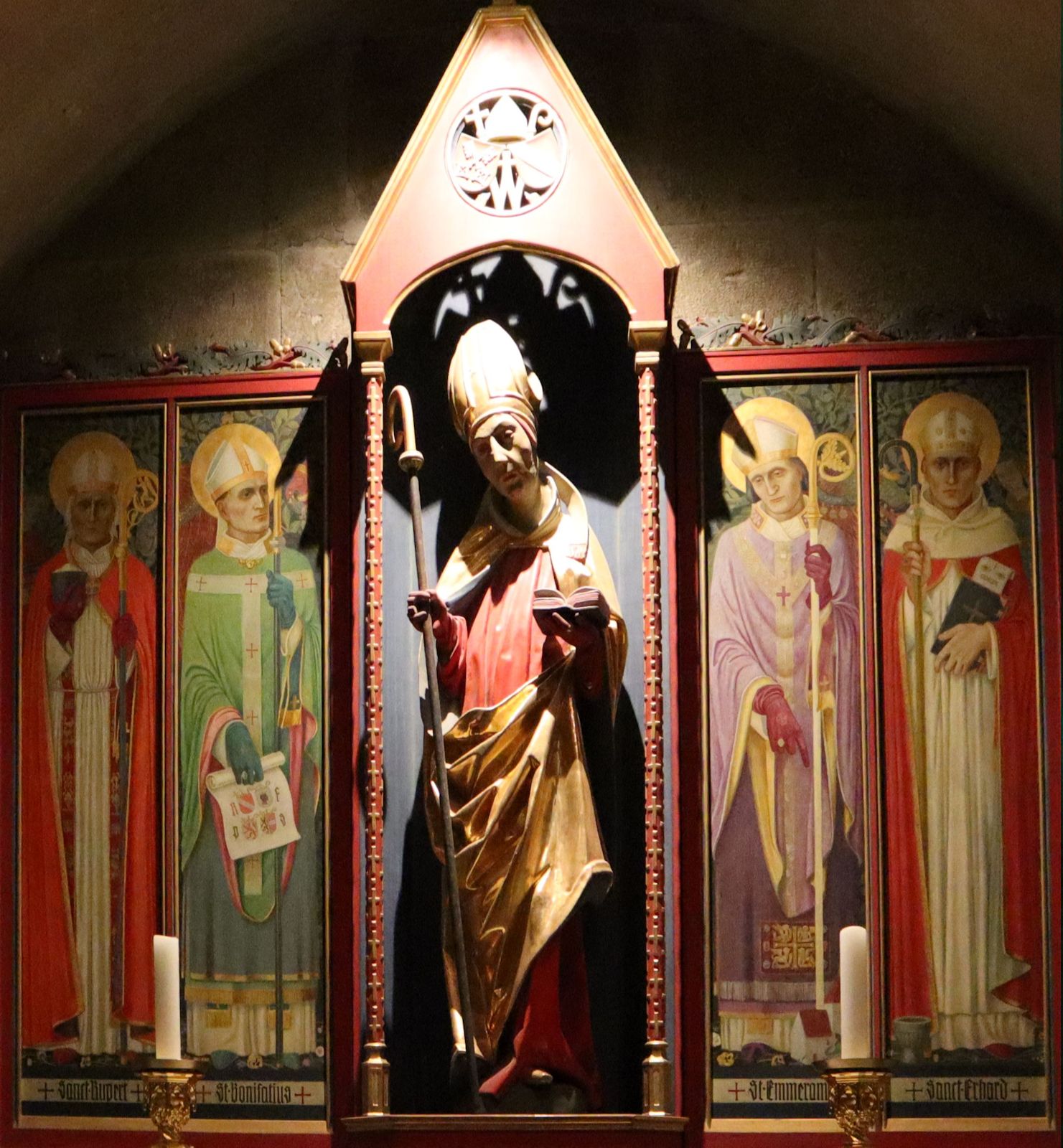
Wolfgang succeeded Michael of Regensburg as Bishop around late 972. Saint Wolfgang ruled the diocese with peace and education.

Even as a bishop, Saint Wolfgang was said to have taught Emperor Henry II. Some traditions have it that Wolfgang taught Henry everything he needed to know about his spiritual life.

Wolfgang was a man of discipline. He was said to have established more abbots for Saint Emeram’s Abbey. He was also said to have renovated abbeys in Obermünster and Niedermünster.

Legacy

Saint Wolfgang was also instrumental in the renovation of the old Benedictine abbey at Niederalttaich. He breathed new life into the ancient monastery, causing it to once again be recognized for its beauty.

Saot Wolfgang was also very generous. When the Diocese of Prague was established in 975, it lacked members. This caused Emperor Otto II to plead with Wolfgang to cut his diocese to about half its size.

Wolfgang agreed and split his membership with Saint Adalbert of Prague. He was so respected that he was always invited to political gatherings.

At an old age, Wolfgang went into seclusion in Upper Austria. Some people claim that this was due to a political problem. Others seem to think he simply got lost.

Regardless of what happened, Saint Wolfgang was said to have been found by a hunter. He then broke back into the city.

Death and Canonization

Saint Wolfgang fell sick while traveling from the Danube to Pöchlarn. Knowing that his end was near, he asked to be carried to Saint Othmarchapel in Pupping.

Saint Wolfgang died on the 31st of October, 994 A.D. He was buried in Saint Emmeram’s Abbey in Germany. Even in death, he was said to have been a bearer of miracles.

Saint Wolfgang was canonized by Pope Leo IX on October 8, 1051. He is celebrated by the Roman Catholic Church on October 31st.

5 Interesting Facts About Saint Wolfgang

  • Did you know that Saint Wolfgang is the patron saint of apoplexy?
    paralysis, stroke, and carpenters?
  • Did you know that where Saing Wolfgang went into solitude is now
    known as Wolfgangsee or Wolfgang Lake?
  • Did you know that Saint Wolfgang’s body was taken to Regensburg by
    Archbishop Hartwich of Salzburg and Count Aribo of Andechs?
  • Did you know that a miniature portrait of Saint Wolfgang survived?
    from 1100?
  • Did you know that Saint Wolfgang is often thought to be a part of
    the Fourteen Holy Helpers?

Prayer to Saint Wolfgang

Dear Lord, Give us the grace to put on the armor of God, that we may be able to resist on an evil day and, having done everything, to hold our ground. Enable us to stand fast with our loins girded in truth, clothed with righteousness as a breastplate, and our feet shod in readiness for the Gospel of peace. In Jesus’ mighty name, we pray. Amen.

Sources:[https://www.catholicdoors.com/prayers/novenas/p04058.htm]{.ul}

St. Willibald

When they lived:

St. Willibald was born around 700 AD and died on July 7, 787 AD.

Where they lived:

St. Willibald lived during a time when Europe was undergoing significant cultural and religious transformations. He was born in Wessex, a region in what is now modern-day England. He later traveled extensively and played a vital role in spreading Christianity in Europe, making significant contributions in Germany and Italy.

Notable world events during the time of their life:

  • Charlemagne’s Coronation (800 AD): Just a few years after St. Willibald’s death, Charlemagne was crowned as the Holy Roman Emperor by Pope Leo III. This event marked a significant shift in European politics and religion, with Charlemagne’s reign being a pivotal moment in the history of medieval Europe.
  • Islamic Golden Age (8th century): While St. Willibald was active, the Islamic world was experiencing a period of enlightenment and progress known as the Islamic Golden Age. This era saw significant advancements in various fields, including mathematics, astronomy, medicine, and philosophy.
  • Viking Raids (8th century): St. Willibald’s time was marked by the expansion of Viking raids across Europe. These invasions greatly impacted the political and social landscape of Northern Europe and led to the eventual Viking Age, which continued for several centuries.
  • Carolingian Renaissance (8th-9th centuries): The Carolingian Renaissance, a revival of art, culture, and learning, was taking place in Europe during St. Willibald’s lifetime. This cultural resurgence laid the foundation for the medieval intellectual and artistic achievements that followed.
  • Death of Empress Wu Zetian (705 AD): In the East, the formidable Empress Wu Zetian of China died around the time of St. Willibald’s birth. Her reign as China’s only female emperor left a lasting impact on Chinese history and gender roles.
  • Alcuin’s Educational Reforms (8th century): Alcuin of York, a prominent scholar and teacher, was active during St. Willibald’s lifetime. Alcuin’s educational reforms in the Carolingian Empire played a crucial role in shaping medieval education.

Their patronage:

St. Willibald is recognized as the patron saint of travelers, pilgrims, and people seeking safe journeys. His own extensive travels throughout Europe, particularly in the service of spreading Christianity, make him an inspiring figure for those embarking on journeys, whether physical or spiritual. His story is a testament to the power of faith and the courage to venture into the unknown, making him a compelling patron for all who seek guidance and protection while on their life’s journeys.

Early Life

St. Willibald was a bishop in Bavaria in the 8th century. He was born in 700 AD on the 21st of October, and he died in 787 AD. His father was St. Richard the Pilgrim, who was the chieftain of Wessex, and his mother was St. Wuna of Wessex, who was also a sister to St. Boniface. His brother was St. Winibald, and his sister was St. Walburga. Looking at his family tree, one can say he was destined to be a saint.

When he was three years old, St. Willibard suffered a terrible illness, and his parents prayed to God. While praying, the parents vowed that they would dedicate St. Willibarld to monastic life if his life was spared. He survived the illness, and when he was five years old, he entered the Benedictine monastery.

Life in the Monastery

When he was in the monastery, he was educated by Abbot Egwald, and he became accustomed to the Irish and Anglo-Saxon monastic ideal of pious rootlessness.

St. Willibald was known for extensive traveling, and in 721 he set out on a pilgrimage to Rome with his father and brother. They went there on a ship, and when they arrived in France, they set about visiting shrines and spending most of their time in prayer. They then arrived in Lucca, a city that is in northern Italy, and his father became gravely ill, and sadly, he died.

After they had managed to bury their father, Willibald and Winibald continued with their journey until they reached Rome. When they were in Rome, they visited the Lateran Basilica and St. Peter’s. They spent some time in Italy, strengthening their devotion and discipline; unfortunately, the two brothers became ill with the black plague.

The Pilgrimage

After they had recovered, they left Rome in 724 and departed by sea, visiting Sicily and Greece along the way. After the departure of his brother, Willibald lived in a monastery in Rome. Some of the areas that St. Willibald visited when they were in Greece include Ephesus, Lycia, and Mount Chelidonium. They almost died of hunger and thirst. However, they managed to cross until they reached the church of Saint John the Baptist.

Willibald and his seven companions also went to Palestine on an a pilgrimage that started in 723 and ended in 726, and they visited Nazareth, Bethlehem, and Egypt. They even went to Cana, Capernaum, and Jerusalem. The pilgrimage continued to the Church of the Nativity, Theca, and the great lavra of St. Sabbas. They also went to the port cities of Gaza, Hebron, Lydda, Joppa, Tyr, and Sidon. They even went to Samaria and again reached Tyre by way of the ladder of Tyre.

After some time in Tyre, Willibald was able to return to Constantinople, where he remained for two years, from 727 to 729, where he was provided with a small room in the Church of the Holy Apostles. He spent his time studying the documents from the first council of Nicaea, which was arranged by Emperor Constantine.

After Constantinople, he sailed to Sicily, and he arrived in Naples approximately seven years after he had left Italy. St. Willibald and his remaining companion, Tidbercht, joined the Benedictine community at Monte Casino. When he was there, he taught the community about his travels, and he spent more than ten years at Monte Casino and another local Benedictine monastery, where he served as a sacristan, dean, and porter.

His life in Germany

In 738, Saint Boniface requested the Pope allow St. Willibald to assist him in his missions in Germany. The pope was delighted about St. William’s history of travels, and he granted St. Boniface’s request.

St. Willibald was ordained priest by Boniface in 741 and asked to begin missionary work in Eichstatt. After a year, he was summoned to Thuringia, where he met his brother Willibald, whom he had not seen in over eight years.

In 746, St. Boniface consecrated Willibald as the Bishop of Eichstatt. Eichstatt was the site of Willibald’s most successful missionary efforts, although there are no statistics for the number of converts. The monastery was one of the first buildings in the region, and it served as an important center.

St. Willibald lived in the monastery and entertained visitors from throughout Europe who would come to hear about his journey and monasticism.

Legacy

St. Willibald is the patron saint of Eichstatt, which is a diocese in Germany, and his feast day is June 7. He is venerated in the Roman Catholic Church and the Eastern Orthodox Church.

5 Interesting Facts About St. Willibald

  • St. Willibald is the first known Englishman to visit the Holy Land.
  • He comes from a family of saints.
  • St. Willibald’s experiences play a major role in the Reformation.
    and future prosperity of his monastery
  • St. Willibald’s mother was reportedly St. Boniface’s sister.
  • St. Willibald served as the bishop of the region of Franconia for
    over four decades.

Prayer to St. Willibald

I joyfully salute you today, O royal virgin, and I thank you especially for that great love with which, together with your brothers Willibald and Winibald, you brought the light of faith to our ancestors. O holy virgin, by your great merits, I pray and beseech you to enlighten me by your example and help me by your powerful patronage, that I may be delivered from every sinful inclination and inordinate attachment to creatures and to myself, and that I may wholly and entirely lose myself in God. Your heroic courage in despising earthly goods encourages and helps me to sever once and for all those ties that still bind me to the world and its pleasures. May your burning love for souls deliver me from all lukewarmness so that I may die to the world and strive after Heaven. Amen.

St. William of York

When they lived:

St. William of York, also known as William FitzHerbert, lived during the 12th century. He was born in 1090 and died in 1154.

Where they lived:

St. William of York lived in England, primarily in the city of York. This was during a time when England was still divided into several smaller kingdoms before the Norman Conquest.

Notable world events during the time of their life:

  • The Investiture Controversy (1075-1122): A struggle between the papacy and secular rulers over the appointment of bishops and church officials.
  • The First Crusade (1096-1099): A significant military campaign with profound consequences for the Christian world and the Middle East.
  • The Anarchy (1135-1153): A period of political turmoil and civil war in England following the death of King Henry I.
  • The Birth of Universities: Emergence of European universities in the 12th century, playing a pivotal role in education and knowledge preservation.
  • The Works of Hildegard of Bingen: Influential contributions to theology and science by visionary abbess Hildegard of Bingen.
  • The Rediscovery of Aristotle: Rediscovery of Aristotle’s works in the West, impacting medieval scholasticism.

Their patronage:

St. William of York is primarily known as the patron saint of York, England. He is also venerated as a patron saint for pregnant women, women in labor, and those who have difficulties conceiving. His intercession is sought by those facing miscarriages or complications during childbirth. The cult of St. William in York Cathedral was a significant aspect of medieval religious life in northern England.

St. William’s story is not only one of religious devotion but also a window into the complex and tumultuous political and religious landscape of 12th-century England, where the power struggles between church and state, as well as the intellectual and cultural developments of the time, were shaping the course of history.

Early Life

William Fitz Herbert was born in the late 11th century, around 1090, in York, the United Kingdom. His father was Herbert of Winchester, said to be the treasurer and Chancellor of King Henry 1. Most records give his mother’s name as Emma, who was a half-sister to King Stephen.

He was well educated and grew up to become a priest.

Positions in the Priesthood

William held administrative positions while in the priesthood. He was chancellor of the Weighton diocese of Yorkshire between June 27, 1109, and February 27, 1114.

And between 1114 and 1143, he was appointed Archdeacon of the East Riding. This position made him a senior ecclesiastical officer of a subdivision of the diocese of York.

By the year 1130, he had become the Treasurer of York. At this point, there were suggestions in some quarters that William’s appointment to these positions at a relatively young age was because of his father’s influence.

His father, Herbert, was a rich and highly connected man, having manorholdings in Yorkshire.

William served in these positions until his appointment as Archbishop.

Trouble in the Cathedral

William experienced a troubled ecclesiastical career. In some places, it is believed that part of his trouble was because he was closely related to the English throne. The monarchy was in a contest between Stephen of Blois (his uncle) and Empress Matilda. It could be said he was a victim of his heritage and show of power.

Another argument is that his troubles resulted from his family’s alleged buying of sacred positions (simony) with their influence.

The first sign of trouble for Williams was when he was appointed Archbishop of York following the death of the sitting bishop. His appointment came in 1141 at the instance of King Stephen in opposition to the selection of Henry Murdac, a Cistercian monk.

His election was rejected by the local archdeacons and the Cistercian brothers (monks) of Yorkshire. The Cistercians had accused Williams of parsimony, unchastity, and interference by King Stephen. The Archbishop of Canterbury, Theobald of Bec, refused to recognize him based on the allegations against him pending the appeal sent to the Pope.

More Trouble for William

In 1143, Pope Innocent 11 ruled that Williams would be consecrated if he could prove that the allegations against him were false and swore an oath to that effect. William proved himself innocent of all the charges, and on September 26, 1143, William was consecrated.

He carried out his duties with humility and introduced many ecclesiastical reforms. This won him the approval of many. But William had yet to obtain the Pallium, an ecclesiastical investment that represents a sign of authority given to the bishop by the Pope. Sadly, the Pope passed away before Williams could obtain the power.

Pope Eugene 111, a Cistercian, became the new Holy See, and William’s effort to obtain the Pallium was abortive. Prompted by many petitions from Bernard Clairvaux (abbot) against William in favor of rival Henry Murdac, the Pope opened a new inquiry into William’s appointment as bishop.

In 1147, William was suspended and deposed by Pope Eugene 111. The Pope concluded that his appointment of William of St. Barbara as Dean of York lacked due process. Hence, Henry Murdac was appointed as the new bishop of York.

William stayed with his friend the King of Sicily for a while and returned to Winchester, where he lived a quiet and devout life as a monk. In 1153, both Henry Murdac and the Pope passed on.

God’s Wish or Murder?

William appealed to the new Pope Anastasius IV to be restored to his former position after the passing of Henry Murdac in October. On December 20, 1153, the Pope granted his request and invested him as the Archbishop of York, 14 years after his first appointment.

Williams returned to York and showed great kindness to the Cistercians and all who had opposed him. He was determined to work for the good of everyone.

Less than a month after he became the archbishop of York, he suddenly fell ill while celebrating Mass on a Trinity Sunday. His death occurred on June 8, 1154.

His archdeacon, Osbert, was suspected of putting poison in the Chalice while drunk. This accusation was never proven.

Following miracles that erupted at his tomb, Pope Honorius 111 canonized him as a saint in 1227.

5 Interesting Facts About St. William of York

  • He’s on record as twice the Archbishop of York. Journey to that
    record was laced with thorns.
  • Williams bore hardship and suffering from others with an unusual
    strength.
  • He was a man who practiced forgiveness. His total acceptance of the
    Cistercians are enough proof for that.
  • I hope you are aware that St. Williams passed through three different
    Popes to be the bishop of York? Yes, it was a strenuous journey.
  • Do you know any of the miracles recorded at his tomb? They include;
    Oil flowing from his grave cured many people of their infirmities.
    Dead people were brought back to life. Five blinds were given.
    their sight, a new sight was restored to a man who had been
    unjustly defeated and blinded in a duel. He was a saint of
    miracles.

Prayer to St. Williams of York

St. William, God chose you to be Archbishop of York, but you were unjustly accused of sin. Your election was opposed by many in favor of another. Even through all this, you never took your eyes off Christ and His will for you. You devoted yourself to a life of prayer and mortification. After many years, you were finally restored to the land that was rightfully yours. Instead of reserving spite, you showed the utmost amount of forgiveness and love for those who had before been in opposition to your election. Please help us to follow your example of perseverance and forgiveness so that we may forgive our transgressors and always persevere in the Lord’s will. Amen.

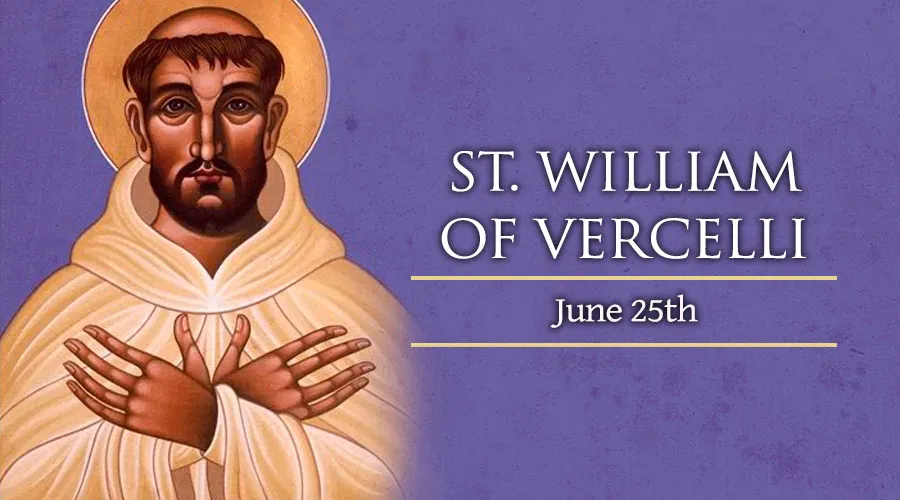
St. William of Montevergine

When they lived:

St. William of Montevergine, also known as Saint William of Vercelli, lived during the 11th and 12th centuries. He was born in the year 1085 and died on June 25, 1142.

Where they lived:

St. William of Montevergine spent most of his life in Italy. He was born in Vercelli, a city in the Piedmont region of northern Italy. He later founded the Monastery of Montevergine in the Campania region, which is in southern Italy. This monastery became a significant center of religious life during his time.

Notable world events during the time of their life:

  • First Crusade (1096-1099): St. William’s early years coincided with the First Crusade, a major military campaign in which European Christians sought to recapture Jerusalem from Muslim control. This event had significant repercussions for Christianity and the entire Mediterranean world.
  • Investiture Controversy (1075-1122): The Investiture Controversy was a power struggle between the papacy and European monarchs over the appointment of bishops and abbots. It had profound implications for the relationship between the Church and secular authorities, influencing the political and religious landscape of St. William’s time.
  • Scholasticism Emerges (12th century): The 12th century saw the emergence of Scholasticism, a philosophical and theological movement that sought to reconcile faith and reason. Figures like St. Anselm and Peter Abelard played significant roles in this intellectual movement, which contributed to the development of Catholic theology.
  • Birth of Genghis Khan (1162): Although St. William of Montevergine did not live to see this event, his lifetime overlapped with the birth of Genghis Khan, the founder of the Mongol Empire. This event marked the beginning of a significant chapter in world history, with far-reaching consequences.

Patronage:

St. William of Montevergine is venerated as the patron saint of various groups and causes:

  • Patron Saint of Montevergine: He is the primary patron of the Monastery of Montevergine and the surrounding region. Pilgrims visit his shrine at the Montevergine Sanctuary to seek his intercession.
  • Childless Couples: St. William is invoked by couples who are struggling with infertility or are seeking to have children. His intercession is believed to bring blessings to those desiring to start a family.
  • People in Need of Mental Healing: Due to his own struggles with mental health, St. William is also considered a patron saint for those dealing with mental illness or seeking mental and emotional healing.
  • Monastic Life: As the founder of the Montevergine Monastery, he is a patron saint of monks and the monastic way of life. His dedication to a life of prayer and contemplation serves as an inspiration to those in religious communities.
  • Protection Against Earthquakes: In regions prone to earthquakes, St. William is invoked for protection against these natural disasters.

St. William of Montevergine’s life, marked by his dedication to spirituality and his ability to overcome personal challenges, continues to inspire people across different walks of life and serves as a reminder of the enduring power of faith and perseverance.

The Life and Works of William of Montevergine

Born of noble parents, William of Montevergine lost his parents at a very young age. As a result of this, a family member raised him. When he reached a suitable age, he undertook a pilgrimage to Santiago de Compostela.

While on this pilgrimage, he came across a blacksmith. He instructed the blacksmith to make an iron implement. This iron implement was to encircle his body, causing pain to William of Montevergine. Hesitantly, the blacksmith made the iron implement. With this implement, William of Montevergine continued his pilgrimage.

Upon returning to Italy, he was beaten up and robbed by thieves. He had intended to continue his pilgrimage to Jerusalem. However, once the thieves beat him up, it was taken as a sign by God to remain in Italy and spread the word of Christ instead.

With this sign of God to remain in Italy, William of Montevergine settled on the summit of Mount Vergine. Here, he lived as a hermit and spread the word of Christ. Soon after this, he gained several followers and founded the Monastery of Montevergine.

Roger II of Sicily served as William’s patron. He also built and founded several monasteries around Sicily in order to continue spreading the word of Christ and helping women and men who needed it. When he became patron to William, he built a monastery opposite his palace. This was done to ensure that William always remained near him. It is also said by Roger II that William was able to perform miracles.

One of his most notable miracles that he performed is known as the “Miracle of the Wolf.” This miracle was performed in 1591. One day at the monastery in Montevergine, a wolf killed a donkey. At the monastery, donkeys are seen as saints and are very valuable. They are used for towing and other tasks around the grounds of the monastery. Upset by the killing of the donkey, William of Montevergine ordered the wolf to perform the tasks of the slain donkey. The donkey immediately became tame and docile, performing all the tasks of the donkey he had slain. The people at the monastery were shocked to see this happen but praised William for his actions.

One of the duties of a priest is to exercise their ministry and continue to spread the word of Christ. Being a hermit, this compromised his chosen way of living. His way of life was also not agreed upon by his fellow priests in the area, who said that his chosen way of life was too private and strict.

As a result of these disagreements with his way of life, William of Montevergine decided to leave Montevergine. In 1128, he left and settled on the plains in Goleto. Here, he founded several monasteries and began to experience a new way of monastic life. He lived in a double monastery, built mostly by the women in the area.

While living and experiencing this new way of monastic life, William of Montevergine also undertook several trips to Apulia. Here, he continued to spread the word of Christ.

The Death of William of Montevergine

On June 25, 1142, William of Montevergine passed away in Goleto of natural causes. His remains stayed in Goleto. On September 2, 1807, the king of Naples, Gioacchino Murat, ordered the remains of William of Montevergine to be transported back to Montevergine.

In 1224, William of Montevergine was canonized by Pope Pius XII and became the patron saint of Irpinia. He is venerated in the Roman Catholic Church, often being attributed to having a wolf and crosier by his side.

5 Interesting Facts About St. William of Montevergine

  • In Italian, William of Montevergine is known as Gulielmo.
  • The miracle performed by William at Ouse Bridge is believed to
    have led to him being canonized.
  • He undertook his first pilgrimage at the young age of fourteen.
  • He is known for being barefoot and choosing not to wear shoes.
  • His relics can still be seen in Montevergine today.

Prayer to St. William of Montevergine

St. William of Vercelli, You were a father to your monks and a shepherd to your people. Pray for us that we might have our sight restored and that we might see, with the eyes of our hearts and souls,God’s presence in and around us. Teach us to nourish our spiritual journeys with prayers so that we too might be instruments of God’s light and love to others. In the spirit of St. Benedict, help us to be people of hospitality who let our work become prayer. Let us find God in each other. Amen.

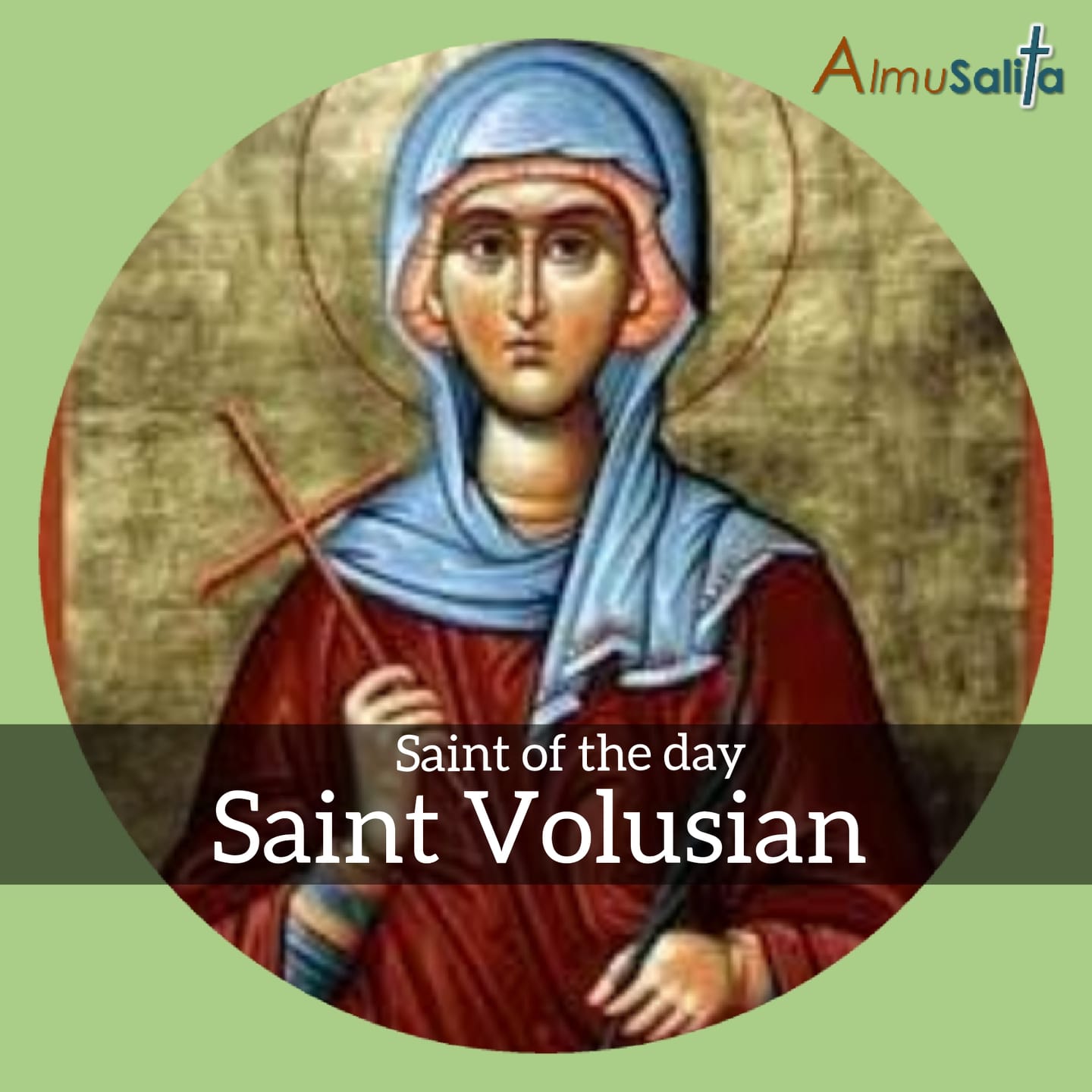
St. Volusian

When they lived:

St. Volusian lived during the early 5th century, specifically from 430 to 496 AD.

Where they lived:

St. Volusian was born and spent most of his life in Tours, a city located in the historic region of Gaul, which corresponds to modern-day France. His connection to this region plays a significant role in his life and legacy.

Notable world events during the time of their life:

  • Fall of the Western Roman Empire (476 AD): St. Volusian lived during a time of great political turmoil as the Western Roman Empire crumbled. In 476 AD, the last Roman emperor, Romulus Augustus, was deposed by the Germanic chieftain Odoacer. This marked the symbolic end of the Roman Empire, a momentous event with far-reaching consequences for Europe.
  • Migration Period (4th-6th centuries): The era in which St. Volusian lived was characterized by massive migrations of various tribal groups across Europe. The Huns, Vandals, Visigoths, and other tribes were on the move, causing upheaval and change throughout the continent.
  • Life of St. Augustine (354-430 AD): St. Augustine, one of the most influential theologians and philosophers in Christian history, lived during the earlier part of St. Volusian’s life. His writings, such as “Confessions” and “The City of God,” continued to shape Christian thought during Volusian’s time.
  • Council of Ephesus (431 AD): In 431 AD, the Council of Ephesus took place, addressing theological disputes within Christianity, particularly related to the nature of Christ. This council had a significant impact on Christian theology during St. Volusian’s lifetime.
  • Spread of Monasticism: The 5th century saw the spread of monasticism throughout Europe, with St. Martin of Tours being a prominent figure in this movement. His influence on St. Volusian’s life and devotion to the monastic lifestyle are worth noting.

Their patronage:

St. Volusian is venerated as the patron saint of Tours, France, and vine growers. His connection to Tours reflects the deep spiritual heritage of this region, and the vineyard patronage likely stems from his association with the cultivation of grapes and winemaking. His life is celebrated as a testament to unwavering faith in a time of profound change and uncertainty, making him an enduring symbol of spiritual resilience.

St. Volusian’s story is one of devotion amid chaos, an unwavering commitment to faith in the face of political and social upheaval. As an emblematic figure of Tours, he reminds us that even in turbulent times, faith can be a source of strength and stability. His patronage over vine growers also reminds us of the enduring connection between spirituality and the land, where faith is cultivated like the grapes that yield the finest wines, growing stronger with time.


Life and Devotion

Saint Volusian of Tours, Also called Volusianus, might be considered a lesser saint, but he is highly revered. However, not much is known about the history of this saint.

Saint Volusian was born in France, Europe, on an unknown date. He was the 7th Bishop of Tours, France, and he also occupied Senatorial power.

Saint Volusian came from a rich and distinguished family. He was highly respected and was related to his predecessor, Saint Perpetuus, and even to Ricius, who was an Aristocrat and Bishop of Limoges.

Even though he was a devout Bishop, it was a time in which clerical celibacy was the rule, and so Saint Volucia was married.

His wife, whose name is unknown, was described as foul-mouthed, bitter,and having a bad temper. His marriage was one of his first challenges in life.

Saint Volusian ruled at a time when Barbaric groups threatened to takeover the government.

Saint Volusian was active in politics, even as a Bishop. It was in those days that Clovis was King of the Franks. It was not long before the Visigoths, early Germanic pagans, began to wage war on France.

As the Visigoths continued to conquer the town, Saint Volusian became more afraid. Eventually, the Visigoths hijacked Saint Volusian’s diocese.

The Goths believed that Saint Volusian was making plans to team up with Clovis to overthrow them. This caused them to exile Saint Volusian to Spain.

Death and Canonization

Saint Volusian died around the year 498. The cause of his death, however, remains debated.

The most debated point is that Saint Volusian died a Martyr. It was told that the Goth followed him into Spain, cornered him, and beheaded him.

This reported Martyrdom might have been the basis for his Canonization.

Much of what is known about Saint Volusian was told in a book written by Gregory of Tours almost a century later. Saint Volusian is celebrated by the Catholic Church on the 18th of January.

5 Interesting Facts About St. Volusian

  • Did you know that Saint Volusian is the patron saint of Foix? Foix
    is a commune that is located in the Occitanie region of
    southwestern France.
  • Did you know that some people place Saint Volusian’s place of death
    to be Toulouse, France?
  • Did you know that Saint Volusian communicated his fears about the
    Goths in a letter to Bishop Ruricius? Ruricius had replied in good
    humor about how Volusian was already in a war and his marriage had
    so I had nothing to be afraid of.
  • Did you know that Saint Volusian’s Felix was taken to Foix?
  • Did you know that an Augustinian Church was built in Foix, Saint
    Volusian’s honor?

Prayer to St. Volusian

Lord, may we venerate and apply the life of St. Volusian, your humble servant of Tours, into our daily lives. That we may be humble of heart and Strong in our proclamation of the gospel of Christ, who lives and reigns with you and the Holy Spirit forever and ever.

Source:[http://aesaintsoftheday.blogspot.com/2010/01/st-volusian-of-tours.html?m=1]{.ul}