St. Vincent Pallotti

When they lived:

St. Vincent Pallotti lived in the 19th century. He was born on April 21, 1795, and died on January 22, 1850.

Where they lived:

St. Vincent Pallotti spent most of his life in Rome, Italy. He was born in Rome and remained there throughout his life, deeply rooted in the city’s rich Catholic tradition.

Notable world events during the time of their life:

  • Industrial Revolution: During St. Vincent Pallotti’s lifetime, the Industrial Revolution was in full swing. This period witnessed significant advancements in technology, manufacturing, and transportation, transforming societies across the world.
  • Napoleonic Wars: St. Vincent Pallotti lived through the Napoleonic Wars, a series of conflicts that reshaped the political map of Europe. The wars had far-reaching consequences, including the spread of revolutionary ideas and changes in European power dynamics.
  • Birth of Photography: In 1839, just a few years before Pallotti’s death, Louis Daguerre introduced the daguerreotype, a pioneering form of photography. This invention marked the beginning of a new era in visual communication and art.
  • Publication of Charles Darwin’s “On the Origin of Species”: In 1859, after Pallotti’s passing, Charles Darwin published his groundbreaking work on evolution. This would have a profound impact on science and society, sparking debates about religion, evolution, and the nature of life itself.
  • Gold Rushes: During Pallotti’s lifetime, several gold rushes occurred, notably the California Gold Rush of 1848-1855. These events attracted people from around the world and significantly altered the economic and demographic landscapes of the regions affected.
  • Revolutions of 1848: In 1848, a series of political upheavals and revolutions occurred across Europe. These events, often referred to as the “Springtime of Nations,” demanded greater political freedom and constitutional reforms.

Patronage:

St. Vincent Pallotti is known as the patron saint of Roman Catholic figures involved in the apostolate of the Catholic Church, particularly those engaged in promoting unity among Christians and spreading the faith. His work was dedicated to encouraging laypeople to actively participate in the mission of the Church and to promote a spirit of collaboration among clergy and laity.

Early Life

Saint Vincent Pallotti was born in the Papal States, Rome, on April 21st, 1795. His parents were Pietro Pallotti and Magdalena De Rossi.

Saint Vincent was said to be of noble blood, descending from distinguished ancestors from Nocia and Rome from his father’s and mother’s sides, respectively. He was the third child of ten children born to Magdalena.

He was baptized in the Saint Lawrence Church in Rome on April 22, 1795.

Vincent gained his initial formal studies at the Pious Schools in San Pantaleone, after which he proceeded to study at the Roman College.

At a very tender age, he was devoutly religious and studied the Bible. He made up his mind to be a part of the church, and at the age of 16, he decided that he wanted to be a Priest.

Saint Vincent became a lower member of the Franciscan church in 1816 before he was ordained a Priest in the Church on May 16, 1818.

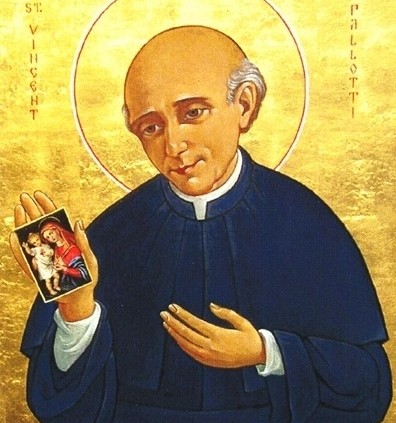
Saint Vincent showed love to the poor and needy and took special heed to the act of penance. A small man with blue eyes that seemed to stare deep into the soul, Vincent Pallotti soon started to wear his head bald as an act of reverence to God.

Dedication and Devotion

A man of great intellect, Saint Vincent continued his studies at the Sapienza University from 1814 to 1818. Shortly after being ordained in the church, he completed his studies and received a Doctorate in theology and Philosophy.

Saint Vincent was assigned the post of assistant professor in his Alma Mater but soon resigned because he needed to focus more on his ecclesiastical duties. When he wasn’t preaching, he spent most of his time caring for the needy.

Saint Vincent established institutions for carpenters, tailors, and shoemakers to help them become better at their trades. He brought doctors to look at the sick, and he did all this out of the kindness of his heart and for the love of God.

Legacy

Saint Vincent Pallotti founded the Union of Catholic Apostolates on January 9, 1835. This apostolate would blossom into one of his greatest achievements while in power. Starting this apostolate, Saint Vincent sought to bring people from all walks of life to salvation.

The Union was approved by Pope Gregory XVI on July 11, the anniversary of its establishment.

It was a difficult time during wars and the outbreak of diseases like the cholera plague. This didn’t deter Saint Vincent Pallotti, however, as he traveled from city to city to preach the Good News and recruit people to the apostolate. He was devoted to growing the mission.

Unfortunately, the Society was disbanded due to its similarity to the Society for the Propagation of the Faith. Vincent, however, petitioned for the reopening of the Society and was met with a favorable reply.

Among the good things he did for society was the creation of the Society of the Catholic Apostolate, a union for priests and brothers.

Death and Canonization

Saint Vincent Pallotti died on the 22nd of January, 1850, in his home city of Rome. He was barely 55 years old but had left a large impact on the church.

After his death, trouble began brewing concerning his society, but it was staunchly defended by people like Cardinal Lambruscini. When the Cardinal passed away, however, the Society was renamed The Pious Society of Missions.

The name stuck for several years until the Holy See commanded that the original name be reclaimed.

Saint Vincent Pallotti was canonized by Pope John XXIII in 1963.

Tradition has it that after his death, before he was buried, there was a sweet smell that was detected around his body and his room. This smell supposedly stayed in his room even after a month, until it faded away.

His body was exhumed from the initial spot twice, in 1906 and 1950, and both times, it was noticed to have remained unspoiled and uncorrupted. This sign, as exhibited by several other saints in history, was taken as a sign of purity.

Saint Vincent Pallotti’s body currently lies in the Church of San Salvatore in Onda, Rome. He is celebrated by the Catholic Church on the day of his death, January 22.

5 Interesting Facts About St. Vincent Pallotti

  • Did you know that Saint Vincent once dressed up as an old woman to
    get the confession of a man who swore to kill any priest that came
    in the room?
  • Did you know that Saint Vincent Palloti’s Society still exists?
    today? It is kept alive by the Pallotine Fathers, Brothers, and
    Sisters.
  • Did you know that Saint Vincent served as a prison chaplain for some
    time in 1838?
  • Did you know that Saint Vincent gave his final sermon on the last
    day of the octave of the Epiphany? This happened in 1850.
  • Did you know that Saint Vincent predicted that Giovanni
    Mastai-Ferretti would be made Bishop?

Prayer of St. Vincent Pallotti

Saint Vincent Pallotti, you were molded by God’s infinite love. You answered God’s call to serve Him. You were there for those seeking counsel ,for the sick, for the youth and the aging, for the rich and the poor, for people of any profession and walk of life. They were all important to you. You wanted to inspire each and every one for the Kingdom of God, reminding people of their duty to be apostles and preparing them for this work. Now I call upon you to intercede for me. Help me to pray. Help me to pray only for what I truly need, what I can truly use, and what is for my salvation and the honor of God. You received many graces and gifts from God. You always thanked God beforehand, as if your prayer had already been answered. I ask you to submit my petitions to God. Be my helpers. I place this prayer before God the Father, through Jesus Christ. Do not leave me without your help. Bless me. Show me the way to Christ. Through the Spirit, lead me to the Father. Amen.

Source:[http://www.stannesparishshankill.com/prayers/prayers-to-vincent-pallotti]{.ul}
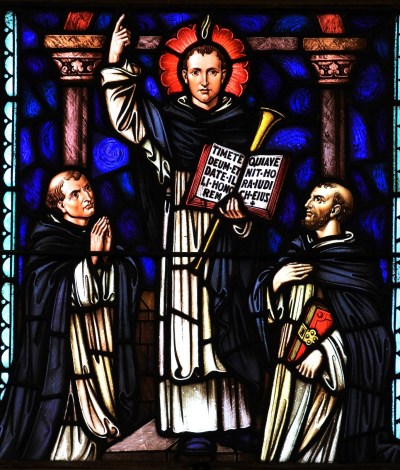
St. Vincent Ferrer

When they lived: St. Vincent Ferrer lived during the late 14th and early 15th centuries. He was born on January 23, 1350, and passed away on April 5, 1419.

Where they lived: St. Vincent Ferrer was born in Valencia, Spain, and spent much of his life traveling throughout Europe, particularly in Spain, France, and Italy, to spread the word of God.

Notable world events during the time of their life:

  • The Hundred Years’ War (1337-1453): This long-standing conflict between England and France overlapped with St. Vincent Ferrer’s lifetime. His ministry took place in regions heavily affected by the war, and he played a role in attempting to bring peace.
  • Western Schism (1378-1417): This was a major crisis in the Catholic Church where multiple popes claimed legitimacy. St. Vincent Ferrer was deeply involved in efforts to resolve this schism and played a key role in promoting the Avignon Pope Benedict XIII.
  • Renaissance Period (14th-17th centuries): St. Vincent Ferrer lived during the early stages of the Renaissance, a period marked by significant cultural, artistic, and intellectual advancements that would shape the future of Europe.
  • Black Death (1347-1351): While St. Vincent Ferrer was born after the peak of the Black Death, the aftermath of this devastating pandemic continued to influence society, and his ministry occurred during the post-plague era.
  • The Council of Constance (1414-1418): St. Vincent Ferrer attended this significant council, which aimed to resolve the Western Schism and address various church reform issues. It played a crucial role in stabilizing the Catholic Church during this tumultuous period.

Their patronage: St. Vincent Ferrer is the patron saint of construction workers, builders, and those in similar professions due to his connection with building and repairing the Church (both spiritually and physically). He’s also known as the patron saint of orphanages, as he showed great care for orphans during his lifetime. Additionally, he is considered a patron of reconciliation and peace due to his efforts to heal the schisms within the Catholic Church during the Western Schism. His life story serves as an inspiration for those seeking to bridge divides and promote unity.

A Brilliant Student and Teacher

Vincent Ferrer was born on January 23, 1350, in Valencia, Spain, to William Ferrer and Constantia Miguel. He was educated at Valencia and completed his study of philosophy at the age of fourteen. Not much is known about his early life. However, his later years are worth noting.

Vincent entered the Order of Preachers (Dominicans) in 1367 at the age of nineteen. He was sent to study in Barcelona the following year. Here, he continued his scholastic duties and devoted himself to preaching. He taught philosophy at Lérida, the famous university of Catalonia, in 1370. It was also where he received his doctorate.

Vincent returned to the Dominican Studium Arabicum et Hebraicum in Barcelona in 1373. In 1377, he was sent to Toulouse to continue his studies. In 1379, he was retained by the legate of the Court of Aragon, Cardinal Pedro de Luna, who was working to win King Peter IV’s obedience to Avignon. He was so thoroughly convinced of the legitimacy of the Avignon popes’ claims that he was one of their strongest champions. From 1385 to 1390, Vincent taught theology at the Valencia Cathedral. It was during that time that he perfected himself in the Christian life.

His Missionary Zeal

In 1390, Vincent was obliged to accompany Cardinal de Luna to France. However, he soon returned home. De Luna became Pope at Avignon in 1394. He summoned Vincent and made him Master of the sacred palace. With much effort and zeal, Vincent made unsuccessful attempts to end the Great Schism. He refused all ecclesiastical honors and dignities, even being a cardinal. He only desired to be appointed an apostolic missionary.

Vincent labored much, which made him the most famous missionary of the 14th century. He evangelized nearly every place in Spain. He also preached in France, Italy, Germany, Flanders, England, Scotland, and Ireland. Because of his preaching, countless conversions followed. His preaching was assisted by the gift of miracles. Though the Church was then gravely divided by the Great Schism, Vincent was honorably received in the provinces subjected to the two claimants to the papacy.

A Great Preacher

For twenty years, Vincent traversed Western Europe. He was preaching penance for sin and preparation for judgment. He was obliged to preach in squares and open places, such were the numbers that flocked to hear him. Because of his strong message for the people to repent and prepare for the coming of the Kingdom by following the teachings of Jesus and the Church, some people referred to him as a modern John the Baptist. Vincent’s preaching inspired many Catholics to renew their faith. His words touched the hearts of people who decided to be baptized as a response to his message.

Vincent lived to see the end of the Great Schism and the election of Pope Martin V. Crowned with his tireless labors, Vincent died on April 5, 1419. He was canonized by Pope Calixtus III at the Dominican Church of Santa Maria Sopra Minerva in Rome on June 3, 1455. His feast day is April 5.

5 Interesting Facts About St. Vincent Ferrer

  • St. Vincent Ferrer is the patron saint of builders. He is renowned for “building” the Church through missionary efforts, prayer, and time spent preaching, teaching, advising, and taking confessions.
  • St. Vincent Ferrer is mostly depicted with wings. The reason was because a number of people have seen him assume wings and fly off to a suffering person while preaching.
  • In his portraits or images, St. Vincent Ferrer is sometimes portrayed holding a trumpet. This is because when he preached, as those who had listened to him attested, his voice could reach as far as three miles away, just like how a trumpet can be heard from a distance.
  • When St. Vincent Ferrer was gravely ill, he had a vision of Christ, St. Dominic de Guzman, and St. Francis of Assisi. He was miraculously healed after receiving this vision. Afterwards, he started to preach about the last judgment and the need for repentance, which merited him the title “angel of the apocalypse”.
  • When he preached, St. Vincent Ferrer spoke only in his native language, which was Spanish. However, people of all languages were able to understand everything he said. His biographers believed that St. Vincent had the ability to speak in tongues.

Prayer to St. Vincent Ferrer

O God, who raised up the Priest Saint Vincent Ferrer to minister by the preaching of the Gospel, grant, we pray, that, when the Judge comes, whom Saint Vincent proclaimed on earth, we may be among those blessed to behold him reigning in heaven. Who lives and reigns with you in the unity of the Holy Spirit, one God, for ever and ever. Amen.

St. Toribio Alfonso de Mogrovejo

When they lived:

St. Toribio Alfonso de Mogrovejo, also known as Saint Turibius of Mogrovejo, lived from November 16, 1538, to March 23, 1606. He was a prominent figure in the late 16th century.

Where they lived:

St. Toribio Alfonso de Mogrovejo lived primarily in two regions:

  1. Spain: He was born in the city of Mayorga, in the region of Castile, Spain. This is where his early life and education took place.
  2. Peru: Toribio de Mogrovejo is most renowned for his work as the Archbishop of Lima, Peru. He lived and worked there for the majority of his life, dedicating himself to the betterment of the Church and the indigenous people of the region.

Notable world events during the time of their life:

  • Spanish Conquest of the Inca Empire (1532-1572): During St. Toribio’s lifetime, the Spanish conquistadors, led by figures like Francisco Pizarro, were actively colonizing South America. This period marked significant clashes of cultures and the conversion of indigenous populations to Christianity.
  • Council of Trent (1545-1563): The Council of Trent was a crucial event in the Catholic Church during St. Toribio’s time. It aimed to address and reform various aspects of the Church, including its teachings, practices, and hierarchy.
  • Scientific Revolution (16th-17th centuries): While not directly related to St. Toribio, this era saw a surge in scientific discoveries and the development of the scientific method by figures like Galileo Galilei and Johannes Kepler. These advancements laid the groundwork for modern science.
  • Renaissance (14th-17th centuries): The Renaissance was a cultural and intellectual movement that encompassed art, literature, and philosophy. Although it began before St. Toribio’s birth, its influence persisted during his lifetime, contributing to the shaping of European culture.
  • Exploration and Colonization: The late 16th century was marked by European exploration and colonization worldwide. Figures like Christopher Columbus and Ferdinand Magellan had already set the stage, and this era saw continued expansion into the Americas, Africa, and Asia.

Patronage:

St. Toribio Alfonso de Mogrovejo is the patron saint of several causes and groups:

  • Archdiocese of Lima: He is the patron saint of the Archdiocese of Lima, where he served as Archbishop. He is revered for his tireless efforts to improve the Church and the lives of the indigenous people in Peru.
  • Latin American Bishops: St. Toribio is also considered a patron saint for Latin American bishops. His dedication to his pastoral duties, missionary work, and advocacy for social justice sets an inspiring example for contemporary clergy.
  • Indigenous Peoples: He is revered for his strong advocacy for the rights and well-being of indigenous populations. St. Toribio worked tirelessly to protect their rights and provide them with spiritual and material support.
  • Legal Profession: Due to his background in law and his emphasis on justice, St. Toribio is also considered a patron saint of the legal profession, especially in Peru.

St. Toribio Alfonso de Mogrovejo’s life and work continue to inspire individuals and groups around the world, making him a significant figure in both religious and historical contexts.

Early Life

The Spanish saint, Toribio Alfonso de Mogrovejo, also known as Turibius of Mogrovejo, was born to Luis Alfonso de Mogrovejo and Ana de Robles Imoran on November 16th, 1538. The location of his birth was Valladolid, Habsburg, Spain. As a young child, Toribio was known to have strongly upheld a devotion to the Blessed Virgin, so much so that no week went by without him fasting in honor of the Blessed Mother. His inquisitiveness to know more led to his studies at Valladolid College at the age of twelve, where he studied humanities. In the years that followed his graduation, Toribio joined his uncle, Juan de Mogrovejo, as a professor in Salamanca’s college, where his duty was to teach law. Years later, he returned as a student at the college in Coimbra, after which he came back to Salamanca. Years after his uncle’s death, because of how knowledgeable Toribio seemed to be, King Philip II assigned him the duty of Grand Inquisitor in the year 1571 at the Inquisition Court in Granada, where he served for five years.

Dedication and Devotion

King Philip II used his influence after Toribio had served as Grand Inquisitor to nominate him as Lima archbishop, given that the position was vacant at the time. Being grounded in canon law, Toribio tried to make the King see the reasons he could not take on the position—that it was one left for people who were ordained priests or kings only. Unfortunately, however, Toribio’s knowledge of canon law did not save him from what fate was deciding for him. His points were overruled by the pope, and subsequently, arrangements began to come up for his ordination before the official announcement of his filling the office. In 1578, Toribio was ordained into the priesthood, and by May of the following year, he was made an Archbishop. Toribio, after that, received his episcopal consecration in the year 1580, carried on by the Archbishop of Seville, Cristobal Rojas Sandoval.

Just after his ordination, Toribio kicked off his ministry by setting out on foot to Lima, where he baptized and taught people about Christ. Being that he was journeying through the archdiocese on foot, Toribio experienced a whole lot of ups and downs, from foot burns to fevers to threats from aggressive tribes to the wild beasts he’d had to face, too. But he didn’t relent. He instead went on to construct roads, hospitals, chapels, schools, and convents. He also established a seminary, which would be the very first of its kind in the entire Western Hemisphere. He fought to make sure that those priests of questionable behavior were brought to order, and though this earned him a title among them, it turned out for the good of all. The saint was also triumphant, among many other things, in including evangelism as a central theme in his episcopal career.

Legacy

Among the many legacies that St. Toribio Alfonso de Mogrovejo left behind after his passing are the schools, convents, hospitals, roads, chapels, etc. of his establishments. He also had a voice that stood for only what was upright. Such could be seen in his reformation of the diocesan priests. His commitment to including evangelism as a core aspect of his episcopal career could also be measured as one of his legacies. All in all, his influence and impact on life are a great legacy to look back on today.

Death and Canonization

Toribio Alfonso de Mogrovejo passed away on March 13th, 1606, at precisely 3:30 p.m. from a fever. This had happened as he’d predicted. Such was the case during the period of a pastoral visit in Pacasmayo. Toribio was canonized as a saint in 1726, on December 10th, precisely by Pope Benedict XIII.

Feast Day

A liturgical feast in honor of St. Toribio Alfonso de Mogrovejo used to be celebrated on April 27th, but currently it is done on March 23rd.

Prayer to St. Toribio Alfonso de Mogrovejo

Lord, through the apostolic work of Saint Turibius and his unwavering love of truth, you helped your church grow. May your chosen people continue to grow in faith and holiness. Grant this through our Lord Jesus Christ, your Son, who lives and reigns with you and the Holy Spirit, one God, forever and ever. Amen.

Source:https://www.365rosaries.blogspot.com/2011/03/march-23-saint-toribio-alfonso-de.html?

St. Timothy

When they lived:

St. Timothy, also known as Timothy the Apostle, lived during the 1st century AD. His exact birth and death dates are not precisely known, but he is believed to have been born around 17 AD and died sometime around 97 AD.

Where they lived:

St. Timothy lived in the ancient city of Lystra, which was located in what is now modern-day Turkey. Lystra was a prominent city in the Roman province of Galatia.

Notable world events during the time of their life:

  • Roman Emperor Nero’s Persecution of Christians (64-68 AD): St. Timothy lived during a period of intense persecution of Christians under the Roman Emperor Nero. This was a time of great danger and hardship for early Christians, and it shaped the early Christian community significantly.
  • Great Fire of Rome (64 AD): In 64 AD, a massive fire ravaged Rome, leading to significant changes in the city’s infrastructure and politics. This event had indirect consequences on the Christian community as Nero scapegoated them for the fire, intensifying the persecution of Christians.
  • First Jewish-Roman War (66-73 AD): St. Timothy lived during the tumultuous years of the First Jewish-Roman War, which culminated in the destruction of the Second Temple in Jerusalem in 70 AD. This event had profound implications for Judaism and early Christianity.
  • Emergence of Early Christian Communities: St. Timothy was a close associate of the Apostle Paul and played a vital role in the early Christian communities. His life coincided with the rapid spread of Christianity throughout the Roman Empire, making his contributions to the faith particularly significant.
  • Development of Early Christian Theology: During Timothy’s lifetime, the early Christian Church was in the process of developing its theology and doctrine. Key figures like St. Paul were writing letters and theological treatises that would later form the basis of Christian doctrine.

Their patronage:

St. Timothy is the patron saint of many diverse groups and causes. Here are a few of the most notable:

  • Young People: St. Timothy is often invoked as a patron saint for young people, students, and those seeking guidance in their studies and careers. His own youthful dedication to the Christian faith makes him an inspirational figure for young believers.
  • Those Suffering from Stomach Ailments: St. Timothy is also recognized as the patron saint of those with stomach ailments. This association may stem from historical accounts of his own physical weaknesses and illnesses.
  • Catholic Church Leadership: As a close companion of the Apostle Paul, St. Timothy is considered a model for bishops and clergy within the Catholic Church. His commitment to the early Christian communities and his role in shaping early Christian doctrine make him an important figure for church leaders.
  • Missionaries: St. Timothy’s work alongside St. Paul in spreading Christianity makes him a fitting patron for missionaries who dedicate their lives to sharing the Christian faith with others.
  • Personal Guidance: Many individuals turn to St. Timothy for personal guidance and inspiration in their own faith journeys. His life story, as recorded in the Bible, is a testament to faith and perseverance in the face of challenges.

St. Timothy’s legacy extends beyond his historical period, making him an intriguing figure for those interested in the early history of Christianity and its enduring influence on the world.

Early Life

Saint Timothy, who is also called Saint Timothy of Ephesus, was born circa 17 A.D. in the Lycaonian city of Lystra. His father was a Greek layman, and his mother was a Jew who had become a Christian convert.

Saint Timothy was one of the members of the early Christian mission. He was a devout Christian from a very young age. He was meek, reserved, religious, and devoted to Christianity.

Saint Timothy’s first real and documented encounter with evangelism probably started when he met Apostle Paul. Paul and Silas were at that time embarking on their second sojourn of evangelism to Lycaonia.

At that time, Saint Timothy was a revered participant in the Church. Apostle Paul grew to admire Saint Timothy’s love for God, piety, and honesty, which he invited to join them on their quest to win souls for Christ.

Without further consideration, Saint Timothy bid his family goodbye and agreed to join Apostles Paul and Silas on their mission work. Thanks to his Greek ancestry, Timothy at that time was uncircumcised.

Out of respect for the Jews in whose territory they would be doing most of the work, Apostle Paul had Saint Timothy get circumcised.

Dedication and Devotion

Saint Timothy abandoned clothes, money, the safety of his home, and other vain items, choosing to follow the Apostles instead.

Saint Timothy became Barnabas’ successor by becoming Apostle Paul’s follower and friend. Together, they went from city to city, trying to convert people to Christianity.

Around 52 A.D., Saint Timothy accompanied Paul and Silas to Macedonia, where they did missionary work. Saint Timothy was said to have been in fragile health, falling sick many times on the road during evangelism.

This, however, did not deter him from following the Apostles every step of the way. The Apostle Paul, in turn, often encouraged him to drink wine for the sustenance of his stomach.

The journey of Saint Timothy and the Apostles Paul and Silas was recorded in some parts of the Bible, such as the Acts of the Apostles.

For some time, Paul had to leave for Athens, Greece. Saint Timothy and Apostle Silas were left behind for a while before meeting up with Apostle Paul in Corinth.

The trio continued to preach the word. They had an intense liking for each other, one more of brotherhood than religious respect, and were almost inseparable.

Although almost always with the Apostle Paul, Saint Timothy’s appearances in the Bible were few. Saint Timothy spent the rest of his life spreading the gospel alongside Apostle Paul until he became Bishop at Ephesus, with the church under his authority.

Saint Timothy was a co-writer of the books of the second book of Corinthians, Philippians, Colossians, both books of Thessalonians, and Philippians.

Apostle Paul spoke about Saint Timothy in high esteem. Even while Paul was imprisoned and expecting persecution, he invited Saint Timothy to say goodbye.

Timothy was said to have run into trouble one time due to his faith and been imprisoned for it. This occurred during the time that the New Testament was being written.

Death and Veneration

While information about Saint Timothy’s death was not recorded in the Bible, tradition has it that he died in 97 A.D. He died in Ephesus, Turkey.

The story says the old Bishop attempted to interrupt a parade that was being held in praise of Artemis, a goddess. He tried to do this by evangelizing. This angered the mob, and they stoned him to death or beat him with clubs in other accounts.

This caused him to be regarded as a Martyr for Christ.

Sometime in the middle of the fourth century, Saint Timothy’s body was taken from Ephesus down to Constantinople. His relics were stationed next to Andrew and Luke’s tombs in the Church of the Holy Apostles.

The relics were transferred to Italy and entombed in the Termoli Cathedral in the 13th Century.

Saint Timothy is celebrated by various churches at different times. He is celebrated on the 22nd of January by Eastern Churches, the 26th of January by the Roman Catholic Church, and the 24th of January by the Lutheran Church.

Saint Timothy was canonized Pre-Congregation.

5 Interesting Facts About Saint Timothy

  • Did you know that Saint Timothy is the patron saint of stomach disorders?
  • Did you know that Saint Timothy was considered the first Bishop of
    Ephesus?
  • Did you know that Apostle Paul sent two letters to Saint Timothy?
    One letter was written from Macedonia Circa 65 A.D., and the second
    was written while he was waiting to be prosecuted.
  • Did you know that Saint Timothy’s mother and maternal grandmother
    were distinguished people of the Church? Their names were Eunice and
    and Louis.
  • Did you know that Saint Timothy’s remains were discovered in 1945?

Prayer to Saint Timothy

Dear Saint Timothy, well known for your gentleness, you were a most faithful disciple of St. Paul and, like him, traveled much to bring the good news to all people. The Letters Paul wrote to you reveal your zeal and inspire us with confidence in you. You, too, were cast into prison, and you too gave your life for Christ. So with confidence, we dare to ask: Please obtain relief if it is God’s will. Amen.

Source:[https://www.heavenlydivinecustomrosary.com/saint-timothy-prayers.html]{.ul}

St. Thomas More

When they lived:

St. Thomas More, also known as Sir Thomas More, lived during the late 15th and early 16th centuries. He was born on February 7, 1478, and died on July 6, 1535.

Where they lived:

Thomas More lived in London, England, for the majority of his life. He was born in the city of London and spent significant time in various parts of the city throughout his career. His later years were marked by his residence in Chelsea, a district in southwest London.

Notable world events during the time of their life:

  • The Age of Exploration (Late 15th to Early 16th Century): This era saw famous explorers like Christopher Columbus (1492), Vasco da Gama (1498), and Ferdinand Magellan (1519) embarking on voyages that would change the world’s understanding of geography and open up new trade routes.
  • The Protestant Reformation (Early 16th Century): Martin Luther’s posting of the 95 Theses in 1517 sparked a religious movement that led to the division of Western Christianity. This period of religious upheaval deeply influenced the life and times of Thomas More.
  • The Italian Renaissance (14th to 17th Century): During More’s lifetime, the Italian Renaissance was in full swing. This cultural and intellectual movement had a profound impact on Europe, fostering artistic, scientific, and philosophical advancements.
  • The Invention of the Printing Press (1450): Johannes Gutenberg’s invention revolutionized communication, making books more widely accessible and facilitating the spread of knowledge.
  • The Birth of Modern Science: In the early 16th century, figures like Nicolaus Copernicus (1473-1543) and Andreas Vesalius (1514-1564) laid the foundation for modern astronomy and anatomy, respectively, marking a shift from medieval thought to scientific exploration.

Patronage:

St. Thomas More is a patron saint of lawyers and statesmen, a role that reflects his own life and career. His deep commitment to the law and his unwavering conscience made him a symbol of integrity in the legal profession. More is also remembered for his literary contributions, including the famous work “Utopia,” which explored themes of an ideal society. Beyond his patronage, his legacy as a martyr for religious freedom and his willingness to stand by his convictions make him a figure of enduring interest and inspiration.

Vocation to Becoming a Lawyer

Thomas More on February 6, 1478, in London More was educated at St. Anthony’s in Threadneedle Street, one of London’s prestigious schools. He also studied at the household of John Morton, archbishop of Canterbury and chancellor of England. John More, his father, was a prosperous barrister who was afterwards made a Knight and Judge of the Kings Bench.

More’s father wanted him to become a lawyer. Realizing that he might have a vocation to the priesthood, he resided in the Carthusian monastery for about four years. He shared as much of the monks’ way of life as was practicable. Although he was attracted especially to the Franciscan order, More eventually decided that he would best serve God and his fellow men as a lay Christian. Despite this, he never discarded his habits of early rising, prayer, and fasting.

More entered Oxford in 1492, where he learned Latin and Greek and prepared for his future studies. In 1494, he left Oxford to become a lawyer, and he trained in London until 1502, when he was finally approved to begin practice. More became a lawyer and a member of the English Parliament. Because of his education and intelligence, More became a tutor for King Henry VIII when he was young.

A Rising Career

In 1505, More married his first wife, Jane Colt, to whom he had four children before her death in 1511. Their marriage was said to be happy, and More often tutored her in literature and music. After Jane’s death, More quickly remarried to Alice Harpur Middleton, a wealthy widow. The wedding took place less than a month after Jane’s passing and was poorly received by his friends.

In 1510, More rose to represent London. He earned a reputation for being honest and effective during his service to the people of London. He became a Privy Counselor in 1514. From 1517 on, Henry VIII took a liking to More and gave him higher posts. In 1529, Henry appointed More Lord Chancellor of England.

Obeying God Rather Than Man

During his term as Lord Chancellor, More prosecuted those accused of heresy and worked tirelessly to defend the Catholic faith. However, in 1530, as Henry worked to obtain a divorce from his wife, Catherine, More refused to sign a letter to the Pope requesting an annulment. This was More’s first time crossing Henry. Henry expected him to take his side, but More refused. In 1532, realizing that he could no longer work for Henry, More resigned from his post.

King Henry VIII decided to separate the Church of England from the Catholic Church in Rome. He commanded the parliament to make a document and proclaim him the head of the Church of England, and he demanded that all the bishops in England and his entire government sign the oath. Knowing that the Pope was the successor of Peter and that there could only be one Church and one Pope, More refused to sign.

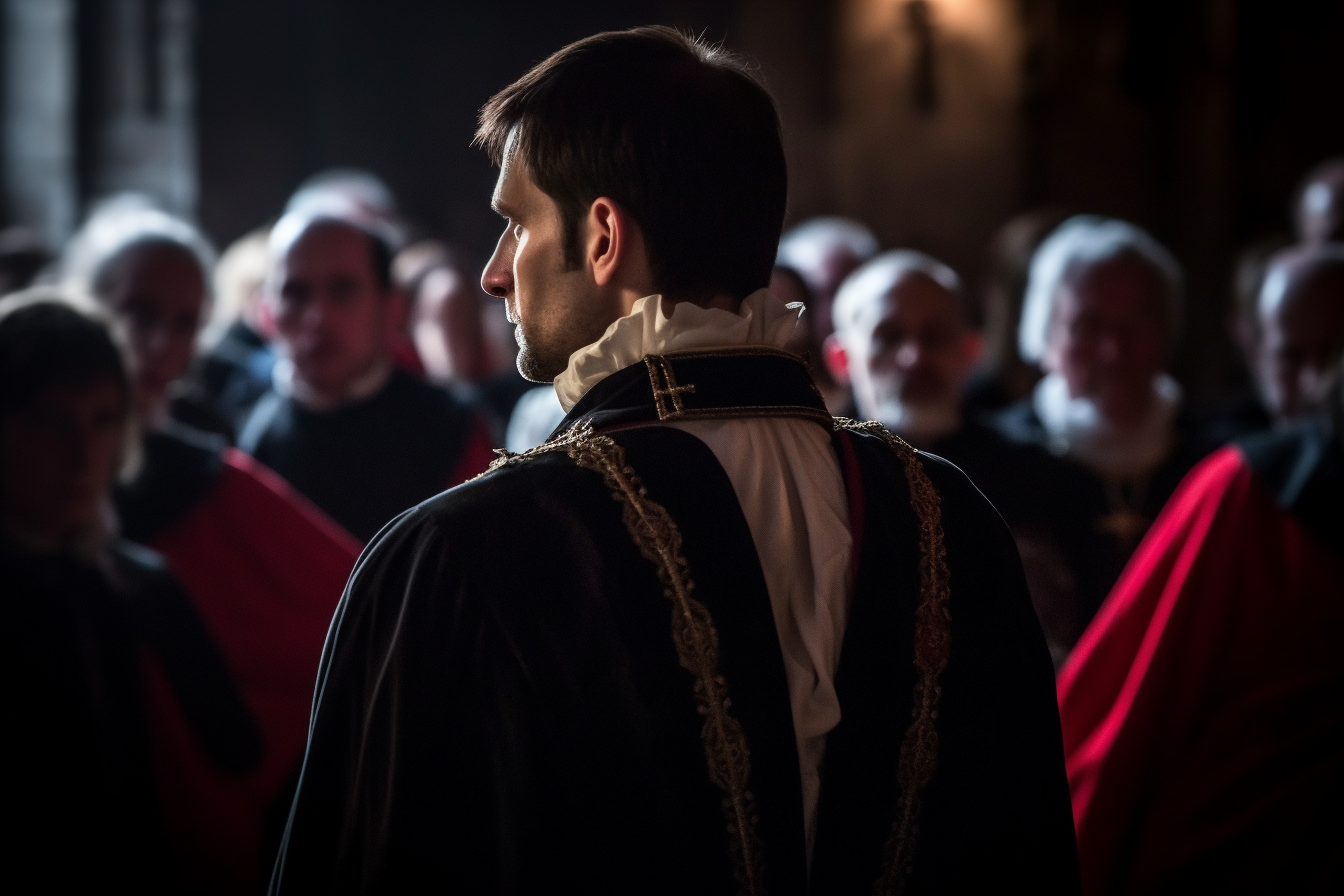
St. Thomas More standing in the middle of a crowded courtroom with his back to the camera

“The King’s Good Servant, but God’s First”

In 1533, More refused to attend the coronation of Anne Boleyn, who was now the Queen of England. More’s absence was seen by the king as an insult to the new queen and an undermining of his authority. Henry had charges thrown against More, such as accepting bribes and conspiracy.

On April 13, 1534, More was ordered to take an oath to acknowledge Anne as the queen, Henry’s divorce from Catherine, and his superiority as head of the Church of England. More accepted Henry’s marriage to Anne, but refused his being the head of the church and the annulment of their marriage. For this, More was arrested and imprisoned in the Tower of London.

More faced trial and was convicted by a partial jury. Despite his defense, More was convicted in fifteen minutes. He was sentenced to be hanged, drawn, and quartered, the punishment for treason. As a final act of mercy, Henry commuted More’s punishment to a mere beheading.

On July 6, 1535, More ascended the scaffold, joking to his executioners that they should help him up the scaffold but that he would see himself down. He then made a final statement, proclaiming that he was “the king’s good servant, but God’s first.” Pope Leo XIII beatified More in 1886, and he was canonized by Pope Pius XI on May 19, 1935. His feast day is June 22.

5 Interesting Facts About St. Thomas More

  • St. Thomas More was canonized together with his good friend, the bishop St. John Fisher. Both have their feast days on the same day.
  • St. Thomas More is the patron saint of adopted children, lawyers, civil servants, politicians, and difficult marriages.
  • One of St. Thomas More’s celebrated works is Utopia. This opus imagines a complex, self-contained community set on an island in which people share a common culture and way of life.
  • St. Thomas More was imprisoned in the Tower of London for 15 months.
  • St. Thomas More’s decapitated body was buried in the Church of St. Peter ad Vincula at the Tower of London in an unmarked grave. To serve as a warning for all, his head was put on display, but his daughter Margaret possibly bribed someone to take it down. The skull may be in the vault of a church in Canterbury.

Prayer to St. Thomas More

O God, who in martyrdom has brought true faith to its highest expression, graciously grants that, strengthened through the intercession of Saints John Fisher and Thomas More, we may confirm by the witness of our lives the faith we profess with our lips. Through our Lord Jesus Christ, your Son, who lives and reigns with you in the unity of the Holy Spirit, one God, for ever and ever Amen.

St. Thomas Aquinas

When he lived:

St. Thomas Aquinas, often referred to as Thomas of Aquino, lived during the 13th century. He was born in 1225 and died in 1274.

Where he lived:

Thomas Aquinas was born in Roccasecca, a small town in Italy. He spent most of his life in various European cities, including Naples, Paris, and Cologne, where he pursued his education and scholarly work.

Notable world events during the time of his life:

  • Mongol Conquests (13th Century): During Thomas Aquinas’ lifetime, the Mongol Empire, under leaders like Genghis Khan and later Kublai Khan, continued its expansion. The Mongol Conquests had a profound impact on Eurasian history, facilitating the exchange of goods, ideas, and cultures along the Silk Road.
  • Fourth Lateran Council (1215): A significant event in the Catholic Church, this council occurred just a decade before Thomas’s birth. It defined several key aspects of Catholic doctrine, including transubstantiation (the transformation of bread and wine into the body and blood of Christ during the Eucharist), emphasizing the importance of sacraments in the faith.
  • Albigensian Crusade (1209-1229): This series of campaigns against the Cathars, a heretical Christian sect in Southern France, took place during Thomas’s early years. It had a significant impact on the religious landscape of Europe.
  • Renaissance of the 12th Century: This intellectual revival, which spanned several centuries, saw the rediscovery of classical Greek and Roman texts and the birth of universities. Thomas Aquinas played a crucial role in this revival, particularly through his integration of Aristotle’s philosophy into Christian theology.
  • Inventions of Eyeglasses and the Astrolabe: While not directly related to Aquinas himself, these inventions during his lifetime had a profound impact on science and exploration. Eyeglasses improved the quality of life for many, while the astrolabe aided navigation and contributed to the Age of Discovery in the following centuries.
  • Gothic Architecture and Notre-Dame Cathedral: The construction of magnificent Gothic cathedrals like Notre-Dame in Paris occurred during Aquinas’s lifetime. These architectural marvels remain icons of medieval Europe.

His patronage:

St. Thomas Aquinas is widely recognized as the patron saint of students, scholars, and universities. His profound intellectual contributions, particularly in the synthesis of Christian theology and Aristotelian philosophy, have left an indelible mark on the world of education. He is celebrated on his feast day, January 28th, and continues to inspire individuals in their pursuit of knowledge and understanding, transcending religious boundaries with his commitment to reason and faith. Aquinas is also the patron saint of Catholic schools, apologists, and theologians, making his influence felt far beyond his own time and place.

Captive Yet Free

In the year 1225, Thomas is believed to have been born in the castle of Roccasecca, now known as the Lazio region of Italy. His parents, Landolph the Count of Aquino and Theodora the Countess of Teano, were rich. As the youngest son, Thomas was expected to enter the monastery. At the age of five, he was sent to the Benedictine monastery at Monte Cassino. It was his parents’ hope that the young Thomas would later on choose the monastic life and eventually become an abbot.

In 1239, Thomas was sent to Naples and enrolled at the studium generale to complete his studies. It was there that he was first attracted to the philosophy of Aristotle. During his stay at the university, he met John of St. Julian, a Dominican preacher, who greatly influenced him to join the recently founded Ordo Praedicatorum (Order of Preachers), more commonly known as the Dominicans.

When his family knew about Thomas’ decision to join the Order, his mother planned for him to be transferred to Paris. While he was traveling to Rome, Thomas was captured by his brothers, who returned him to their parents at Monte San Giovanni Campano. He was held under strict surveillance for a year. It was there that his family tried to prevent him from joining the Order. Unhindered by his captivity, Thomas taught his sisters and continued to communicate with members of the Dominican Order. When his mother realized that she could not sway Thomas, she tried to save the family name by arranging Thomas’ escape through a window. She held that an escape done in secret was better than appearing to accept her son’s decision.

The Silent Giant

After his escape in 1244, Thomas returned to Naples, then to Rome, where he met Johannes von Wildeshausen, Master General of the Dominican Order. In the following year, he went to study at the University of Paris. It is believed that it was there that he met the venerable St. Albert the Great, who was the Chair of Theology at the College of St. James at the time.

Thomas was described as a quiet student who seldom spoke at the university. This behavior led other students to believe that he was mentally delayed. After he completed his studies, Thomas became an apprentice professor in Cologne. He instructed his students in the books of the Old Testament. It was during this time that he wrote numerous works on philosophy and theology. In 1252, he returned to Paris and pursued his master’s in theology while at the same time serving as a professor of biblical studies. He spent most of his life teaching his students, writing books in theology and philosophy, and holding positions in the Order.

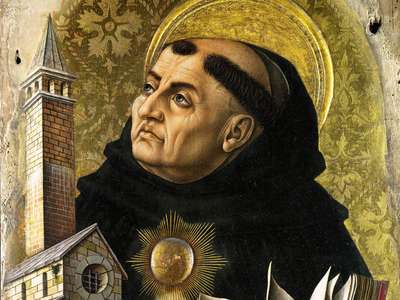
Nothing but You, Lord

In 1273, Thomas was seen by the sacristan Domenic of Caserta in intense prayer, crying and levitating, before an icon of the crucified Christ in the Chapel of Saint Nicholas at the Dominican convent of Naples. During this dramatic moment, Christ is said to have told Thomas, “You have written well of me, Thomas. What reward would you have for your labor?” In turn, Thomas responded, “Nothing but You, Lord.”

After this event, Thomas left his routine of writing his works. When asked why he stopped writing, Thomas replied, “I cannot go on. All that I have written seems to me like so much straw compared to what I have seen and what has been revealed to me.” His celebrated opus Summa Theologiae, his last and, unfortunately, uncompleted work, deals with the whole of Catholic theology. After a lingering illness, Thomas died on March 7, 1274. His remains were placed in the Church of the Jacobins in Toulouse on January 28, 1369. It is unknown who beatified Thomas. However, on July 18, 1323, Pope John XXII canonized him. His feast day is January 28.

Five Interesting Facts About St. Thomas Aquinas

  1. St. Thomas Aquinas was given the nickname “dumb ox” by his fellow students. This was because of his stout body and his shy and quiet demeanor.
  2. St. Thomas Aquinas was the mind behind the classic compositions Tantum Ergo and Panis Angelicus.
  3. In an attempt to seduce St. Thomas Aquinas, his brothers brought a prostitute into his cell. Instead of succumbing to her charms, Thomas wielded a burning stick and chased her away from the castle!
  4. It has been said that St. Thomas Aquinas had terrible handwriting, yet he managed to write a lot of books!
  5. St. Thomas Aquinas is the patron saint of students and all universities.

Prayer to St. Thomas Aquinas

O God, who made Saint Thomas Aquinas outstanding in his zeal for holiness and his study of sacred doctrine, grant us, we pray, that we may understand what he taught and imitate what he accomplished. Grant this through Christ, our Lord. Amen.

St. Theodosius the Cenobiarch

When They Lived:

St. Theodosius the Cenobiarch, also known as St. Theodosius the Great, lived during the late 4th century and into the early 5th century. He was born around 423 AD and passed away on January 11, 529 AD.

Where They Lived:

St. Theodosius the Cenobiarch lived in the Eastern Roman Empire, particularly in the region that is now known as modern-day Turkey. He is closely associated with the city of Cappadocia, which was a significant center of Christian monasticism during his time.

Notable World Events During the Time of Their Life:

  • Fall of the Western Roman Empire (476 AD): St. Theodosius lived during a time of great political upheaval. In 476 AD, the Western Roman Empire officially fell when Romulus Augustulus, the last Roman emperor of the west, was deposed by the Germanic chieftain Odoacer. This event marked the end of an era in Western Europe.
  • Reign of Byzantine Emperor Justinian I (527-565 AD): During the later years of St. Theodosius’ life, Emperor Justinian I ruled the Eastern Roman Empire. His reign is known for the reconquest of parts of the Western Roman Empire, the codification of Roman law (Corpus Juris Civilis), and the construction of the Hagia Sophia in Constantinople, a masterpiece of Byzantine architecture.
  • Life of St. Benedict of Nursia (480-547 AD): St. Theodosius’ lifetime coincided with that of another influential Christian figure, St. Benedict of Nursia. St. Benedict founded the Benedictine Order and wrote the Benedictine Rule, which greatly influenced monastic life in Western Christianity.
  • Development of Christian Monasticism: St. Theodosius lived in an era when Christian monasticism was flourishing. Monastic communities were growing across the Eastern Roman Empire, and St. Theodosius himself played a pivotal role in this movement by establishing the first coenobitic, or communal, monastery.

Their Patronage:

St. Theodosius the Cenobiarch is revered as the patron saint of monastic communities and those who seek a life of solitude, contemplation, and spiritual growth. His legacy is particularly significant in Eastern Orthodox Christianity, where he is celebrated for his contributions to the development of communal monasticism. St. Theodosius’ dedication to a life of prayer, asceticism, and the care of the poor continues to inspire individuals on their spiritual journeys today.

Early Life

Theodosius was born in 423 in Mogarissos, Cappadocia (which is now known as Turkey), within Saint Basil’s province. At a young age, he decided to follow in the footsteps of Abraham by dropping everything, including his friends, relatives, and even parents, to dedicate his life to God. He left for Jerusalem around 451, which was the same period when the Holy Fourth Ecumenical Council of Chalcedon assembled.

The moment he landed in Antioch, he searched for Saint Symeon the Stylite to request the saint’s blessings. At the Saint Symeon pillar, he was astonishingly called by his name and asked to climb the column. When Theodosius ascended the column and kneeled before Saint Symeon, the saint pulled him into an embrace. Saint Symeon blessed Theodosius and foretold that an amazing spiritual glory was coming to the young devotee’s life.

Call to Dedication and Devotion

While in Jerusalem, Theodosius visited and worshipped at the Holy Places. He decided to go into quiet solitude. However, to gain the discipline needed for that undertaking, he took up monastic activities near the Tower of David, under the guidance of hermit abbot Longinus. As time went on, he was appointed as the leader of a church located in the middle of Bethlehem and Jerusalem. However, he didn’t stay long there, as the distractions from his many admirers became overwhelming. Later, he moved to a cave on the mountain peak so he could truly seek God and be free from any earthly distractions.St. Theodosius the Cenobiarch leaving the city for a life of solitude

Legacy

Theodosius the Cenobiarch founded a small society of monks, which eventually developed into the St. Theodosius Monastery. This monk society swiftly expanded to include monks from numerous cultures as well as languages such as Armenian and Greek.

The monks became renowned for their venerable work and kindness to the elderly, the mentally ill, and the physically sick.

Saint Theodosius was known for his generous spirit and kind heart. He constantly provided food for multitudes of the poor and needy. He trusted in God to continually provide and never sent travelers away, even in times when the food was barely enough.

Theodosius was chosen to lead the monks in the community right after his friend, Sabbas, was appointed by Patriarch Salustius of Jerusalem as the archimandrite of the monks isolated in Palestine.

The title “the Cenobiarch” which means “chief of those living a life in common”, is a testament to his leadership of the monk community. In addition, he is known as the monk who introduced the cenobitic way into monasticism.

Theodosius was known for his opposition to heresies such as Monophysitism and Eutychianism. This led to him being offered a huge bribe by Emperor Anastasius, a proponent of Eutychianism, in hopes of luring the saint to his cause. Instead, Saint Theodosius used the money to take care of the poor. He also persisted with his anti-heresy preaching. Due to these reasons, Anastasius dismissed Theodosius from his role as leader of the monks. However, when emperor Justinian took over power, he reinstated Theodosius.

Death

St. Theodosius the Cenobiarch passed away at nearly 105 years of age in Palestine. His remains are interred in the first place he ever resided as a monk.

Feast Day

The feast day of St. Theodosius is celebrated on the 11th of January.

5 Interesting Facts About St. Theodosius the Cenobiarch

  • Did you know Saint Theodosius was his mother’s spiritual father?
  • It is said that the cave where Saint Theodosius lived as a hermit was the same one the three Magi stayed in on the night God sent an angel to them.
  • Did you know Saint Theodosius is the patron saint of file makers?
  • Did you know St. Theodosius did not eat bread for thirty years? He only ate wild vegetables, dates, and legumes.
  • Did you know that to stop himself from falling asleep while praying in the cave on the mountain, Theodosius tied himself to a rope hanging from the cave roof?

Prayer to St. Theodosius the Cenobiarch

None.

St. Teresa of Avila

When they lived:

St. Teresa of Avila, also known as St. Teresa of Jesus, lived during the 16th century. She was born on March 28, 1515, and she passed away on October 4, 1582.

Where they lived:

St. Teresa of Avila lived primarily in Spain. She was born in Gotarrendura, a small village in the province of Ávila, and spent much of her life in the region of Castile, Spain. She is closely associated with the town of Ávila itself, where she founded several convents and monasteries.

Notable world events during the time of their life:

  • Protestant Reformation (16th century): St. Teresa of Avila lived during a time of religious upheaval in Europe. The Protestant Reformation, initiated by figures like Martin Luther and John Calvin, was challenging the authority of the Catholic Church and leading to significant religious and political changes.
  • Exploration and the Age of Discovery: The 16th century was an era of exploration and discovery. This period saw the voyages of explorers such as Christopher Columbus, Ferdinand Magellan, and Hernán Cortés, who opened up new trade routes and expanded European influence around the world.
  • Scientific Revolution: The Scientific Revolution was beginning to take shape during St. Teresa’s lifetime. Figures like Nicolaus Copernicus and Galileo Galilei were challenging traditional views of the cosmos, leading to a fundamental shift in our understanding of the universe.
  • Spanish Inquisition: St. Teresa of Avila lived during a time when the Spanish Inquisition was active. This institution aimed to maintain Catholic orthodoxy and suppress heresy, leading to significant social and religious tensions in Spain.
  • Elizabethan Era in England: In England, during St. Teresa’s lifetime, Queen Elizabeth I was reigning. Her rule was marked by a significant cultural flowering, including the works of William Shakespeare and the expansion of the British Empire.
  • Battle of Lepanto (1571): One of the significant military events during her lifetime was the Battle of Lepanto, a naval battle between the Holy League, led by the Papal States and Spain, and the Ottoman Empire. It was a pivotal moment in the ongoing conflict between Christian and Islamic powers in the Mediterranean.

Their patronage:

St. Teresa of Avila is the patron saint of many groups and causes, making her a figure of diverse influence:

  • Patroness of Spain: St. Teresa is considered one of Spain’s greatest saints and a symbol of Spanish spirituality.
  • Patroness of Catholic Writers: She is the patron saint of writers and theologians, thanks to her own extensive writings on spirituality and mysticism.
  • Patroness of Headache Sufferers: Interestingly, she is also invoked by those suffering from headaches, as it is believed that she herself experienced severe migraines.
  • Patroness of the Sick: Due to her own health struggles, St. Teresa is often sought after by those who are ill or facing physical ailments.
  • Patroness of Lace Workers: This unique patronage is attributed to a story where she lost a book, and a vision of an angel presented it to her with a beautiful piece of lace.

St. Teresa’s life was marked by spiritual fervor, mysticism, and a profound dedication to reforming the Carmelite order. Her writings, including “The Interior Castle” and “The Way of Perfection,” continue to be studied and revered today for their insights into Christian spirituality and mysticism.

Inspired by the martyrs

Teresa de Cepeda y Ahumada was born in Avila, Spain, on March 28, 1515. In her autobiography, she mentions some details of her childhood. Her parents were pious Catholics, which to some degree inspired Teresa to take up a life of prayer. She had three sisters and nine brothers.

As a young child, Teresa showed signs of a deeply religious nature. She would often retreat into silence and spend time praying. She enjoyed giving alms to the poor. However, when she was a teenager, Teresa’s mother, who was very close to her, died, leaving her distraught at the void she left. The young Teresa tells of her despair and how she turned to the Virgin Mary, seeking comfort.

When she was still a child, Teresa often read about the lives of martyrs. This inspired her to long for martyrdom. A few years later, she would speak of her childhood reading and state that she had discovered in it the way of truth, which she summed up in two important principles: “all things of this world will pass away” and that God alone is “for ever, ever, ever”. She was taught by the Augustinian nuns of Santa Maria de las Gracias de Avila. With their instruction and her reading of spiritual books, especially the classics of Franciscan spirituality, Teresa was introduced to recollection and prayer.

Reforming the Carmelite Order

When she was twenty years old, Teresa entered the Carmelite Monastery of the Incarnation in Avila. As a Carmelite, she took the name Teresa of Jesus. Three years later, she fell seriously ill. She was so ill that she remained comatose for four days, looking as if she were already dead. In 1543, she lost the closeness of her relatives. Her father died, and all her siblings, one after another, left for America. During Lent of 1554, when she was 39 years old, Teresa reached the apex of her struggle against her own weakness. Her fortuitous discovery of the statue of Christ most grievously wounded left a deep mark on her life.

At the age of 43, Teresa decided she wanted to found a new order, recommitting to the values of poverty and simplicity. She began to realize her ideal of the reform of the Carmelite Order. In 1562, she founded the first reformed Carmel in Avila with the approval and support of Don Alvaro de Mendoza, the city’s bishop. Shortly afterwards, Teresa’s reforms also received approval from the Superior General of the Order, John Baptist Rosi.

In the succeeding years, Teresa continued her work of founding new Carmelite convents. Under her guidance, seventeen new convents were established. Her encounter with John of the Cross was fundamental. In 1568, Teresa and John of the Cross set up the first convent of Discalced Carmelites in Duruelo, near Avila. In 1580, she obtained authorization from Rome for her reformed Carmels to be a separate and autonomous province. This was the beginning of the Discalced Carmelite Order.

Teresa’s earthly life came to an end while she was in the middle of her founding activities. She died on the night of October 15, 1582, in Alba de Tormes, after setting up the Carmelite Convent in Burgos while on her way back to Avila. Her last humble words were: “After all, I die as a child of the Church”, and “O my Lord and my spouse, the hour that I have longed for has come. It is time to meet one another”. She was beatified by Pope Paul V in 1614 and canonized by Gregory XV in 1622. Her feast day is October 15.

Five Interesting Facts About St. Teresa of Avila

  • St. Teresa of Avila wrote her autobiography, Way of Perfection, and Interior Castle. Her works contain some of the most profound insights into the spiritual life ever written.
  • Pope Paul VI proclaimed St. Teresa of Avila a Doctor of the Church in 1970. She was one of the four women Doctors of the Church (St. Therese of Lisieux, St. Catherine of Siena, and St. Hildegard of Bingen).
  • St. Teresa of Avila is the patron saint of headaches. On many occasions in her writings, she expressed the terrible migraines she experienced.
  • St. Teresa of Avila is also the patroness of Spain and the patron saint of lacemakers.
  • One of St. Teresa of Avila’s known miracles was the healing of her injured nephew. She performed a miracle after part of a building fell on the boy.

Prayer to St. Teresa of Avila

O God, who through your Spirit raised up Saint Teresa of Jesus to show the Church the way to seek perfection, grant that we may always be nourished by the food of her heavenly teaching and fired with longing for true holiness. Through our Lord Jesus Christ, your Son, who lives and reigns with you in the unity of the Holy Spirit, one God, for ever and ever Amen.

St. Simon the Zealot

When they lived: St. Simon the Zealot is believed to have lived during the 1st century AD.

Where they lived: Simon’s origins are somewhat shrouded in mystery, but he is often associated with the region of Cana in Galilee, hence his alternate name “Simon the Canaanite.”

Notable world events during the time of their life:

  • The Roman Empire: During Simon’s lifetime, the Roman Empire was at its zenith, influencing the political and cultural landscape.
  • The Life of Jesus Christ: Simon’s calling by Jesus marked the beginning of his journey as one of Christ’s apostles.
  • The Jewish-Roman Wars: The 1st century witnessed conflicts like the Great Jewish Revolt and the destruction of the Second Temple in Jerusalem.
  • Scientific Progress: While not widely documented in relation to Simon, this era saw advancements in fields like astronomy and medicine.
  • Cultural Diversity: Galilee, where Simon is associated, was a melting pot of cultures, contributing to the diversity of ideas and beliefs.
  • Trade and Commerce: The 1st century saw flourishing trade along the Silk Road and the Mediterranean, shaping the world in which Simon lived.

Their patronage: St. Simon the Zealot is often considered the patron saint of curriers and tanners, symbolizing personal transformation and the enduring impact of faith.

Chosen to be Christ’s Apostles

After spending a whole night in prayer, the Lord Jesus Christ chose twelve men who were called Apostles. He chose rather unlikely candidates (Jesus could have chosen the best and the wisest!) who would be His Apostles and to proclaim the Kingdom of God to all peoples. Most of us knew the “more popular” Apostles like Peter, John, Matthew, Thomas and even Judas Iscariot. If there are more known Apostles, then there are also least known Apostles. Two of these are Sts. Simon and Jude.

Simon and Jude were ordinary men who were chosen by Jesus Himself to proclaim the Good News and to “make disciples of all nations” (Matthew 28:19). Their names appear in the list of Apostles in Matthew 10:2-4, Mark 3:16-19, Luke 6:14-16 and Acts 1:13. Simon and Jude, unlike the other Apostles, had little “exposures” in the Gospels, which makes it quite difficult to know some details of their life.

Closest to Jesus

However, with their almost incognito identity in the Gospels, it is ironic that these two were actually among the closest to Jesus. Both Simon and Jude were cousins of Jesus! Tradition is quite sure of it as regards Jude Thaddaeus, since Cleopas, his father, was the brother of Joseph, the foster father of Jesus. His mother, Mary of Cleopas, was a cousin of the Virgin Mary. As for Simon, things are shrouded in mystery. Many identify in Simon the homonymous cousin of Christ, brother of James the Lesser.

Called by Other Names

Simon and Jude were known by other names during their lives. Simon was called “the Zealot” or “Zelotes”. The Zealots were a violent political party of strict adherence to the Torah and were concerned for the national and religious life of the Jews, which unfortunately led them to despise even their fellow Jews who sought conciliation and peace with the Roman authorities. As a member of the Zealot party, Simon believed in the importance of people adhering to Jewish law. However, his encounter with Jesus changed his life. He became convinced that the most important thing was to follow Jesus and his teachings. Moreover, another reason Simon had a nickname was to keep people from confusing him with the other Simon, who was called Peter by Jesus.

On the other hand, Matthew and Mark call Jude simply “Thaddaeus” (Matthew 10: 3; Mark 3: 18), while Luke calls him “Judas, the son of James” (Luke 6: 16; Acts 1: 13). Jude was named Jude Thaddaeus or Judas Thaddaeus. Just like the reason for avoiding confusion, this title was used to distinguish him from the other Apostle Judas who betrayed Jesus. The only recorded statement of Jude Thaddaeus was during the Last Supper Discourses of Jesus, when he asked “Master, [then] what happened that you will reveal yourself to us and not to the world?” (John 14:22).

Partners in Mission

After the Pentecost, the Apostles dispersed from Jerusalem to proclaim the Gospel in other places. Jude Thaddaeus departed from Galilee and Samaria and went to Syria, Armenia and Persia. Authoritative sources claim that in this area, he met Simon and became partners in the mission. Because of their eyewitness accounts of the life and ministry of Jesus, their missionary activity won many converts.

Their proclamation won many believers, as well as enemies. They were arrested and taken to the Temple of the Sun. There, they were made to renounce Christ by worshipping the goddess Diana. Jude Thaddaeus, in refusing to deny Christ, declared that idols were false gods. It was said that two demons came out of the temple and destroyed him. Overwhelmed by fright, the people who witnessed this are said to have pounced viciously on the two Apostles and were brutally killed. These holy men have their feast day on October 28.

Five Interesting Facts About St. Simon the Zealot and Jude Thaddaeus

  • St. Jude Thaddaeus is the patron saint of desperate cases and lost causes.
  • St. Simon the Zealot is the patron saint of couriers, tanners, woodcutters and sawyers.
  • The nickname “Thaddaeus” is of uncertain origin and is explained either as coming from the Aramaic, taddà’, which means “breast” and would therefore suggest “magnanimous”.
  • The Gospels according to Matthew and Mark describe St. Simon as a “Cananaean”.
  • According to the apocryphal Acts of Simon and Judas, St. Simon was martyred by being cut in half with a saw.

Prayer to St. Simon the Zealot

O God, who by the blessed Apostleshave brought us to acknowledge your name,graciously grant,through the intercession of Saint Simon,that the Church may constantly growby increase of the peoples who believe in you.Through our Lord Jesus Christ, your Son,who lives and reigns with you in the unity of the Holy Spirit,one God, for ever and ever. Amen.

St. Simon Stock

When they lived:

St. Simon Stock is believed to have lived in the 12th and 13th centuries.

Where they lived:

St. Simon Stock is most famously associated with the town of Aylesford in Kent, England. He is believed to have spent a significant portion of his life as a hermit in the nearby wilderness of Mount Carmel in the Holy Land.

Notable world events during the time of their life:

  • The Third Crusade (1189-1192): St. Simon Stock lived during the tumultuous era of the Crusades. The Third Crusade, which aimed to recapture Jerusalem from Saladin, was a significant international event during his time. This event had far-reaching political and religious consequences.
  • Magna Carta (1215): St. Simon Stock’s life overlapped with the sealing of the Magna Carta, a foundational document in the development of constitutional and legal principles. Although this event primarily affected England, its principles would later influence legal systems worldwide.
  • The University of Paris (Founded in 1150): During St. Simon Stock’s lifetime, the University of Paris, one of the earliest and most influential universities in Europe, was flourishing. This institution played a pivotal role in the spread of knowledge and the development of medieval education.
  • Invention of the Magnetic Compass (12th Century): The 12th century saw the invention and widespread use of the magnetic compass for navigation. This technological advancement greatly influenced exploration and trade during St. Simon Stock’s era.

Patronage:

St. Simon Stock is most famously known as the patron saint of the Carmelite Order. His vision of the Virgin Mary and the scapular, a piece of clothing worn as a devotional object, is central to his patronage. He is also the patron saint of several towns, including Aylesford in England and Bordeaux in France.

When they lived:

St. Simon Stock is believed to have lived in the 12th and 13th centuries.

Where they lived:

St. Simon Stock is most famously associated with the town of Aylesford in Kent, England. He is believed to have spent a significant portion of his life as a hermit in the nearby wilderness of Mount Carmel in the Holy Land.

Notable world events during the time of their life:

  • The Third Crusade (1189-1192): St. Simon Stock lived during the tumultuous era of the Crusades. The Third Crusade, which aimed to recapture Jerusalem from Saladin, was a significant international event during his time. This event had far-reaching political and religious consequences.
  • Magna Carta (1215): St. Simon Stock’s life overlapped with the sealing of the Magna Carta, a foundational document in the development of constitutional and legal principles. Although this event primarily affected England, its principles would later influence legal systems worldwide.
  • The University of Paris (Founded in 1150): During St. Simon Stock’s lifetime, the University of Paris, one of the earliest and most influential universities in Europe, was flourishing. This institution played a pivotal role in the spread of knowledge and the development of medieval education.
  • Invention of the Magnetic Compass (12th Century): The 12th century saw the invention and widespread use of the magnetic compass for navigation. This technological advancement greatly influenced exploration and trade during St. Simon Stock’s era.

Patronage:

St. Simon Stock is most famously known as the patron saint of the Carmelite Order. His vision of the Virgin Mary and the scapular, a piece of clothing worn as a devotional object, is central to his patronage. He is also the patron saint of several towns, including Aylesford in England and Bordeaux in France.

St. Simon Stock’s life is a fascinating blend of religious devotion and historical context. His vision of the Virgin Mary and the scapular is a significant aspect of Catholic tradition, while the events of his time, such as the Crusades and the emergence of universities, add depth to his historical significance. This combination of spirituality and the broader historical landscape makes his story an intriguing subject for exploration.

St. Sabas was a monk and priest who was born in 439 AD and is known for his contributions to the early Christian monastic movement. He is also known by his Greek name, Saint Sabbas the Sanctified, and is venerated as a saint in the Eastern Orthodox Church. In this article, we will explore the life of St. Sabas and his impact on the development of monasticism.

Early Life

St. Sabas was a monk and priest who was born in 439 AD and is known for his contributions to the early Christian monastic movement. He is also known by his Greek name, Saint Sabbas the Sanctified, and is venerated as a saint in the Eastern Orthodox Church. In this article, we will explore the life of St. Sabas and his impact on the development of monasticism.

Founding of the Mar Saba Monastery

In 483 AD, St. Sabas founded the Mar Saba Monastery, which was located in the Kidron Valley near Jerusalem. The monastery was built on a site that had been used for hermitages for centuries, and it quickly became an important center of monastic life. St. Sabas is credited with establishing a strict set of rules for the monastery, which were based on the principles of prayer, hard work, and self-denial.

Contributions to Monasticism

St. Sabas is known for his contributions to the development of monasticism, which is the practice of living a solitary life devoted to religious practices such as prayer and contemplation. He is considered one of the “fathers” of Eastern monasticism, along with St. Anthony the Great and St. Pachomius.

St. Sabas is also known for his efforts to reform and revitalize monasticism in Palestine, which had become lax and corrupt. He was a strong advocate for the solitary life of the hermit, and he encouraged monks to live in small, isolated communities rather than in large, urban monasteries. He believed that this type of monasticism was more conducive to a life of prayer and contemplation.St. Simon Stock praying in the monastary

Later Life and Legacy

St. Sabas spent the latter part of his life traveling throughout Palestine and the surrounding region, preaching and establishing monasteries. He is said to have visited many of the holy places in Palestine, including Bethlehem, the Jordan River, and the Mount of Olives.

St. Sabas died in 532 AD at the age of 93. He was canonized as a saint by the Eastern Orthodox Church, and his feast day is celebrated on December 5th.

Today, the Mar Saba Monastery still stands and is considered one of the oldest and most important monasteries in the world. It is a popular site for pilgrims and tourists, and it continues to be a center of monastic life.

Conclusion

St. Sabas was a monk and priest who is known for his contributions to the early Christian monastic movement. He is considered one of the “fathers” of Eastern monasticism, and he is credited with founding the Mar Saba Monastery, which is one of the oldest and most important monasteries in the world. His legacy continues to be celebrated in the Eastern Orthodox Church, and his teachings continue to inspire monastic communities today.