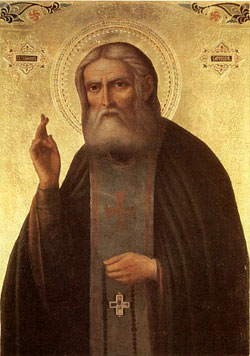
St. Seraphim of Sarov

When they lived:

St. Seraphim of Sarov, also known as Seraphim Sarovsky, lived from July 30, 1754, to January 14, 1833. His life spanned the latter part of the 18th century and the early 19th century.

Where they lived:

St. Seraphim of Sarov primarily lived in the Sarov Monastery, located in the Tambov region of Russia. This monastery, nestled in a dense forest, became his spiritual haven and the center of his ascetic life.

Notable world events during the time of their life:

  • American Revolution (1775-1783): While St. Seraphim lived far from the American colonies, the American Revolution had a significant impact on global politics and set the stage for the emergence of the United States as a world power.
  • French Revolution (1789-1799): The French Revolution, with its radical political and social upheavals, unfolded during St. Seraphim’s lifetime. This event marked a turning point in European history, influencing not only France but the entire continent.
  • Napoleonic Wars (1803-1815): St. Seraphim lived through the tumultuous era of the Napoleonic Wars. These conflicts reshaped the map of Europe and had a profound impact on Russia, where the Sarov Monastery was situated.
  • Industrial Revolution (late 18th to early 19th century): The Industrial Revolution transformed economies and societies across the Western world, ushering in a new era of technological progress and urbanization. This global shift had far-reaching consequences for humanity.
  • First Steam-Powered Locomotive (1804): During St. Seraphim’s lifetime, Richard Trevithick, a British engineer, built the first full-scale working steam locomotive. This innovation revolutionized transportation and played a pivotal role in the Industrial Revolution.
  • Publication of the Brothers Grimm Fairy Tales (1812): In 1812, the Brothers Grimm, Jacob and Wilhelm, published their famous collection of fairy tales. These stories continue to captivate readers worldwide and have left an enduring cultural legacy.
  • Simón Bolívar’s Liberation Movements (early 19th century): Simón Bolívar, known as “The Liberator,” was leading the struggle for independence in several South American countries during St. Seraphim’s lifetime. His efforts had a profound impact on the map of South America, leading to the creation of new nations.

Their patronage:

  • Spiritual Enlightenment: St. Seraphim is revered for his deep spirituality and the teachings he imparted. He is a patron saint for those seeking spiritual growth and enlightenment.
  • Reconciliation and Unity: St. Seraphim encouraged reconciliation and unity among people. He is often invoked by those seeking to mend relationships and promote harmony.
  • Mental and Emotional Health: Many turn to St. Seraphim for solace and healing of mental and emotional ailments. His life story, marked by a long period of isolation and prayer, offers inspiration to those facing mental struggles.
  • Nature and Conservation: Given his connection to the wilderness of Sarov, St. Seraphim is also considered a patron of nature and environmental conservation. People pray to him for the protection of the natural world.
  • Monastic Life: St. Seraphim’s life as a hermit and his dedication to monasticism make him a patron saint for monks, nuns, and those seeking a life of devotion and simplicity.

A Miracle Child

He was born on July 19, 1759 (some records say 1754), and he got baptized with the name Prokhor Moshnin by Isidore and Agathaia Moshnin in Kursk, Russian Empire. Just an ordinary boy, his father, Isidore, was a merchant.

History has it that when St. Seraphim was seven, he fell from the bell tower of the Kursk cathedral (about 3/4 stories tall), but contrary to expectations, he was unharmed. When he became gravely ill at the age of nine, Seraphim received a cure from the icon of the Blessed Virgin Mary. He would later experience some visions.

Seraphim was 19 in 1777 when he joined the Sarov monastery as a novice. In 1786, he took his monastic vows and took the religious name Seraphim. A year later, he became a deacon, and by 1793, Seraphim was ordained a priest at 34.

After his ordination as a priest, Seraphim took to the woods.

Life in Solitude and Confinement

Seraphim lived as a hermit (someone living separately from society for religious reasons) in a small hut in the woods for 25 years. He led an extreme ascetic life in the woods. It is stated that he only ate bread from the monastery and vegetables. At one time, he was said to have eaten only grass for three years.

While chopping wood one day, Seraphim was attacked by a gang of thieves hoping to steal money from him. Unfortunately, they found nothing of value with him except the icon of the Virgin Mary. They severely beat him up and left him dead.

Seraphim spent five months recovering in the monastery, after which he returned to the woods. He remained hunched for the rest of his life.

Devotion as a Way of Life

For every day he lived, St. Seraphim only sought a life of intense and personal devotion to God. He’s attributed to wearing peasant clothing, a crucifix around his neck, and having his hands over his chest.

Perhaps one of his most remarkable devotions, deemed a miracle by the Eastern Orthodox Church, was when he spent 1000 consecutive nights and days on a rock, kneeling with his hands upraised in prayer.

It is worth mentioning that, while in solitude, St. Seraphim welcomed everyone who visited him. Be it a man, woman, child, or animal.

In 1815, after a spiritual encounter he attributed to the blessed virgin Mary, seraphim returned to the monastery to help the pilgrims.

Notable Quotes of St. Seraphim

When St. Seraphim returned to the monastery, he taught the people about the life of prayer and meditation. Every pilgrim who met with him always left in joy, filled with the hope of the resurrection of Christ.

St.Seraphim served as a confessor to many of the faithful and pilgrims. Blessed with the gifts of healing and prophecy, a large number of people were drawn to him.

Let’s take a look at some of St. Seraphim’s quotes from his many teachings.

“Acquire a peaceful spirit, and around you, thousands will be saved.”

“A sign of spiritual life is the immersion of a person within himself and the hidden workings within his heart.”

“Those who have truly decided to serve the Lord God should practice the remembrance of God and uninterrupted prayer to Jesus Christ, mentally saying, Lord Jesus Christ, son of God, have mercy on me, a sinner.”

“Bear sorrows for the sake of the heavenly kingdom. Without sorrow, there is no salvation. The kingdom of God awaits those who have patiently endured. And all the glory of the world is nothing in comparison.”

“It is necessary that the Holy Spirit enter our hearts. Everything good that we do and do for Christ is given to us by the Holy Spirit, but prayer most of all, which is always available to us,

On Sin and Forgiveness, St. Seraphim has this to say: “The Lord sometimes allows people who are devoted to him to fall into such dreadful vices, and thus to prevent them from falling into a still greater sin, pride. Your temptations will pass, and you will spend the remaining days of your life in humility. Only do not forget your sin”.

The Journey to Glory

St. Seraphim died on January 14, 1833. He was canonized by the Russian Orthodox Church in 1903. Pope John Paul II, following his reverence in the Catholic Church, called him a saint.

References:[http://ww1.antiochian.org/learning-about-saint-st-seraphim-sarov]{.ul}

[St. Seraphim of Sarov on OrthodoxWiki] {.ul}

5 Interesting Facts About Saint Seraphim

  • He called everyone who came to him “My Joy” and greeted anyone
    He met with “Christ is Risen”.
  • He lived, taught, and preached forgiveness. How do we know this? When
    The thieves who attacked him were arrested, and St. Seraphim pleaded to
    the judge for mercy on their behalf.
  • Are you aware that St.Seraphim is a mystic? He was reputed to
    discern the thoughts and problems of people who visited him before
    They voiced out words.
  • A Saint with the desire to share with people the inner glory of God.
    He’s on record as being the first priest or monk to have taught lay
    people the traditional monastic method of contemplation, self-
    denial and prayer.
  • Strange as it sounds, St. Seraphim is known as the Patron Saint of
    Russia’s Nuclear weapons

Prayer to Saint Seraphim

O great Saint of God, our venerable and God-bearing Father, Seraphim! Look down from the glory that is above upon us, who are humble and weak, burdened with our many sins, and ask for your help and consolation. Bend down to us in thy loving kindness and help us to carry out God’s commandments without stain, firmly to keep the Catholic Faith, to approach God in heartfelt confession for all our sins, to make progress in Christian devotion, and to be worthy of thy prayers before God. Yea, O Saint of God, hearken unto us, who pray to thee in faith and love, and despise us not who seek thee as our defender:now, and at the hour of our departure, help us and defend us by thy prayers from the wicked assaults of the devil, lest evil powers should have dominion over us; but let us be granted, by thy help, to inherit the bliss of heavenly mansions. For we place our hope in thee, O kind-hearted father:be thou indeed our guide to salvation, and bring us to the unwaning light of eternal life, by thy good intercession before the throne of the Most Holy Trinity, so that we may glorify and hymn with all the Saints, the name worthy of adoration, of the Father, and of the Son, and of the Holy Spirit, for ages of ages. Amen.

source:[https://www.orthodox.net/trebnic/to-seraphim-of-sarov.html]{.ul}
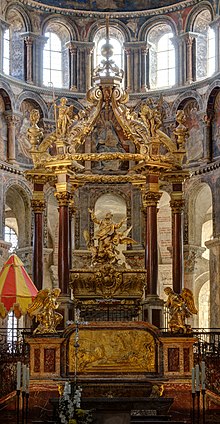
St. Saturninus

When they lived:

Saint Saturninus is believed to have lived during the 3rd century, precisely in the 3rd and 4th decades AD, in the city of Toulouse, which is now in modern-day France.

Where they lived:

Saint Saturninus spent the majority of his life in Toulouse, a bustling Roman city located in the southern part of France. During his time, Toulouse was known for its vibrant culture and was an essential center for trade and commerce in the region.

Notable world events during the time of their life:

  • Diocletian’s Persecution (303-311 AD): Saint Saturninus lived during the height of the Diocletianic Persecution, one of the most severe and widespread persecutions of Christians in the Roman Empire. This event had a profound impact on the early Christian community and likely influenced Saint Saturninus’ own life and mission.
  • Roman Empire Division (284-395 AD): The Roman Empire underwent significant political changes during Saint Saturninus’ time, with the empire being divided into the Eastern and Western Roman Empires. This division had far-reaching consequences for the spread of Christianity and the role of bishops like Saint Saturninus.
  • Galen’s Medical Contributions (2nd century AD): Though Galen lived before Saint Saturninus, his medical teachings and discoveries greatly influenced the state of medicine during this era. This scientific progress would have indirectly affected the health and well-being of people in Toulouse, including the early Christians whom Saint Saturninus ministered to.
  • Spread of Christianity: Saint Saturninus lived during a period when Christianity was rapidly spreading throughout the Roman Empire. His own missionary work in Toulouse contributed to the growth of the Christian faith in the region, making it a notable event in the context of early Christian history.

Their patronage:

Saint Saturninus is the patron saint of Toulouse, France, and his story is deeply interwoven with the city’s history and culture. He is also the patron saint of vineyards, celebrating the rich tradition of winemaking in the region. Saint Saturninus’ association with vineyards and wine can be quite intriguing, as it connects the spiritual and cultural aspects of life in Toulouse.

The Early Life of St. Saturninus

According to the lost acts of the saint, he was the son of Aegeus, King of Achaea, and Cassandra. His birth was in Patras, Greece, around the 3rd century.

Much isn’t known about his childhood, but he was clearly from a royal lineage as his father was a king, and his mother before marriage was the daughter of Ptolemy, King of the Ninevites.

Bishopric of St. Saturninus

St. Saturninus was one of the seven bishops sent out by St. Fabian at a time when persecutions of Christians were very high and the small Christian communities had all but dissolved.

Assumed to be the first bishop of Toulouse, St. Saturninus soon arrived in Toulouse, where he was able to build a small church community. His church community was located some distance from where the pagan priests worshipped and received oracular messages.

It is recorded that his presence there caused the pagan gods to be upset, so the priests no longer received messages from them.

Works of St. Saturninus

The only records of his works are the lost acts of Saturninus. But while he served as a bishop, he was able to convert many pagans, including the farmer who joined him as a missionary, known as St. Honestus.

He also served as a missionary to Gaul, the Pyrenees, and the Iberian Peninsula. St. Saturninus teamed with St. Martial, and together, they were able to perform many miracles, healing different diseases and ailments.

It was St. Saturninus who converted and baptized St. Firminus of Amiens.

Records also have it that he and his group were once arrested and imprisoned in Carcassonne by the prefect, Rufinus, and were miraculously freed by an angel.

Death and Canonization of St. Saturninus

St. Saturninus died as a martyr sometime in 257 A.D. His martyrdom was because he refused to make a sacrifice to the pagan gods. The pagan priests accused him of being responsible for the silence of their gods and thought it a good punishment for him to make a sacrifice to them.

He vehemently refused, saying he worshipped the only true God. To this end, he was insulted greatly and tied to the feet of a bull. The saint was dragged down a steep hill by the bull so roughly that his skull got broken and his brains gushed out, while his remains were strewn all over.

His remains would later be picked up by two devout Christian women and buried in a ditch. His successors would later give him a proper burial and build a church at the point where the bull stopped, called “The Taur” (bull).

His canonization was by pre-congregation, and his feast day is on the 29th of November. He is greatly patronized by Toulouse and France. He is also the patron saint of bullfighters.

He is also protected against ants and diseases such as mad cow disease,smallpox, syphilis, anxiety, and fraud.

When next you see a picture of a bishop being dragged by a bull, or a bishop with a bull at his feet,

If you see a bull with a cross and a mitre, then you are most likely looking at the picture of St. Saturninus.

5 Interesting Facts About St. Saturninus

  • St. Saturninus was a prince by birth, as both his parents were of
    royal lineage.
  • He was among the 72 disciples who worked with Christ.
  • St. Saturninus was also present at the last supper with the other
    disciples.
  • He was consecrated as a bishop by St. Peter, the first pope of the
    church.
  • He and his companions were freed from imprisonment by an angel.

Prayer to St. Saturninus

O God, Who grantest us to be gladdened by the Heavenly birthday of blessed Satruninus, Thy Martyr,vouchsafe that we may be helped by his merits. Through our Lord Jesus Christ, Thy Son,Who liveth and reigneth with Theein the unity of the Holy Ghost,one God, world without end Amen.

[https://www.catholicdoors.com/prayers/english4/p02821.htm]{.ul}

St. Sabas

When they lived:

St. Sabas, also known as Saint Sabbas or Sabas the Sanctified, lived during the late 5th century and into the early 6th century. He was born in 439 AD and passed away in 532 AD.

Where they lived:

St. Sabas spent the majority of his life in the Judean Desert, which is located in the eastern part of the Holy Land, near Jerusalem. He was closely associated with the Mar Saba Monastery, one of the oldest active monasteries in the world, situated in the Kidron Valley.

Notable world events during the time of their life:

  • The Fall of the Western Roman Empire (476 AD): This marked a significant transition in the history of Europe.
  • The Council of Chalcedon (451 AD): A major ecumenical council of the Christian Church.
  • The Life of St. Benedict (c. 480–547 AD): St. Benedict founded the Benedictine Order.
  • The Byzantine-Persian War (502–506 AD): A time of conflict in the Eastern Mediterranean.
  • The Birth of Boethius (c. 480–524 AD): A Roman philosopher and statesman.
  • The Academy of Gondishapur (c. 3rd–7th century AD): A center for learning and translation of Greek and Roman texts in the East.
  • The Plague of Justinian (541–542 AD): A pandemic with a profound impact on the Eastern Roman Empire.

Their patronage:

St. Sabas is the patron saint of monasticism, monks, and hermits. He is revered for his ascetic lifestyle, commitment to prayer and meditation, and his role in the development of monasticism in the Eastern Orthodox tradition. St. Sabas’ life and teachings continue to inspire those who seek spiritual growth and a deeper connection with their faith through solitude and contemplation.

Early Life

Little is known about the early life of St. Sabas. He was born in Cappadocia, which is a region in modern-day Turkey, and was raised in a Christian family. At a young age, he became a monk and dedicated his life to God.

Founding of the Mar Saba Monastery

In 483 AD, St. Sabas founded the Mar Saba Monastery, which was located in the Kidron Valley near Jerusalem. The monastery was built on a site that had been used for hermitages for centuries, and it quickly became an important center of monastic life. St. Sabas is credited with establishing a strict set of rules for the monastery, which were based on the principles of prayer, hard work, and self-denial.

Contributions to Monasticism

St. Sabas is known for his contributions to the development of monasticism, which is the practice of living a solitary life devoted to religious practices such as prayer and contemplation. He is considered one of the “fathers” of Eastern monasticism, along with St. Anthony the Great and St. Pachomius.

St. Sabas is also known for his efforts to reform and revitalize monasticism in Palestine, which had become lax and corrupt. He was a strong advocate for the solitary life of the hermit, and he encouraged monks to live in small, isolated communities rather than in large, urban monasteries. He believed that this type of monasticism was more conducive to a life of prayer and contemplation.

Later Life and Legacy

St. Sabas spent the latter part of his life traveling throughout Palestine and the surrounding region, preaching and establishing monasteries. He is said to have visited many of the holy places in Palestine, including Bethlehem, the Jordan River, and the Mount of Olives.

St. Sabas died in 532 AD at the age of 93. He was canonized as a saint by the Eastern Orthodox Church, and his feast day is celebrated on December 5th.

Today, the Mar Saba Monastery still stands and is considered one of the oldest and most important monasteries in the world. It is a popular site for pilgrims and tourists, and it continues to be a center of monastic life.

Conclusion

St. Sabas was a monk and priest who is known for his contributions to the early Christian monastic movement. He is considered one of the “fathers” of Eastern monasticism, and he is credited with founding the Mar Saba Monastery, which is one of the oldest and most important monasteries in the world. His legacy continues to be celebrated in the Eastern Orthodox Church, and his teachings continue to inspire monastic communities today.

St. Rupert

When they lived:

St. Rupert, also known as Saint Rupert of Salzburg, lived during the late 7th and early 8th centuries. He was born around 660 AD and passed away in 710 AD.

Where they lived:

St. Rupert’s life was primarily centered around the region of Bavaria, which is now part of modern-day Germany and Austria. He is best known for his missionary work in the Bavarian region and the establishment of the city of Salzburg, which would later become a prominent ecclesiastical center.

Notable world events during the time of their life:

  • Spread of Christianity in Europe: St. Rupert’s life unfolded during a crucial period in European history when Christianity was rapidly spreading across the continent. The conversion of pagan tribes in Bavaria was a significant event during his lifetime, and St. Rupert played a pivotal role in this process.
  • Islamic Expansion: The 7th and 8th centuries were marked by the Islamic expansion into Europe. Events such as the Umayyad Caliphate’s conquest of Spain and the establishment of Muslim rule in the Iberian Peninsula had far-reaching implications for the Western world during St. Rupert’s lifetime.
  • Scientific Advancements: Although St. Rupert was primarily a religious figure, his era also saw some significant scientific advancements. Notably, the works of scholars like Bede in England and Isidore of Seville in Spain contributed to the preservation and transmission of knowledge during this period.
  • The Anglo-Saxon Kingdoms: St. Rupert’s time coincided with the Anglo-Saxon period in England. This era saw the emergence of powerful kingdoms like Northumbria and Mercia, each with its distinct culture and political dynamics.
  • Rise of the Carolingian Empire: During St. Rupert’s life, the Carolingian Empire, under figures like Charles Martel and Charlemagne, was on the ascent. This empire would later play a crucial role in the consolidation of Christian power in Europe.

Patronage:

St. Rupert is celebrated as the patron saint of the city of Salzburg, Austria, which he founded. He is also revered as the patron of the state of Bavaria, Germany, and his feast day is observed on the 24th of September. St. Rupert’s legacy extends beyond his missionary work; he is often invoked as the patron saint of salt miners due to the historical importance of salt in the region. Legend has it that he miraculously found salt deposits while evangelizing, cementing his association with this vital industry.

Additionally, St. Rupert’s story serves as an inspiring example of missionary zeal, peaceful conversion, and cultural exchange in a time when Europe was transitioning from its pagan roots to a predominantly Christian civilization. His efforts to establish the church in Bavaria and his role in shaping the history of Salzburg make him an intriguing figure to explore, both from a religious and historical perspective.

Beginning of Missionary Work

Rupert started his missionary work in Altotting, where he preached to the locals. Through hard work and dedication, he managed to convert a large population along the Danube River. He sailed down the river, reaching the Bulgarian border with the Pannonian lands, which were under the rule of the Avar Khaganate.

He lived in Lorch, the former Roman city of Lauriacum, where an early church already existed. Rupert abandoned his plans to work in the territories of the Pannonian Avars because of the hostile, warlike conditions in the borderlands. He moved to the ruined city of Juvavum and established his base, which he named Salzburg.

Existing Christian traditions gave him a proper foundation to establish the Salzburg Cathedral. This work was completed by his successor, Vergilius. He reestablished the monastic community at St. Peter’s Abbey. Rupert also established the Benedictine nunnery of Nonnberg, and his niece Erentrude became its first abbess. He introduced higher education and other reforms that promoted the development of the local salt works.

Rupert’s missionary work spread into the Alps, where he founded the first monastic cell at present-day Bischofshofen. His energetic dedication to establishing churches and monasteries earned Rupert the name Apostle of Bavaria and Austria. He left his mark as a successful evangelist of the region which includes Bavaria, the homeland of PopeBenedict XVI.

Bavaria in Rupert’s days was neither fully pagan nor solidly Catholic. Although missionaries evangelized the region in the past, the local religion tended to mix portions of the Christian faith with pagan beliefs and practices.

Death of Rupert

He died on Easter Sunday, around the year 710. However, other sources state that he returned to his hometown of Worms, where he died in the year 717.

Patronage

Rupert is the patron saint of the state of Salzburg and several settlements, such as Sankt Ruprecht in Styria and Sentrupert in Slovenia. He is also the patron of salt miners.

5 Interesting Facts About St. Rupert

  • St. Rupert’s mortal remains were transferred to Salzburg Cathedral by
    Bishop Vergilius on September 24, 774.
  • Rupert served as both the bishop of Salzburg and the abbot of the
    Benedictine monastery he established. This traditional pairing of the
    Two roles were passed on by St. Rupert’s successors until the late 10th
    century.
  • Rupert was born into a noble and royal family of the Franks, but he
    was far nobler in faith and devoutness.
  • He died on Easter Sunday after preaching and celebrating Mass.
  • His feast day is celebrated by the Eastern Orthodox Church on March
    27.

Prayer to St. Rupert

Dear Lord Jesus, Your holy bishop, Saint Rupert, built many sacred places and enabled many to learn about You and their faith through the nuns and monks that resided in these holy institutions. Through the intercession of Saint Rupert, we pray that we will build up the faith through our actions and love of others. Amen.

St. Robert Bellarmine

When they lived:

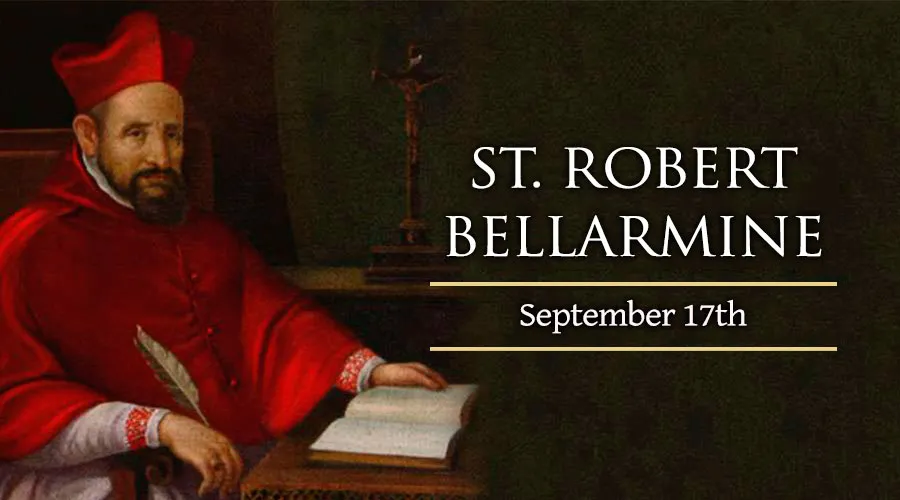
St. Robert Bellarmine, also known as Saint Roberto Bellarmino in Italian, lived from October 4, 1542, to September 17, 1621. He was a prominent figure of the late Renaissance and the early Baroque period.

Where they lived:

St. Robert Bellarmine was born in the city of Montepulciano, located in the Tuscany region of Italy. He spent much of his life in various Italian cities, including Rome and Padua, and eventually passed away in Rome.

Notable world events during the time of their life:

  • Counter-Reformation (16th and 17th centuries): St. Robert Bellarmine played a significant role in the Counter-Reformation, a period of Catholic resurgence and reform in response to the Protestant Reformation. He engaged in theological debates and wrote extensively to defend Catholic doctrine.
  • Galileo Galilei’s Observations (17th century): During Bellarmine’s lifetime, the famous astronomer Galileo Galilei made groundbreaking observations with his telescope. Bellarmine engaged in a correspondence with Galileo regarding the Church’s stance on heliocentrism, marking an intersection between science and religion.
  • Thirty Years’ War (1618-1648): The Thirty Years’ War was one of the most destructive conflicts in European history, encompassing religious, political, and dynastic struggles. Bellarmine’s death in 1621 occurred during the early stages of this war, and the conflict continued to reshape Europe’s religious and political landscape.
  • The Establishment of the Gregorian Calendar (1582): In 1582, Pope Gregory XIII introduced the Gregorian calendar to reform the Julian calendar. This reform corrected inaccuracies in dating and remains the calendar system used worldwide today.
  • Foundation of the Jesuit Order (1540): St. Robert Bellarmine was a member of the Society of Jesus, commonly known as the Jesuits. The Jesuits played a significant role in the Counter-Reformation, and their influence on education and missionary work was profound during this era.
  • Exploration and Colonialism: The age of exploration and colonialism was in full swing during Bellarmine’s lifetime. European powers were establishing colonies across the Americas, Africa, and Asia, leading to profound global changes.
  • Rise of Baroque Art and Architecture: The Baroque period in art and architecture emerged during Bellarmine’s lifetime. This ornate and dramatic style had a lasting impact on European culture and can be seen in many churches and buildings of the time.

Their patronage:

St. Robert Bellarmine is the patron saint of catechists, catechumens, and the Archdiocese of Cincinnati. His significant contributions to Catholic theology and his commitment to teaching and defending the faith make him a fitting patron for those involved in religious education and instruction. Moreover, his interactions with Galileo and the relationship between faith and science also make him a symbol of the ongoing dialogue between religion and scientific inquiry. Bellarmine’s life exemplifies the intellectual and spiritual ferment of his era, and his legacy continues to inspire both Catholics and scholars today.

A Rising Theologian

St. Robert Bellarmine was born on October 4, 1542, in Montepulciano, near Siena, Italy. He was the nephew, on his mother’s side, of Pope Marcellus II. He had an excellent academic formation in the humanities prior to his entry into the Society of Jesus on September 20, 1560. At the Roman College in Padua and at Louvain, both his philosophical and theological studies focused on St. Thomas Aquinas and the Fathers of the Church. These were very important and crucial to his theological inclination.

Robert Bellarmine was ordained to the priesthood on March 25, 1570. For some years, he was a professor of theology in Louvain. Later on, he was summoned to Rome by Pope Gregory XIII, where he was assigned to teach at the Roman College. While he was there, he was entrusted with the chair of apologetics. During the decade of his post, he compiled a series of lessons that subsequently formed the Controversiae, an opus whose clarity, richness in content, and generally historical tone had earned it renown.

The Council of Trent had just concluded in the face of the Protestant Reformation. The Catholic Church was obliged to reinforce, strengthen, and confirm her identity. In this context, Bellarmine’s action fits. From 1588 until 1594, he was assigned as the first spiritual director of the Jesuit students at the Roman College. Among these students whom he met and gave direction was Aloysius Gonzaga, who later became a saint. After some time, he became the religious superior.

Bellarmine’s untiring service

Pope Clement VIII appointed Bellarmine to various offices, namely, as papal theologian, consultor to the Holy Office, and rector of the College of Confessors at St. Peter’s. Some years later, he was created cardinal on March 3, 1599, by the same Pontiff and was appointed Archbishop of Capua on March 18, 1602. In his three years as bishop, he distinguished himself by his zeal as an outstanding preacher in his cathedral, by his weekly visitations to parishes, by the Diocesan Synods, and by a Provincial Council that he established. Although he was named a cardinal, he lived a humble and caring life. He gave most of his money to the poor. While he had little regard for his own comforts, he always saw to it that his servants and aides had everything they needed.

Cardinal Bellarmine took part in the conclaves that elected Pope Leo XI and Pope Paul V. After this, he was called to Rome again, where he was appointed a member of the Congregations of the Holy Office, of the Index, for the Rites, for Bishops, and for the Propagation of the Faith. He also held diplomatic responsibilities in the Republic of Venice and in England to defend the rights of the Apostolic See.

In his last years, Cardinal Bellarmine composed various works on spirituality in which he concentrated on the results of his yearly spiritual exercises. On September 17, 1621, Cardinal Bellarmine died in Rome. He was beatified by Pope Pius XI in 1923, canonized in 1930, and proclaimed a Doctor of the Church in 1931. His feast day is September 17.

Five Interesting Facts About St. Robert Bellarmine

  1. St. Robert Bellarmine is one of the patron saints of catechists and catechumens.
  2. Under the order of Pope Paul V in 1616, St. Robert Bellarmine notified Galileo Galilei that his heliocentric theory was opposed to biblical teaching and could not be supported by the Church at the time.
  3. St. Robert Bellarmine was St. Aloysius Gonzaga’s spiritual director and was also present during the latter’s death in 1591. St. Robert Bellarmine helped get St. Aloysius Gonzaga beatified.
  4. A story was told about a miracle attributed to St. Robert Bellarmine. When he was walking on the banks of a river one night, he caught sight of fishermen who had no catch. He told the men to lower the nets and leave them for a while, and with a loud voice he cried out “Come, fish, come!”, The fishermen lifted their nets filled with fish.
  5. St. Robert Bellarmine wrote a hymn to Mary Magdalene. This hymn is now included in the Roman Breviary.

Prayer to St. Robert Bellarmine

O God, who adorned the Bishop Saint Robert Bellarmine with wonderful learning and virtue to vindicate the faith of your Church, grant, through his intercession, that in the integrity of that same faith, your people may always find joy. Through our Lord Jesus Christ, your Son, who lives and reigns with you in the unity of the Holy Spirit, one God, for ever and ever Amen.

St. Rita

When they lived:

St. Rita, also known as Saint Rita of Cascia, lived from 1381 to May 22, 1457.

Where they lived:

St. Rita lived in Roccaporena, a small town in the Umbria region of Italy. This picturesque town is located in the Apennine Mountains and is known for its natural beauty.

Notable world events during the time of their life:

  • Hundred Years’ War (1337-1453): St. Rita lived during the latter part of the Hundred Years’ War, a conflict between the Kingdom of England and the Kingdom of France.
  • Renaissance (14th-17th centuries): St. Rita’s lifetime coincided with the early stages of the Renaissance, a period of significant cultural and artistic growth in Europe.
  • Invention of the Printing Press (c. 1440): Just a few years before St. Rita’s death, Johannes Gutenberg invented the printing press with movable type, a development that revolutionized the spread of knowledge and information.
  • End of the Byzantine Empire (1453): In the final years of St. Rita’s life, the Byzantine Empire, centered in Constantinople (modern-day Istanbul), fell to the Ottoman Empire.
  • Discovery of the New World (1492): Although after St. Rita’s time, her era laid the groundwork for Christopher Columbus’s voyage to the Americas, which would reshape world history.

Their patronage:

  • Impossible Causes: St. Rita is often invoked by those facing seemingly insurmountable challenges.
  • Abuse Victims: Due to her own experiences with a difficult marriage, St. Rita is a patroness for those suffering from abuse, offering them solace and strength.
  • Lonely People: She is also a patron saint for those who are lonely or experiencing loneliness, providing them with comfort and companionship through prayer.
  • Marriage: St. Rita is considered a patron saint of married couples, offering guidance and support for those seeking a harmonious and loving marital life.
  • Lost Causes: St. Rita’s reputation for interceding in seemingly hopeless cases has earned her the title of the patron saint of “lost causes,” making her a source of hope for those facing dire situations.

St. Rita’s life was marked by personal challenges, unwavering faith, and a deep connection to the struggles of everyday people. Her story continues to inspire and provide solace to people facing difficulties around the world.

Childhood

Formally named Margherita Lotti, she was born in Roccaporena, Italy, in the year 1381. Rita was baptized as an infant, and surprisingly, on the day after she was baptized, a swarm of white bees surrounded her, buzzing in and out of her mouth without hurting her. This was considered a symbolic act that meant Rita was filled with virtue.

Marriage

She got married to Paolo Mancini at a very young age at a planned wedding by her parents. She graduated to being a mother at the age of twelve. Her marriage was arranged after she pleaded with her parents to allow her to join the convent.

Rita suffered in her marriage to Paolo since he mistreated her and acted violently toward her. He was also a dissatisfied man who still pursued other women even after marrying Rita. He was a man hated by many.

She had a positive impact on her husband and even helped him settle issues between him and several enemies he kept. Unfortunately, Paolo wasn’t able to reconcile with each of his enemies, and one of his allies betrayed and killed him.

Rita was widowed, and she publicly pardoned her husband’s murderer, but her two sons were focused on avenging their father’s death. Seeing her sons’ rage, Rita prayed to God to take his sons earlier before they lost their souls to sinful acts. She was truly virtuous.

Monastery Saint

She requested to join the Augustinian order located in Cascia, but she was not allowed to. She persisted and was given a condition to fulfill for her request to be granted. The condition was for her to find a way to solve the issues between the Mancinis and the Chiquis.

She asked for help from her patron saints, Augustine of Hippo, Nicholas of Tolentino, and John the Baptist, as she tried to settle the issues. Luckily, Bernardo Mancini finally denounced the enmity between the Mancinis and the Chiquis, and the two families signed a peace agreement. Rita was finally able to join the Saint Mary Magdalene Monastery.

In respect to her achievement in reconciling the Chiquis and the Mancinis, a painting was mounted on the wall of the Saint Francis Church in Cascia. The painting was a symbol of the embrace shared by the Mancinis and the Chiquis, out of pleas by Rita.

Once in the monastery, aged thirty-six, she respectfully performed her duties and received her sacraments filled with faith. She lived a regular Christian life, often praying to God and living an exemplary life. She lived for forty more years, depicting the best lifestyle according to the rule of Saint Augustine.

Miracles and death

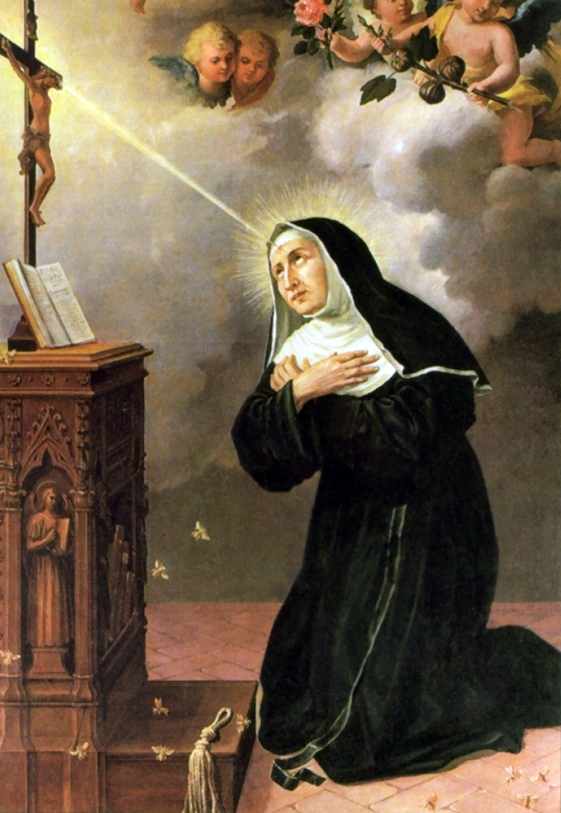
She once prayed to God and requested to suffer as Christ had suffered and to relieve Christ’s burden. Afterward, a wound appeared on her forehead. It was so deep that it couldn’t heal. Due to the strange wound, Rita’s health deteriorated, and she constantly grew weaker each day.

Some months before her death, one of her relatives paid her a visit. On seeing her physical state, the relative asked Rita for a wish she expected to be fulfilled before her death. Although she was reluctant at first, she finally asked for a rose from her family farm back in Roccaporena.

As strange as it may sound, it was during the winter season, but upon passing Rita’s family farm, the relative saw a single rose in the field filled with snow. She plucked it out and immediately returned to the monastery, where Rita lay sick, and handed her the rose.

The rose was a product of Rita’s answered prayers for her dead husband and sons, and Rita believed that she would reunite with them after her death. She died in peace on May 22, 1457.

Now she is observed as the patron saint of lost and impossible causes: sickness, wounds, marital problems, abuse, and mothers.

5 Interesting Facts About St. Rita

  1. Upon her request, a rose miraculously grew on Rita’s family farm.
    during the winter season.
  2. After her baptism, a swarm of bees surrounded Rita, flew in, and
    out of her mouth and caused her no harm.
  3. She prayed to God to take away her sons before they lost their souls.
    in their attempts to avenge their father’s death.
  4. When Rita died, the bells of the convent mysteriously rang without
    aid from human hands.
  5. She was a mother of twins and was widowed at 24.

Prayer to St. Rita

Dear St. Rita, during your entire life on earth, you found happiness by following the will of our heavenly Father. Help me to be as trusting of God in all His plans for me. Help me this day to give myself to Him as you did, without limit, without fear, without counting the cost. Help me to be generous in serving the needs of others, patient in all difficulties, and forgiving toward all who injure me. Help me to learn more deeply the great mystery of the Cross of Jesus, so that by embracing it as you did,I may come to experience its power to heal and to save. Amen.

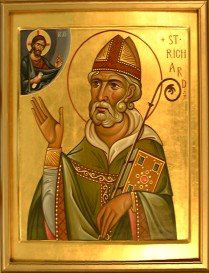
St. Richard of Wyche

When they lived:

St. Richard of Wyche, also known as Saint Richard of Chichester, lived during the late 12th and early 13th centuries. He was born in 1197 in Droitwich, England, and passed away on April 3, 1253, in Dover, England.

Where they lived:

St. Richard primarily lived in England during a tumultuous period in the country’s history.

Notable world events during the time of their life:

  • Magna Carta (1215): During St. Richard’s lifetime, the Magna Carta was sealed by King John of England in 1215. This historic document laid the foundation for the principles of constitutional law, limiting the power of the monarchy and establishing certain rights and liberties for the people.
  • Albigensian Crusade (1209-1229): This was a significant religious and political conflict in southern France. It was a part of the larger Albigensian heresy, where the Catholic Church sought to suppress the Cathar movement. St. Richard’s life would have been influenced by the wider struggles within the Catholic Church.
  • Fourth Lateran Council (1215): This ecumenical council, convened by Pope Innocent III, addressed various issues within the Catholic Church, including matters of doctrine and discipline. It played a pivotal role in shaping the Church’s institutional framework and theology during St. Richard’s time.
  • Innocent III’s Papacy: Pope Innocent III, who served from 1198 to 1216, was a powerful and influential figure in the Catholic Church. His papacy witnessed significant developments in canon law, theology, and church-state relations.
  • The Mongol Empire’s Expansion (Early 13th Century): During St. Richard’s lifetime, the Mongol Empire, led by Genghis Khan and his successors, was rapidly expanding across Asia and into Eastern Europe. This marked a significant shift in the global balance of power.

Their patronage:

St. Richard of Wyche is the patron saint of several noteworthy causes and groups:

  • Patron Saint of Sussex: St. Richard is revered as the patron saint of Sussex, a county in southern England. He is deeply respected by the local population for his piety and contributions to the region.
  • Patron Saint of Coachmen and Laborers: St. Richard is also the patron saint of coachmen and laborers. This patronage reflects his humble and hardworking nature during his life.
  • Patron Saint of Protection Against Inflammatory Diseases: In more recent times, St. Richard has been invoked as a patron saint against inflammatory diseases, symbolizing his role in healing and compassion.

St. Richard’s life and legacy are a testament to his unwavering faith, dedication to serving others, and his enduring impact on the region of Sussex and the broader Catholic Church. His story provides valuable insights into the religious and historical context of medieval England.

Early Life

Richard of Wyche, also known as Richard of Chichester or Richard de Wyche, was born around 1197 in Burford, very close to Wyche town. He soon lost his parents, thus becoming an orphan at a young age. Richard’s parents had left their estate to the inheritance of Richard’s elder brother, who at the time wasn’t old enough for such an inheritance. As a result of this, the estate was left to be under a feudal wardship until Richard’s brother was of the right age to claim his inheritance. Coming of age, Richard’s brother took control of the estate as his possession by inheritance, but was then requested to provide payments for a medieval form of death duty. This new responsibility did not leave his family any good, as they soon became penurious, and little Richard, at the time, in a bid to support his family as much as he could, had to start farming. Later on, his brother passed on the inheritance of the property to Richard, and arrangements were made for him to marry a noblewoman, but Richard declined all offers. He rather preferred to own nothing, just him, his study, and the Church.

Call to Dedication and Devotion

Richard went to school at the University of Oxford and soon became a teacher at the same institute after completing his studies. Richard went on to Paris and Bologna, exhibiting his proficiency in Canon law. When he learned that one of his former tutors, Edmund of Abingdon, had been made archbishop of Canterbury, he supported Edmund’s clerical reform and was even in agreement with the papal rights against the king. Hopefully, as bad as things could get, Richard was appointed chancellor of the Diocese of Canterbury in 1237 by his former tutor, Edmund. It was during Richard’s exile at Pontigny that he fully joined the archdiocese and remained there until the archbishop passed away three years later. Then Richard decided that he was going into the priesthood. He went on to study theology for two years. After his studies, Richard was made parish priest in Charing, and after some time, he was reappointed chancellor of Canterbury by the new archbishop.

Years later, though the king and some other parties did not show their support, Richard was chosen as Bishop of Chichester. He was consecrated in March 1245 at Lyons by Innocent IV. It wasn’t an easy task, really. He faced a lot of opposition and hatred from different angles, yet he wasn’t discouraged by it. To those corrupt clergy and usurers who without mercy gabbled the Massyes, Richard was especially merciless and rigid. His interest was to see that the Masses were treated fairly and that justice got to everyone the way it was due.

Legacy

To his memory, still in remembrance are his militant acts to liberate the masses from the hands of people who would only exploit them. He worked tirelessly to reform the manners of the corrupt clergy and priests, who were falling apart. In his chapel, Richard had a body of statues signifying the reformation of fallen clergy. More important is the impact he’d made while tutoring his students and pastoring his congregation. Also to his memory is that he dedicated the Chapel at Dover, named after his patron, St. Edmund.

Death and Burial

Richard died in the year 1253, aged 56, in Maison Dieu, Dover. This death had sufficed just after he had dedicated the St. Edmund’s Chapel in the same city. As he’d wished, his body was buried in the chapel on the north side of the nave, Chichester.

Feast Day

St. Richard’s feast days are both on April 3 and June 16.

An Interesting Fact About St. Richard of Wyche

  1. Miracles are believed to happen at the tomb of Richard in Chichester.

Prayer to St. Richard of Wyche

Thanks be to Thee, my Lord Jesus Christ. For all the benefits Thou hast given me, for all the pains and insults Thou hast borne for me O most merciful Redeemer, friend, and brother, May I know Thee more clearly, love Thee more dearly, and follow Thee more nearly.

Source: Bullock-Webster, p. 31. Acts and Devotion Prayer 48

St. Polycarp

When they lived: St. Polycarp lived from around 69 AD to 155 AD. He was born in Smyrna, which is modern-day Izmir in Turkey.

Where they lived: St. Polycarp spent most of his life in Smyrna, which was a thriving Roman city in Asia Minor (modern-day Turkey). Smyrna was known for its significant Christian community and its role as a hub of trade and culture in the Eastern Mediterranean during that time.

Notable world events during the time of their life:

  • The Great Fire of Rome (64 AD): This devastating fire occurred during St. Polycarp’s early years and was blamed on Christians by the Roman authorities. It led to the persecution of Christians, setting the stage for the challenges faced by early Christians like Polycarp.
  • Roman Emperor Trajan’s Reign (98-117 AD): Trajan’s rule marked a period of relative stability and expansion in the Roman Empire. During this time, the early Christian community was growing, and policies regarding their treatment varied across the empire.
  • Bar Kokhba Revolt (132-136 AD): This Jewish rebellion against Roman rule in Judea had significant consequences for the Jewish and Christian communities. It led to further tension between Jews and Christians, who were increasingly seen as distinct from Judaism.
  • Ptolemy’s Almagest (c. 150 AD): Although not directly related to St. Polycarp’s life, Ptolemy’s work on astronomy, the “Almagest,” was a groundbreaking scientific achievement during this period, influencing the understanding of the cosmos for centuries.
  • The Antonine Plague (165-180 AD): This devastating pandemic, which occurred shortly after St. Polycarp’s death, had a profound impact on the Roman Empire, affecting society, trade, and the stability of the state.

Their patronage: St. Polycarp is recognized as the patron saint of several groups and causes:

  • Smyrna/Izmir: As a native of Smyrna, he is a patron of this city and its Christian community.
  • Dyers: St. Polycarp is also the patron saint of dyers, likely because of the symbolism of dyeing, which can represent the transformation of one’s soul through faith.
  • Earaches and epilepsy: There are accounts of St. Polycarp miraculously healing individuals suffering from earaches and epilepsy, so he is considered a patron for those with these afflictions.
  • Against fear of fire: Legend has it that when St. Polycarp was burned at the stake, the flames did not harm him. This led to his association with protection from fire and related fears.

St. Polycarp’s life and legacy are not only intertwined with early Christianity but also offer a window into the complex and dynamic world of the Roman Empire during the second century. His story of unwavering faith and courage in the face of persecution continues to inspire many today.


At the Feet of the Beloved Disciple

It must have been a great privilege to be taught by the Apostles and to hear their personal encounters with Jesus from their own testimonies. What an honor to be with those men who had seen the Lord with their own eyes and who had heard His teachings! That was what our beloved Polycarp experienced as a humble disciple of St. John the Evangelist.

According to tradition, St. Polycarp was born around 69 AD. He was of Greek origin and became the bishop of Smyrna. He was one of the most revered Christian leaders during the first half of the second century. Being a leader of the early Christian community, he faced several challenges, particularly how he would carry out the teachings of Jesus correctly and how he would answer questions that never existed during the time of the Apostles.

Responding to Controversies

Now that the Apostles were gone, the early Church started to encounter serious issues. Heresies sprang up under the guise of true teaching. The Roman Emperors ordered persecution among the Christians. Arguments and controversies arose over many concerns, like how to celebrate the liturgy, the liturgy that Jesus never laid down rubrics for.

Polycarp, the holy bishop of Smyrna, had but one response to all of these: sequela Christi, that is, to be faithful to the life of Jesus and to imitate His life. When faced with heresies, he showed his candidness, which imitated the response of Jesus to the Pharisees. Marcion, the figurehead of the Marcionites, who were adherents of a dualistic heresy, confronted Polycarp and demanded respect by saying, “Recognize us, Polycarp.” Polycarp answered that he indeed recognized him and that Marcion is the “firstborn of Satan”. When faced with Christian disagreements, he was all respect and forgiveness.

Polycarp was a close friend of another great leader, Ignatius, the bishop of Antioch. On his way to his cruel yet glorious martyrdom in Rome, Ignatius visited Polycarp at Smyrna and later wrote him a personal letter at Troas. Polycarp’s leadership was recognized by the churches in Asia Minor by choosing him as a representative to discuss with Pope Anicetus the date of what was considered to be a major controversy in the early Church, that is, the celebration of Easter in Rome.

Even unto Death

Polycarp was not spared from dying a martyr’s death. One day, during a bloody “show” when Christians were attacked by wild animals in the arena, the crowd became so mad that they demanded more of this “show”. They were bored by seeing “ordinary” Christians being killed. And so, to satisfy their insatiable appetite for violence, they demanded that the old Polycarp be captured and killed.

The horrible demand reached the holy bishop. The Christians persuaded Polycarp to flee and leave the city. He spent his time in deep prayer for the people he loved and for the Church. While he was praying, he saw a vision of his pillow turning into fire. He announced this to his friends, saying that his dream meant he would be burned alive.

After he was captured, Polycarp was brought to the Smyrna stadium to be killed. The proconsul offered him the chance to renounce his faith and worship the emperor. Polycarp refused to do such an act. In order to instill more fear, the proconsul said that Polycarp would be burned alive if he did not abandon the faith. Once again, the 86-year-old bishop refused, for he believed that an hour of fire was better than eternal fire. After praying, Polycarp was burned at the stake. However, the flames did him no harm. When the captors saw he was not being burned, they stabbed him. The blood that flowed from the bishop put the fire out. Unwilling to allow the Christians to reclaim the body of the martyred bishop, the authorities ordered that Polycarp’s body be burned. Polycarp was believed to have been martyred on February 23, 156.

Five Interesting Facts About St. Polycarp

  1. St. Polycarp is the patron saint of earaches, dysentery, and intestinal disorders.
  2. St. Polycarp was apparently the last to be martyred in Smyrna.
  3. There is an existing account of St. Polycarp’s martyrdom. It is entitled “The Martyrdom of Polycarp”. It is believed to be an eyewitness account and one of the oldest “actas” of a Christian martyr.
  4. Since the persecutors did not permit the Christians to recover the remains of St. Polycarp, they stole the martyr’s bones! This is considered to be one of the earliest examples of the veneration of relics.
  5. The relics of St. Polycarp are kept in a marble stone under the main altar of the Church of SantAmbrogio della Massima in Italy.

Prayer to St. Polycarp

God of all creation,You gave Your bishop Polycarp the privilege of being counted among the saints who gave their lives in faithful witness to the Gospel. May his prayers give us the courage to share with him the cup of suffering and to rise to eternal glory. We ask this through Christ, our Lord. Amen.

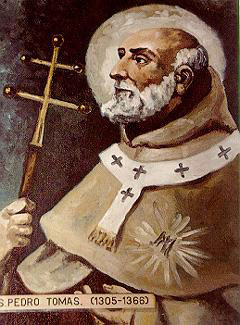
St. Peter Thomas

When They Lived:

Saint Peter Thomas, also known as Saint Peter Thomas of Villanova, lived during the late 13th and early 14th centuries. He was born in 1255 and passed away in 1323.

Where They Lived:

Saint Peter Thomas was born in the town of Bilbao, which is located in the Basque region of Spain. He later lived and served as a Carmelite friar in various locations, including Spain and Italy.

Notable World Events During the Time of Their Life:

  • The Reign of King Edward I of England (1272-1307): This was a significant period in English history marked by the conquest of Wales and conflicts with Scotland. Saint Peter Thomas’s life overlapped with this era of English expansion.
  • The Mongol Empire: During Saint Peter Thomas’s lifetime, the Mongol Empire, led by rulers like Kublai Khan, continued to exert its influence over vast territories in Asia and Eastern Europe. This global event highlighted the interconnectedness of different regions.
  • The Renaissance (14th Century): Although the Renaissance began in Italy, its cultural and artistic impact would soon spread across Europe. Saint Peter Thomas lived at the cusp of this transformative period, which would shape the course of history.

Their Patronage:

Saint Peter Thomas is the patron saint of the Carmelite Order. He is revered for his contributions to the Carmelite tradition and his commitment to the ideals of poverty, contemplation, and service. His life and teachings continue to inspire Carmelite communities and individuals seeking spiritual guidance.

Saint Peter Thomas’s story is one of devotion and a testament to the tumultuous times in which he lived. His unwavering commitment to the Carmelite order and his witness to the broader events of his era make him an intriguing figure to explore in the context of both religious and historical studies.

Early Life

Saint Peter Thomas is a highly respected saint in the Roman Catholic Church. This Carmelite Priest and Papal legate, however, has limited biography information available.

Little is known about what Saint Peter Thomas did all his life.

Saint Peter Thomas was born approximately in the year 1305 in Southern Perigord, France. Often called Pierre Tomas in some books of literature,Peter Thomas was born into an extremely poor family.

Some parts of history recognize his father as a laborer who worked for a rich lord in the town. All parts of history, however, make it known that the family was so poor that they had very little to get by on.

After the death of his brother, Saint Peter Thomas decided to venture out of town in search of greener pastures. He left his home to lessen the burden on his family and instead went to the small town of Montpazier.

In Monpazier, he saw himself through school. He sustained himself by begging for alms and tutoring younger students.

After three years of living in Monpazier, he moved on to Argen. Details of what he did during his stay are nonexistent. What is known is that he lived on alms and taught, just like he did in Monpazier.

He continued like this until the age of 20, when he moved back to Montpazier.

Dedication and Devotion

  1. He went on to make his religious vows at Bergerac, where he ended up
    teaching for two years.

Legacy

Saint Peter spent most of his life serving the Church.

He was appointed Prosecutor General of the Order and an official minister at the Papal Court of Pope Clement VI in Avignon. There, his devout righteousness and dedication to religion drew attention and respect.

For some time, he held the position of Papal legate to Milan, Genoa, and Venice. By 1354, he had been appointed Bishop of Patti and Lipari.

It is said that he served as Bishop of Coron for some time in 1359 before he was elected Archbishop of Crete in 1363. Circa 1364, he was made Latin Patriarch of Constantinople.

Saint Peter Thomas joined the fight against the Turks.

In 1365, he joined a military operation fighting Alexandria, Egypt, in which he became seriously injured.

Death and Canonization

Saint Peter Thomas succumbed to his injuries and died in 1366 at Famagusta, Cyprus.

It is recorded that before he died, he gave all his properties to charity.

In 1608, He was beatified by Pope Paul V and then canonized in 1628 by Pope Urban VIII.

He is celebrated every year on the 6th of January.

5 Interesting Facts About St. Peter Thomas

  1. Did you know that Saint Peter Thomas’ primary aim was to stimulate
    peace and harmony with the Eastern Churches?
  2. Did you know that Peter is derived from the Greek word ‘Petros?
    meaning stone, and Thomas from the Aramaic word ‘Ta’oma, meaning
    twin?
  3. Did you know that in his time, Saint Peter Thomas was respected in
    both Catholic and Orthodox Churches?
  4. Did you know that many people consider Saint Peter Thomas the
    forerunner of ecumenism?
  5. Did you know that some historical writers think Saint Peter died at
    2 a.m?

Prayer to St. Peter Thomas

Father,you inspired in your bishop, St. Peter Thomas, an intense desire to promote peace and Christian unity. Following his example, may we live steadfastly in faith and work perseveringly for peace. We ask this through Christ, Our Lord. Amen.

Source:[https://www.carmelite.org/carmelite-spirituality/saints-of-carmel/st-peter-thomas]{.ul}

St. Peter Chrysologus

When they lived:

St. Peter Chrysologus, also known as “Peter of the Golden Words,” lived during the late 4th century and the early 5th century. He was born around 380 AD and died in 450 AD.

Where they lived:

St. Peter Chrysologus lived in the city of Ravenna, which was the capital of the Western Roman Empire at that time. Ravenna is located in present-day Italy and was a major political and cultural center during his lifetime.

Notable world events during the time of their life:

  • Fall of the Western Roman Empire (476 AD): Although St. Peter Chrysologus did not witness this event himself, he lived during the decline of the Western Roman Empire, and its eventual fall to Odoacer in 476 AD marked the end of ancient Roman rule in the Western Mediterranean.
  • Sack of Rome by the Visigoths (410 AD): In 410 AD, the Visigoths, led by Alaric, famously sacked the city of Rome. This event shocked the Roman world and had profound cultural and historical implications.
  • Council of Ephesus (431 AD): The Council of Ephesus, which took place during St. Peter Chrysologus’s lifetime, addressed theological disputes, including the nature of Christ. It affirmed the title of the Virgin Mary as “Theotokos” (Mother of God), a significant development in Christian doctrine.
  • Life of St. Augustine (354-430 AD): The influential theologian and philosopher St. Augustine of Hippo lived during a significant portion of St. Peter Chrysologus’s life. Augustine’s writings had a lasting impact on Christian thought and theology.
  • The Fall of Carthage (439 AD): Carthage, a major city in North Africa, fell to the Vandals in 439 AD, further contributing to the fragmentation of the Western Roman Empire.

Their patronage:

St. Peter Chrysologus is recognized as a Doctor of the Church and is known for his eloquent and concise preaching, earning him the nickname “Chrysologus,” which means “Golden Words.” He is the patron saint of preachers and is celebrated for his ability to convey complex theological concepts in simple, understandable language. His sermons have been admired for their clarity and pastoral wisdom, making him a model for clergy and theologians. Additionally, he is often invoked by those seeking inspiration for effective communication and public speaking.

St. Peter Chrysologus’s life and teachings continue to inspire individuals in their pursuit of effective communication and spreading the Christian faith. His legacy as a preacher and theologian remains influential in the Catholic Church to this day.

Trained and Formed by a Bishop

There are only a few known details about the life of St. Peter Chrysologus. He was born around the late fourth or early fifth century in the Italian town of Imola. Sources differ as to whether this occurred around 380 or as late as 406. He was known for testifying courageously to the full humanity and divinity of Jesus Christ during a period of confusion over the doctrines of the Catholic Church.

Peter’s biography was first written by Agnellus in the ninth century and gives very scanty information about him. He was baptized, educated, and ordained a deacon by the Bishop of Imola, Cornelius, whom he greatly admired and regarded as his spiritual father. Cornelius did not only ordain Peter, but he also taught him the value of self-denial and humility. These lessons from his mentor inspired Peter to embrace the life of a monk for many years. He embraced a lifestyle of asceticism, prayer, and simplicity.

Elevated to the Rank of Archbishop

However, Peter’s simple monastic life came to a conclusion after the death of Archbishop John of Ravenna in 430. The clergy and people of Ravenna chose a successor and asked Cornelius, who was still the Bishop of Imola, to go to Rome and ask for the approval of the Pope for the candidate. Cornelius brought Peter, who was still a deacon then, along with him on a visit to Pope Sixtus III, where Peter was declared John’s successor.

The new Archbishop of Ravenna was received warmly by the Western Roman Emperor Valentinian III and his mother, Galla Placidia. His piety, zeal, and excellent preaching won him respect and admiration in his See. However, throughout the metropolitan area, Peter encountered the surviving remnants of the pagan religion along with the various abuses and distortions of the Catholic faith. With utmost zeal and pastoral care, he curbed these abuses and evangelized non-Christians during his leadership in Ravenna.

Defending the Faith Against Heresies

One of the major erroneous teachings of Peter’s time was monophysitism. This belief held that Jesus Christ did not possess a distinct human nature in union with His eternal divine nature, even though He took on an earthly and human body with its cycle of birth, life, and death. Peter greatly labored to prevent the westward spread of this heresy, which was promoted by the monk Eutyches from Constantinople. After the Synod of Constantinople in 448 condemned this monk, Eutyches endeavored to gain the support of Peter, but without success.

Besides his courageous defense of the Catholic faith and its doctrines, Peter also made improvements to the city’s cathedral. He also built several new churches. He addressed a significant letter to Eutyches, emphasizing the authority of the Pope in the monophysite controversy.

In anticipation of his death, Peter returned to Imola. In the year 450, one year before the Church’s official condemnation of the heresy of monophysitism, Peter Chrysologus died. He is credited as the author of around 176 surviving homilies, which contributed to his later proclamation as a Doctor of the Church. His feast day is July 30.

St. Peter Chrysologus eating dinner with his pet dog

Five Interesting Facts About St. Peter Chrysologus

  1. St. Peter was given the title Chrysologus,” which means “golden speech” or “golden-worded” in Greek.
  2. In 1729, because of his very short but theologically rich homilies, St. Peter Chrysologus was distinguished as the “Doctor of Homilies”.
  3. Some of St. Peter Chrysologus’ surviving works offer eloquent testimony to the Church’s traditional beliefs about Mary’s perpetual virginity, the penitential value of Lent, Christ’s Eucharistic presence, and the primacy of St. Peter and his successors in the Church.
  4. In Christian art, St. Peter Chrysologus is depicted with a dog at his feet, a bishop’s staff, or a beehive.
  5. One of St. Peter Chrysologus’ famous dictums is “If you jest with the devil, you cannot rejoice with Christ.”

Prayer to St. Peter Chrysologus

O God, who made the Bishop Saint Peter Chrysologus an outstanding preacher of your Incarnate Word, grant, through his intercession, that we may constantly ponder in our hearts the mysteries of your salvation and faithfully express them in what we do. Through our Lord Jesus Christ, your Son, who lives and reigns with you in the unity of the Holy Spirit,God, for ever and ever Amen.