St. Alphege

St. Alphege: A Historical Perspective

When They Lived:

St. Alphege, also known as Alphege of Canterbury, lived from c. 954 to April 19, 1012.

Where They Lived:

St. Alphege lived primarily in England, particularly in the region of Canterbury.

Notable World Events During Their Life:

  • Viking Invasions: St. Alphege’s life was marked by the Viking Age, a tumultuous period characterized by repeated Viking invasions and raids across Europe.
  • Battle of Maldon (991): The Battle of Maldon was a significant conflict during St. Alphege’s lifetime, where the Anglo-Saxons faced off against Viking raiders.
  • Conversion of Vladimir the Great (988): The conversion of Vladimir the Great, ruler of Kievan Rus, to Christianity marked a momentous shift in the religious and geopolitical landscape of Eastern Europe.
  • Foundation of the University of Al Quaraouiyine (859): The establishment of the University of Al Quaraouiyine in Morocco stands as a testament to the growing importance of knowledge and education during St. Alphege’s time.
  • Canute the Great’s North Sea Empire: Canute the Great’s reign impacted the political dynamics of the region and influenced St. Alphege’s time.

Their Patronage:

St. Alphege is recognized as the patron saint of Greenwich in London and also of kidnap victims.

His patronage of kidnap victims comes from his own experience of being captured by Viking raiders in 1011. During his captivity, he exhibited unwavering faith and charity, leaving an enduring legacy that continues to inspire those facing adversity.

St. Alphege’s life and the events of his time are a testament to the challenges, triumphs, and spiritual resilience of an era marked by both turmoil and transformation. His story serves as a reminder of the power of faith, compassion, and courage in the face of daunting circumstances.

Early Life

Saint Alphege was born in Weston, Summerset, England. He was born around the year 953 A.D.

No detailed account mentions the names of his parents or what he did at a young age.

Saint Alphege joined a monastery in his early life and became a monk. He was first said to have joined the monastery at Deerhurst and spent some time there.

He moved to Bath, still in England, where he was said to have become an an anchorite.

Dedication and Devotion

Saint Alphege was a devoted young man who took great pleasure in studying the word of God. He was said to have spent time alone praying or been seen preaching in groups.

Although he was humble, he was also very austere. He took care not to get too comfortable with things he considered vanity.

Some parts of history claim that Alphege joined Glastonbury Abbey, where he became a monk. Not all historians agree with this claim, however.

Tradition has it that Saint Alphege became an abbot in Bath between the years 977 and 982.

Some historians account for the gap in the years by claiming that Alphege lived in Gloucester, where he was a monk. After asking to be allowed, it was said that he had left the Deerhurst monastery and gone into seclusion.

Several accounts claim he shared power as an abbot with his predecessor.

Saint Alphege was very respected. He was revered for his holiness and love for the Church. This caused him to be elected Bishop of Winchester around 984.

Some people account his appointment as a result of Archbishop Dunstan of Canterbury, who respected Alphege.

Saint Alphege received his vow of consecration on the 19th of October, 984.

As bishop, he commands authority in favor of establishing religious institutions. He was also said to have been in charge of the building of the organ in the Cathedral.

This huge instrument was said to have produced music that could be heard from more than a mile away.

Saint Alphege was also said to have promoted the cult of Swithun and that of his predecessor, Thelwold. He did this by transferring the reliquaries that belonged to Thelwold to a more befitting cathedral at Winchester.

Saint Alphege was also noted to have reached a treaty with a Viking named Olaf Tryggvason. Olaf was so impressed with Saint Alphege’s beliefs that it is said that he converted to Christianity.

Legacy

Around 1006, Saint Alphege was appointed Archbishop of Canterbury. In 1007, he traveled to Rome to accept the pallium that represented his status as the Archbishop. The pallium was given to him by Pope John XXIII.

Saint Alphege was, however, robbed on his way home.

Back at Canterbury, he ordered the writing of The Second Life of Dunstan to stimulate Dunstan’s court. Saint Alphege also helped with the implementation of new practices in the liturgy for Witenagemot’s sake.

Around 1011, the Danes attacked England. It is estimated that between September 8 and September 29, they raided Canterbury. They were said to have been helped by Lfmaer, a man who was once saved thanks to Saint Alphege.

Alphege was kidnapped and held for seven months. After he was removed from Canterbury, the cathedral was robbed and burned down.

Death and Canonization

Saint Alphege was imprisoned and tortured. He was told that he was going to be released if his people paid a ransom of about four thousand pounds.

Alphege refused to pay the ransom. He was killed in Greenwich on the 19th of April, 1012.

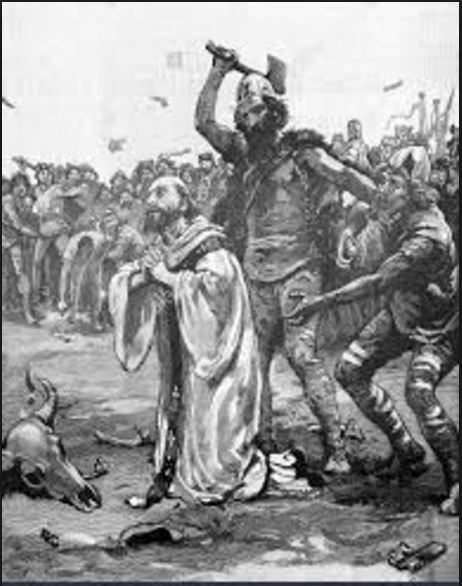
Saint Alphege was said to have been beaten to death with an ax. He died as a martyr.

Saint Alphege was canonized by Pope Gregory VII in 1078. He is celebrated on the 19th of April.

5 Interesting Facts About St. Alphege

  1. Did you know that Saint Alphege is the patron saint of Greenwich and
    kidnap victims?
  2. Did you know that the Church organ requires the strength and skill of
    24 men to be built?
  3. Did you know that the Viking Olaf Tryggvason was said to have
    never fought another battle against the English, thanks to Saint
    Alphege?
  4. Did you know that Saint Alphege took Swithun’s head as a relic?
    him to Canterbury in 1006?
  5. Did you know that Saint Alphege’s Church is recognized as the site
    of the Saint’s death?

Prayer to St. Alphege

Lord Jesus Christ, who willingly walked the way of the cross, strengthen your church through the example and prayers of your servant Alphege to hold fast the path of discipleship; for with the Father and Holy Spirit, you live and reign, one God, forever and ever. Amen.

Source:[http://satucket.com/lectionary/Alphege.htm]{.ul}

St. Clare of Assisi

Saint Clare of Assisi: The Radiant Light of Poverty and Devotion

When they lived:

Saint Clare of Assisi, born Chiara Offreduccio, lived during the late 12th and early 13th centuries. She was born on July 16, 1194, in Assisi, Italy, and she passed away on August 11, 1253, at the age of 59.

Where they lived:

Saint Clare spent the majority of her life in the town of Assisi, nestled in the picturesque Umbrian region of Italy. This enchanting town became the backdrop for her remarkable journey of faith and selflessness.

Notable world events during the time of her life:

  • The Third Crusade (1189-1192): As a young girl, Saint Clare witnessed the fervor and upheaval caused by the Third Crusade, a major military campaign led by European leaders to recapture the Holy Land from Saladin’s forces. This event undoubtedly had a profound impact on the religious atmosphere of her time.
  • Magna Carta is signed (June 15, 1215): In 1215, while Clare was beginning her religious life, the Magna Carta was signed in England. This historic document laid the groundwork for modern constitutional law and established principles that would shape the rights and liberties of people worldwide.
  • The Mongol Empire Expands (1206-1227): During Saint Clare’s lifetime, the Mongol Empire under Genghis Khan and later under his successors, continued its remarkable expansion, impacting trade, culture, and communication across vast territories and civilizations.
  • The University of Oxford is Founded (c. 1096-1167): Although this event happened before Saint Clare’s birth, it highlights the growing intellectual and educational landscape during her time. The establishment of prestigious universities like Oxford paved the way for knowledge dissemination, ultimately influencing the intellectual climate of Europe.

Her patronage:

  • Television and Visual Communication: Interestingly, Saint Clare is the patron saint of television and visual communication. This unusual association is believed to stem from an incident where, despite being bedridden, she was said to have witnessed the celebration of Mass on the wall of her room, as though watching it on a screen.
  • Eye Disorders: Saint Clare’s intercession is sought for those suffering from eye ailments and vision problems, symbolizing the clarity of her unwavering faith and her ability to bring light to those in spiritual darkness.
  • Goldsmiths and Embroiderers: These patronages are attributed to her skillful craftsmanship and dedication to her chosen vocation as a nun, emphasizing her commitment to the art of embroidery and adornment used in religious contexts.
  • Laundry Workers: Saint Clare’s compassion and humility extend even to the humble laundry workers, reflecting her life of simplicity and service.
  • Good Weather: In some regions, Saint Clare is invoked to protect crops from adverse weather conditions, demonstrating the belief in her spiritual connection to nature and its elements.St. Clare of Assisi gardening

Saint Clare of Assisi’s life continues to inspire countless individuals around the world, her unwavering faith and commitment to a life of poverty and devotion shine as a beacon of hope in an ever-changing world. Her story serves as a reminder that true wealth lies not in material possessions but in a heart dedicated to love and service.

Following the Footsteps of Francesco

She was the beautiful eldest daughter of Favorino Sciffi, Count of Sasso-Rosso and his wife Ortolana As such, Clare’s family was wealthy and influential. She was taught to read and write, as well as needlework and spinning yarn. Though coming from a rich family and living in a palace, Clare had little interest in her luxurious surroundings.

The Poor Ladies of San Damiano

On March 20, 1212, Clare professed her vows, dedicating her life to God. That day marked the birth of the Second Order of St. Francis. Soon after, Agnes, Clare’s sister, joined her. They moved to San Damiano Church, recently built by Francis. Not long after, other women joined them, including residents of San Damiano. Known for their life of asceticism, they became known as the “Poor Ladies”.

Clare’s group was known as the Order of San Damiano. In 1216, Clare became the abbess of the order. She spent her days praying and doing manual work. At the same time, she was also dedicating her time to changing the governing rule of the order from Benedictine spirituality to the newly founded Franciscan rule. Their daily lives consisted of prayer and manual labor. Despite the radical life of poverty they had, the sisters were very happy because the Lord was close to them all the time.

Toward the end of Francis’ life, Clare cared for him and accompanied him when he breathed his last in 1226. Despite ill health, Clare resumed to promote and guide the growth of their order. After years of labor for the Order, Clare went to her heavenly reward in 1253. Her remains were placed in the Chapel of San Giorgio while the church dedicated to her remains was being built. At Pope Innocent’s request, the canonization process for Clare began immediately. In August 1255, two years after Clare’s death, Pope Alexander IV canonized her. Following Clare’s canonization, her sisters became known as the Order of St. Clare, or “Poor Clares”.

Five Interesting Facts About St. Clare of Assisi

  • St. Clare of Assisi is the patron saint of television. This was because late in her life, she fell so sick that she was not able to
    attend Mass. Miraculously, the images and sounds of the entire mass appeared in full on the wall of her room, like how televisions work. today. She is also the patroness of eye disease, goldsmiths, and
    laundry.
  • St. Clare and her sisters in the Order wore no shoes, ate no meat,
    lived in a poor house and kept silent most of the time.
  • In 1224, an army of rough soldiers under Frederick II, known as the
    Saracens came to attack Assisi. Although very sick, St. Clare went out.
    and had the Blessed Sacrament placed on the wall where the enemies could
    see it. Then, on her knees, she begged God to save the sisters, and a
    A sudden fright struck the attackers, and they fled as fast as they could.
    without harming anyone in Assisi.
  • Two days before St. Clare of Assisi died, Pope Innocent IV approved
    that the rule she wrote would serve as the governing rule for the order.
    of San Damiano.
  • When St. Clare’s tomb was opened, it was discovered that her body,
    though blackened with age, was still incorrupt.

Prayer to St. Clare of Assisi

O God, who in your mercy led Saint Clare to a love of poverty, grant, through her intercession, that, following Christ in poverty of spirit, we may merit to contemplate you one day in the heavenly Kingdom. Through our Lord Jesus Christ, your Son, who lives and reigns with you in the unity of the Holy Spirit, one God, for ever and ever Amen.

St. Aldegunais

Saint Aldegunais: The Enigmatic Patroness of a Bygone Era

When they lived:

Saint Aldegunais, also known as Saint Alda, lived during the early Middle Ages in the 7th and 8th centuries. Her exact birth and death dates remain shrouded in mystery, adding to the enigmatic aura surrounding her life.

Where they lived:

Saint Aldegunais resided in the region of Hainaut, which was part of the Frankish Empire, located in present-day Belgium and France. Her humble beginnings in this historically rich area provided the backdrop for her remarkable journey.

Notable world events during their life:

  1. The Rise of the Islamic Caliphate (632-750 CE): During Saint Aldegunais’ life, the Islamic Caliphate was in the midst of a significant expansion. The Umayyad and Abbasid dynasties brought sweeping political changes and cultural exchanges throughout the Mediterranean, reshaping the geopolitical landscape of the time.
  2. The Age of Viking Raids (Late 8th to 11th centuries): Saint Aldegunais lived during the era when Viking raiders from Scandinavia were at the height of their power. Their maritime raids and explorations extended across Europe, leaving a lasting impact on trade, politics, and the cultural exchange between regions.
  3. The Carolingian Renaissance (8th and 9th centuries): The reign of Charlemagne, the Carolingian ruler, marked a resurgence of learning and art across Europe. The Carolingian Renaissance saw the preservation and copying of classical texts, laying the groundwork for the revival of education and culture.
  4. The Great Schism of 1054: Though Saint Aldegunais predates the actual event, her life unfolded during a time of growing theological and political tensions between the Eastern and Western Christian churches. The eventual Great Schism in 1054 would lead to the permanent division between the Roman Catholic Church and the Eastern Orthodox Church.
  5. Emergence of the First Universities: In Saint Aldegunais’ lifetime, the first universities began to take shape, notably the University of Al Quaraouiyine in Fez, Morocco (founded in 859) and the University of Bologna in Italy (founded in 1088). These institutions played a pivotal role in the advancement of education and knowledge in various disciplines.

Their patronage:

Saint Aldegunais is often venerated as the patroness of forgotten dreams and lost causes. Legend has it that she was a compassionate healer who tended to the sick and the destitute, giving hope to those who felt abandoned and lost in their struggles. As a symbol of resilience and determination, she is invoked by those seeking guidance during challenging times. Additionally, she is considered a protector of women, especially those facing difficult circumstances, offering solace and empowerment to those who look to her as a role model.

Early Life

There is not much detail concerning the life of Saint Aldegundis. She lived a rather short life but was instrumental in the early Catholic Church.

Saint Aldegundis, also stylized as Aldegonde or Adelgonde in some literary works, came from a family of saints.

She was born to Walbert and Bertilla de Mareuil, who would later be venerated by a Catholic church. She was also said to be a sister to Saint Waltrude or Waudru.

Saint Aldegundis was born circa 639 A.D. in Guînes, the County of Hainaut. Her father at that time was Count of Guînes, and she was said to be connected to the noble Merovingian family.

Saint Aldegundis grew up in the Low Countries, in the province of Hainaut, Flanders.

She was a very pretty woman who had chosen to be dedicated to God. She was a devout Christian and spent most of her time praying.

Saint Aldegundis was sought out by many men from noble families, but she turned each one of them away. She was encouraged to pick a suitor and start a family, but she made it known that she was consecrated to God.

Dedication and Devotion

She took a vow of consecration and sought a cloistered life. She has presented the veil, a sign of her virginity, and a vow to abstain from marriage and sex. The veil was bequeathed to her by Saint Amadiys, the Bishop of Maastricht.

It was said that she had lived in a convent in Mons.

History documents that Saint Aldegundis walked across the Sambre River to a desert called the Malbode. On its shore, she built a small hospital, which later became a nunnery.

She was the founder of the nunnery, which was later named the Maubeuge Abbey, a cloister for Benedictine nuns.

There, she taught her sisters how to live a life of piety. She spent most of her time praying, preaching, and helping the less privileged.

Throughout the final years of her life, she was plagued with the disease of cancer. This, however, did not deter her from her dedication to God.

Saint Aldegundis was also said to have seen visions during her time. She was widely fought for and respected by many.

Death and Canonization

Saint Aldegundis battled breast cancer in her final year. She died in 684 in her abbey, the Abbey of Maubeuge.

Saint Aldegundis died at the age of 44. She was buried at the Abbey of Maubeuge.

Soon after her death, she was succeeded by her niece and Waltrude’s daughter, Aldetrude. Her niece had also spent most of her spiritual life at the Abbey.

Her Abbey continued to grow even after her death. While it remained famous, it was soon taken possession of by canonesses.

She was canonized Pre-Congregation and is celebrated by the Catholic Church on the 30th of January.

5 Interesting Facts About St. Aldegunais

  1. Did you know that Saint Aldegundis is said to be the patron saint
    against cancer and wounds?
  2. Did you know that Saint Aldegundis was a companion of Saint Humbert
    of Pelagius?
  3. Did you know that Saint Aldegundis was said to have walked on the
    water from Sambre without getting her shoes wet?
  4. Did you know that Saint Aldegundis is also said to be the patron
    saint against childhood diseases, ulcers, pain, and sudden death?
  5. Did you know that Saint Aldegundis was taught spirituality by her?
    sister Waltrude?

Prayer to St. Aldegunais

The compassionate Lord, Saint Aldegundis, had a special concern for those suffering from cancer. I ask him to intercede for me, my family, and my friends so that we may remain free from cancer. If any of us are stuck with this disease, I ask him to pray for our healing. Lord Jesus, help us to feel the closeness of the Holy Spirit, who is the Comforter. Teach us to live in hope and faith, and protect us from fear and discouragement. Help us to experience the joy of uniting our sufferings with yours. And show us how to minister to others who’ve been diagnosed with life-threatening illnesses. Saint Aldegundis, pray for us. Amen.

Source:[https://gogoodnews.net/posts/saint-aldegundis/]{.ul}

St. Abban

St. Abban

When they lived:

St. Abban, also known as Saint Ewin and Saint Aibenn, lived during the early 6th century. His exact birth and death dates are not well-documented, but he is believed to have been born around 520 AD.

Where they lived:

St. Abban hailed from Ireland, specifically County Wexford, which is located in the southeast of the country. He spent much of his life in this region, where he became renowned for his piety, wisdom, and sanctity.

Notable world events during the time of their life:

  • The fall of the Western Roman Empire (476 AD): During St. Abban’s lifetime, the Western Roman Empire faced its final collapse in 476 AD. This event marked the end of an era and the beginning of the Middle Ages, which greatly influenced the historical context in which St. Abban lived and spread his teachings.
  • The Age of Saints in Ireland: St. Abban lived during a period known as the “Age of Saints” in Ireland. This era, from the 5th to the 7th century, saw the emergence of numerous holy men and women who became influential figures in spreading Christianity across the island. St. Abban was one of the prominent saints of this era, contributing to the Christianization of Ireland.
  • The Byzantine-Sassanid War (502-506 AD): During the time of St. Abban, the Byzantine Empire was engaged in a war with the Sassanid Empire, a major conflict between the Eastern Roman and Persian empires. This war had significant geopolitical implications and cultural exchanges, which might have indirectly impacted the spread of Christianity during that period.

Their patronage:

St. Abban is venerated as the patron saint of many aspects, including:

  • Patron Saint of Agriculture: St. Abban is believed to have had a deep connection with nature and the land. As a result, he is revered as the patron saint of agriculture, with people seeking his intercession for favorable weather conditions, bountiful harvests, and fertility of the soil.
  • Protection against Plagues: During his lifetime, St. Abban was reputed to have performed miraculous healings and protection against contagious diseases. As such, he is invoked as a patron saint to protect against plagues and illnesses.
  • Fertility and Family Harmony: St. Abban is also recognized as a patron saint of fertility and family harmony. Couples seeking children and families in search of unity often turn to him for blessings and prayers.
  • Navigators and Mariners: Legends say that St. Abban, despite being landlocked in Ireland, had a strong affinity with the sea. Thus, he is invoked by navigators and mariners for safe journeys and protection on the waters.

Interesting Facts:

One of the most intriguing aspects of St. Abban’s life is the establishment of several monastic foundations attributed to him. Notably, he founded the monastery of Magheranoidhe in Wexford, which later became a renowned center for learning and religious study. Additionally, St. Abban was known for his humility, kindness, and generosity, making him beloved among the local people and contributing to his widespread veneration.

Early Life

What is known about Saint Abbán is gleaned from the documents that were written about him.

Only three documents about Saint Abbán were said to have survived in recent times, two written in Latin and one in Irish. Although incomplete, they tell the story of Saint Abbán.

There are numerous accounts of who this man could have been. These accounts differ greatly, and it is not known for sure what Saint Abbán’s entry could have been.

One thing is certain: Saint Abbán was of Irish descent. Some of his biographies state that he was of the U Chormaic Irish clan, sometimes called the Moccu Chormaic clan.

He was born Circa 570. His father was said to have been a Laignech or Leinsterman. He came from a long line of distinguished noble families.

Other documents, however, claim that his father was Cormac, prince of Leinster. This version claimed Saint Abbán’s mother was Mlla, a sibling of Saint Ibar.

There is no detail about how Saint Abbán lived his early years. Some documents state that he was set to be heir to the throne of Leinster. He was, however, more interested in pursuing his spiritual needs and declined the offer.

Dedication and Devotion

Saint Abbán was a devoted young man. He knew he was destined for greatness in his church. He also performed several miracles that convinced his father that he was meant for great acts.

Saint Abbán was sent to live with his mother’s brother, Saint Ibar, who was at that time a bishop. Together, they traveled to Rome to minister to the people.

It is said that Saint Abbán wielded such great power that he used it to chase off dangers from men, monsters, and animals. In various documents, it is said that Saint Abban also wielded the power of the Seasand Rivers.

Saint Abbán, throughout his biographies, was associated with various saints like Saints Finnisn and Saints Brendan. He was also placed in places like Ireland, where he was said to have preached to the people.

Saint Abbán was said to have planted Churches after returning from Rome for the second time. He was said to have pioneered several churches, like the Cell Ailbe, Camross, and a monastery in County Carlow.

Legacy

Some writers argue that Abingdon, a town near Oxford, adopted the name in reverence to Saint Abbán. They reckon that this was because he had preached to the King and the people at that time and converted them to Christianity.

Saint Abbán is associated with various religious happenings. However,probably due to his existence quite early on and the absence of documentation, his works are not known for sure.

Saint Abbán was said to have established many chapels in places that are now known as County Wexford and Ferns.

He founded a convent in Magheranoidhe, modern-day Adamstown. He was also said to have founded a monastery and served as Abbot in Leinster until his death.

What is known, however, is that this missionary and prince who wielded so much power played an important role in the early Church.

Death and Canonization

Saint Abban died on the 16th of March, 620 A.D. He passed away in modern-day Wexford, Ireland.

Saint Abbán was canonized Pre-Congregation. He is commemorated on the 16th of March and the 27th of October.

5 Interesting Facts About Saint Abban

  1. Did you know that modern-day Adamstown was once called Abbanstown?
    after Saint Abbán?
  2. Did you know that Saint Abbán’s sister was said to have been Saint
    Gobnait?
  3. Did you know that Saint Abbán was said to have founded a church in
    Ballyvourney? It is said that he bequeathed it to his sister.
  4. Did you know that Sainr Abbán was said to be buried next to the
    convent in Ballyvourney?
  5. Did you know that Saint Abban is the patron Saint of Mag Arnaide?

First Martyrs of the See of Rome

First Martyrs of the See of Rome: Defenders of Faith Amidst Turmoil

When they lived:

The First Martyrs of the See of Rome lived during the 1st century AD, around the period of 64 to 67 AD.

Where they lived:

They resided in Rome, the bustling heart of the Roman Empire, which was the epicenter of political, cultural, and religious activities during that time.

Notable world events during their life:

  • The Great Fire of Rome (64 AD): During the reign of Emperor Nero, a catastrophic fire ravaged the city of Rome, causing widespread devastation and loss of life. In the aftermath, Nero, seeking a scapegoat, blamed the Christians for the fire, leading to the persecution of the early Christian community in Rome.
  • The Roman Colosseum Inauguration (80 AD): The construction of the iconic Colosseum was initiated during the late 1st century AD, representing the grandeur of the Roman Empire. Tragically, it would later become a site of immense suffering and martyrdom for countless Christians during the Roman persecutions.
  • The Jewish-Roman War (66-73 AD): This brutal conflict between the Roman Empire and the Jews in Judea had a profound impact on the early Christian community in Rome, which included both Jews and Gentiles. The war’s outcomes further complicated the religious and political climate in the city.
  • Pompeii’s Destruction (79 AD): In 79 AD, the eruption of Mount Vesuvius buried the prosperous city of Pompeii under a thick layer of volcanic ash and pumice. Though not directly related to the Roman persecution of Christians, this catastrophic event symbolized the uncertainty and vulnerability of life during those times.
  • Seneca’s Death (65 AD): The influential philosopher, Seneca the Younger, was forced to commit suicide on charges of conspiracy against Nero. His death is believed to have influenced some early Christian thinkers and apologetics as they navigated their faith amidst political turmoil.

Their patronage:

The First Martyrs of the See of Rome are revered as the patrons of courage, steadfastness, and religious tolerance. They epitomized the unwavering devotion of early Christians who faced brutal persecution for their faith. They serve as a beacon of hope for believers enduring adversity and offer inspiration to those seeking the strength to stand firm in their beliefs, even in the face of oppression and danger.

After the Footsteps of Christ

The Christian faith has been widespread for 2,000 years now. Since the mission of the Apostles, it has grown into a worldwide community of faith in the Lord Jesus Christ. However, Christianity did not tread a smooth path leading to the present time. It has gone through difficulties and challenges.

The Gospel of Christ has gained many followers and believers. At the same time, it also went through persecutions that led many men and women, young and old alike, to die for their faith. This served as the fulfillment of Christ’s words: “If the world hates you, realize that it hated me first… Remember the word I spoke to you, ‘No slave is greater than his master.’ If they persecuted me, they will also persecute you.” (John 15:18, 20).

The Persecution begins.

The Church remembers the First Martyrs of the See of Rome. In the first century, there was a large Jewish population living in Rome. Perhaps as a result of the controversy between Jews and Jewish Christians, the Roman Emperor Claudius expelled all Jews from Rome in 49–50. The historian Suetonius said that this expulsion was because of the disturbances in the city “caused by a certain Chrestus” (Christ). Probably many came back after the death of Claudius in the year 54.

A decade later, in the year 64, a huge fire consumed large sections of Rome. The emperor of the Roman Empire then was Nero. Rumors blamed the tragedy on Nero, who wanted to enlarge his palace. Nero blamed the Christians, who were then a growing “radical” sect in Rome, for the conflagration of the city.

Broken, but Not Crushed

The historian Tacitus, a staunch critic of Emperor Nero, wrote down a vivid description of what Nero did to the Christians in Rome:

Yet no human effort, no princely largess, nor offerings to the gods could make that infamous rumor disappear that Nero had somehow ordered the fire. Therefore, in order to abolish that rumor, Nero falsely accused and executed with the most exquisite punishments those people called Christians, who were infamous for their abominations.

The originator of the name, Christ, was executed as a criminal by the procurator Pontius Pilate during the reign of Tiberius, and though repressed, this destructive superstition erupted again, not only through Judea, which was the origin of this evil, but also through the city of Rome, to which all that is horrible and shameful floods together and is celebrated.

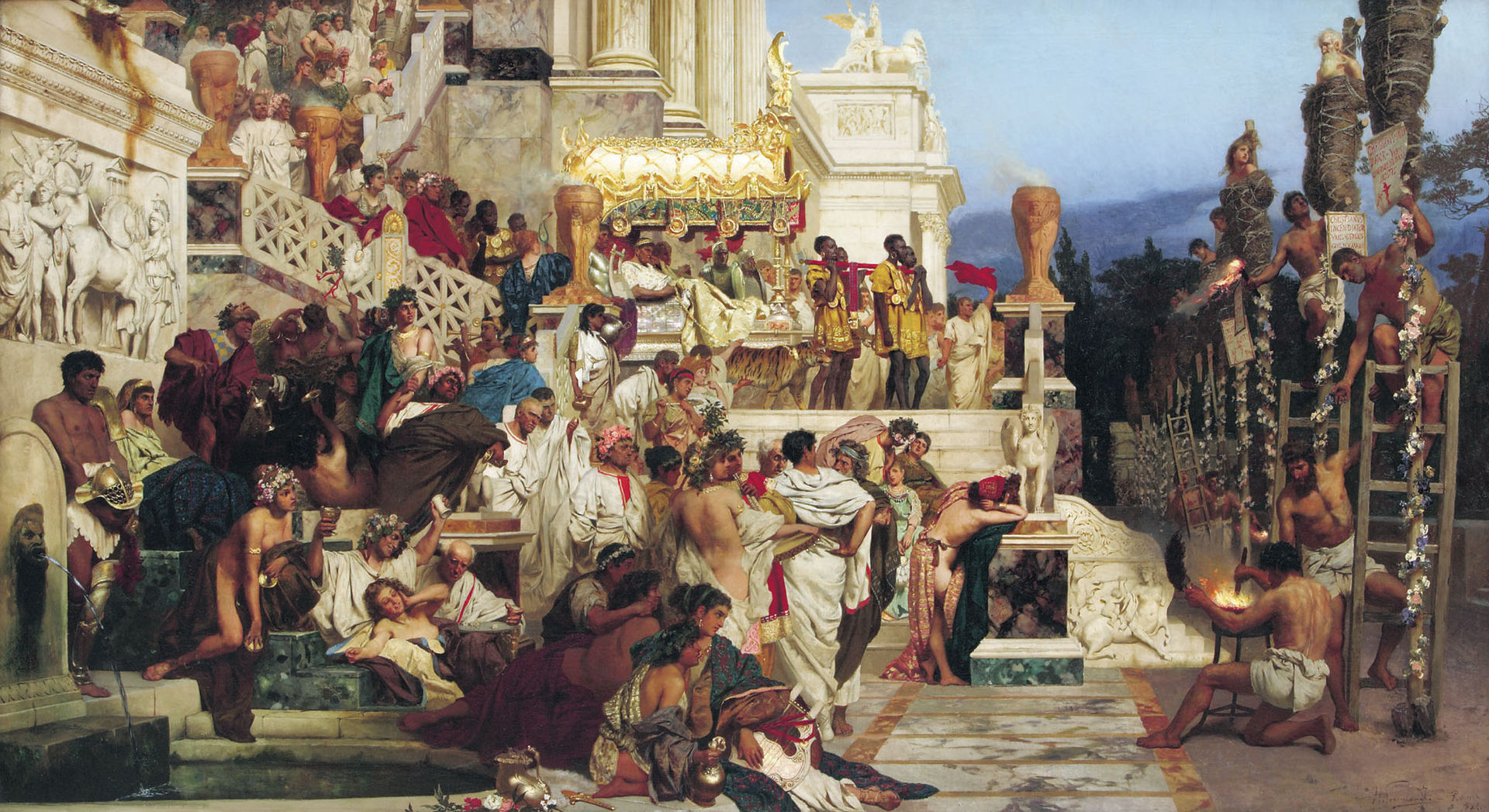
Therefore, first those were seized who admitted their faith, and then, using the information they provided, a vast multitude were convicted, not so much for the crime of burning the city but for hatred of the human race. And perishing, they were additionally made into sports: they were killed by dogs by having the hides of beasts attached to them, or they were nailed to crosses or set aflame, and, when the daylight passed away, they were used as nighttime lamps.

Nero gave his own gardens for this spectacle and performed a Circus game, in the habit of a charioteer mixing with the plebs or driving about the racecourse. Even though they were clearly guilty and merited being made the most recent example of the consequences of crime, people began to pity these sufferers because they were consumed not for the public good but on account of the fierceness of one man. (Tacitus, The Annals, written around 116; 44.2-44.5)

Threatened by an army revolt and condemned to death by the senate, Nero committed suicide in the year 68 at the age of 31. He left a horrible mark in the history of mankind, while these unnamed men and women are commemorated by the Church until the end of time. Their feast day is on June 30.

Five Interesting Facts About the First Martyrs of the See of Rome

  1. The First Martyrs of the See of Rome were called the “Disciples of the Apostles”. This was because so many of them would have learned about Christ from His closest followers themselves.
  2. The site of Nero’s Circus was also the location of Peter’s crucifixion. Today, this place is marked by the Piazza dei Protomartiri Romani (Square of the Roman Protomartyrs) in the Vatican, next to St. Peter’s Basilica.
  3. The Memorial of the First Martyrs of the See of Rome was actually not added to the Church’s liturgical calendar until 1969, nineteen hundred years later! It was then that the first martyrs of Rome began to be venerated collectively.
  4. Aside from being blamed for the fire, Christians were also accused of atheism. This was because they refused to believe in or recognize the Emperor as a deity, let alone the pagan Romans’ false gods.
  5. The placement of the Memorial of the First Martyrs of the See of Rome is on June 29, directly after the Solemnity of Sts. Peter and Paul, who are the principal patron saints of Rome. The subsequent martyrs are associated with their patronage.

Prayer to the First Martyrs of the See of Rome

O God, who consecrated the abundant first fruits of the Roman Church by the blood of the Martyrs, grant, we pray, that with firm courage we may together draw strength from so great a struggle and ever rejoice at the triumph of faithful love. Through our Lord Jesus Christ, your Son, who lives and reigns with you in the unity of the Holy Spirit,God, for ever and ever Amen.

Bl. John of Parma

Bl. John of Parma

When they lived:

Bl. John of Parma, also known as Blessed John of Parma, lived from 1209 to 1289.

Where they lived:

John of Parma was born in Parma, Italy, and spent much of his life within the Franciscan Order, traveling to various locations in Europe.

Notable world events during the time of their life:

  • The Mongol Empire: During John of Parma’s lifetime, the Mongol Empire, led by figures like Genghis Khan and later Kublai Khan, rapidly expanded its territory, impacting vast regions of Asia, Europe, and the Middle East.
  • The Albigensian Crusade: The early 13th century saw the Albigensian Crusade in Southern France, a military campaign by the Catholic Church against the Cathars, a dualistic religious sect. This conflict resulted in significant religious and social changes in the region.
  • The Seventh Crusade: In 1248, King Louis IX of France launched the Seventh Crusade to the Holy Land, an attempt to recapture Jerusalem and other territories from Muslim control. Despite initial successes, the Crusade ultimately ended in failure.
  • The Medieval Inquisition: The 13th century marked the establishment of the Medieval Inquisition by Pope Gregory IX, aiming to suppress heresy within the Catholic Church and wider society. This led to various trials and persecutions of religious dissenters.
  • The Magna Carta: In 1215, during John of Parma’s early years, the Magna Carta was signed in England, a significant document that limited the power of the monarchy and laid the groundwork for modern constitutional law.
  • The Italian Renaissance: Towards the end of John of Parma’s life, the Italian Renaissance was starting to take shape, leading to a flourishing of art, literature, and scientific advancements.

Their patronage:

Bl. John of Parma is considered a patron saint of Franciscan students and scholars. His life was marked by a deep devotion to learning and intellectual pursuits within the Franciscan Order, making him a fitting intercessor for those seeking knowledge and wisdom.


Early Life

Blessed John of Parma was born circa 1209 in Parma, Italy. It was recorded that his family name was Buralli.

Blessed John was said to have been of noble descent. There is not much information about his parents or siblings.

Blessed John was trained and taught by his uncle, who was at the time a cleric at St. Lazarus Church. He was such an intelligent young man that, after completing his basic education, he was appointed tutor of philosophy.

He was pious and sought more spiritual knowledge. This caused him to join the Order of the Friars Minor at the age of 25. He dedicated his time and body to practicing religion.

Blessed John was humble and practiced poverty to help rid him of an annual anchor.

He was appointed priest and became a teacher at notable institutions like the Universities of Naples, Bologna, and finally Paris.

In July 1247, Blessed John was elected Minister General. This was partly influenced by Pope Innocent IV, who had taken a special liking to him.

Blessed John served for ten years until February 2, 1257.

Dedication and Devotion

All the activities carried out by Blessed John were documented thanks to a man called Salimbene. Salimbene worked and went everywhere with Blessed John.

Blessed John was hardworking and needed to see the whole of the Order. He went around from one community to the next on foot and mostly dressed poorly. He was said to always have been escorted by just one or two friars.

His first stop was England, where he was welcomed by King Henry III. There, he was impressed by the state of the Order and so traveled on to France.

In France, he was welcomed by King Louis IX. From then on, he passed through Burgundy and Provence. Finally, in September 1248, he set out for Spain.

In Spain, at the request of Pope Innocent, Blessed John hosted the Chapter of Metz. It was at this Chapter that he set up a new document to guide the order.

It was during this time that trouble began brewing between the mendicants and the University of Paris.

Blessed John fought for peace between both parties. Afterward, he wrote a letter that would be released in Milan in 1255. This letter was asking for peace between the warring Dominican and Franciscan Orders.

Legacy

Due to these disputes, Blessed John’s authority was undermined. This,and some other reasons caused by political challenges, caused Blessed John to leave his post.

It is recorded that Pope Alexander II might have been a key player in the resignation of Blessed John. Salimbene tried to convince Blessed John not to resign, but without success.

Blessed John resigned his office, certain that he could do nothing more to help the Order. He appointed Bonaventure as his replacement before disappearing into the hermitage.

Blessed John withdrew to the village of Greccio. There he lived inisolation. He lived there peacefully until he was once again summoned for a hearing due to some accusations made against him.

Blessed John was acquitted of these charges and once more returned to solitude. There he prayed, fasted, and meditated.

Death and Canonization

At the age of 80, in 1274, Blessed John made a decision to go and minister in Greece. He was permitted by Pope Nicolas IV.

Blessed John died in a monastery on the 19th of March, 1289.

Pope Pius VI announced his beatification in 1777. He was canonized pre-Congregation.

Blessed John is celebrated on the 20th of March.

5 Interesting Facts About Blessed John of Parma

  1. Did you know that Blessed John was one of the first Ministers of the
    orders of Friars Minor?
  2. Did you know that Blessed John is also said to have studied in
    Paris?
  3. Did you know that Blessed John was such a good evangelist that even
    the powerful traveled to hear him speak?
  4. Did you know that Blessed John was the first Minister General to
    visit the whole Order?
  5. Did you know that miracles were said to have been recorded at
    Blessed John’s tomb?

Prayer to Blessed John of Parma

You stayed true to your faith by advocating for the successful return of a simple way of living through the Franciscan order advocated by Saint Francis. May we stay true to our beliefs, especially regarding our faith in God, and seek to bring his works to others, especially the elderly in need. Amen.

Source:[https://clicktopray.org/blessed-john-of-parma-45952/]{.ul}

Bl. Guillaume Repin

  • When they lived: 1709 – 1759
  • Where they lived: Saint-Sauveur-en-Rue, Forez, France
  • Notable world events during the time of their life:
    1. Seven Years’ War (1756-1763)
    2. Age of Enlightenment (17th to 18th century)
    3. 1755 Lisbon Earthquake
    4. Mozart’s Early Career (1761-1766)
    5. Founding of the British Museum (1753)
  • Patronage: Bl. Guillaume Repin is the patron saint of rural communities, shepherds, and agricultural workers. He is also venerated as a protector of animals, especially sheep.

Early Life

Guillaume Repin was born on August 26th, 1709. He was born in Thouarcé, Maine-et-Loire, France.

He was the second child of Renato Repin and Renata Gourdon. There isn’t a lot of information about what this pious man did in childhood.

There are no known records of where he received his primary education or what type of upbringing he went through. However, when Saint Guillaume Repin was 19 years old, which was circa 1728, he joined the seminary.

He chose to join a Church in Angers, where he was appointed a priest, even at a young age.

Dedication and Devotion

Saint Guillaume was a devout young man. He was also selfless and generous. He not only spent his time praying, preaching, and meditating,but he also participated in activities that aimed at alleviating the problems of the poor and sick.

From 1734 to 1749, Saint Guillaume was appointed coadjutor. He was made a bishop whose main job was to assist the diocesan bishop of the Church of Giuliano di Angers.

Saint Guillaume Repin remained pious even under authority. He served for some time, and then he was unanimously voted as the parish priest of San Sempliciano.

While he was still a parish priest, Guillaume was named a canon.

He continued to rule the ministry for what seemed like a long time. He was loved and revered by all who knew him.

While in authority, he made sure that the Church was always welcoming. Some records show that he had the parishes renovated several times. He believed in keeping what he considered the abode of God beautiful and clean.

It was while he was in power that the French Revolution broke out. The new government that had assumed authority had sworn to persecute Christians.

In order to be free, Christians who were arrested were required to denounce or swear off their faith. If they refused, these Christians were tortured, stolen from, exiled, or killed.

The authorities even required ministers and priests to take an oath that went against their religion and God. It required them to pledge allegiance to what was called the “Civil Constitution of the Clergy.”

Many Christians could not withstand the heat and so crossed to the other side of their religions. These people joined the mob and persecuted their former brothers and sisters.

Saint Guillaume Repin was one of the few Christians who refused to incriminate their brothers or give up their faith. He staunchly refused to be a partaker of the oath and so was impeached on February 10, 1791.

Afraid of the backlash, Saint Guillaume Repin fled back to Angers. He stayed in hiding for a few weeks until the 17th of June, 1792, when he was caught.

He was imprisoned with other presbyters who refused to take the oath. At this time, Guillaume Repin was around 82 years old and was the older priest to be held in the large holding cell.

While imprisoned, he continued to lead the mass.

Legacy

On the 14th of August in the same year, taking the oath was not optional for every French citizen. Refusal to take the oath was not to be forgiven or lenient.

Still, Saint Guillaume Repin refused to change his mind. He was not going to take the oath.

On the 30th of November, Guillaume and other aged and feeble priests were taken to one of the Christian institutions called the School of the Brothers of the Christian Doctrine. They were held prisoner there.

On June 17, 1793, all the priests were set free by the insurgents. However, unable to follow his Samaritan due to his rapidly failing health, Saint Guillaume Repin hid in the Magues until he was once again captured.

After a series of interrogations, Saint Guillaume was found guilty and condemned to death.

Death and Canonization

Saint Guillaume died by beheading using a guillotine. He died for his belief in God.

He was killed on January 2, 1794. Saint Guillaume Repin was beatified by Pope John Paul II on the 19th of February, 1984.

Bl. Agnello of Pisa

  • When he lived: Blessed Agnello of Pisa lived during the 12th century, specifically from around 1195 to 1239.
  • Where he lived: Agnello lived in Pisa, a city located in the region of Tuscany, Italy. Pisa was an important maritime and trading center during that time.
  • Notable world events during the time of his life:
    • The Third Crusade (1189–1192): This major military campaign involving European powers, led by Richard the Lionheart, King Philip II of France, and Emperor Frederick Barbarossa, aimed to recapture the Holy Land from Saladin.
    • The Fourth Crusade (1202-1204): This Crusade was originally intended to recapture Jerusalem but ended up diverting to Constantinople, resulting in the sack of the city by the Crusader forces.
    • The signing of the Magna Carta (1215): The Magna Carta was a historic document signed by King John of England, limiting the powers of the monarchy and establishing certain rights for the English barons and the Church.
    • Mongol Empire Expansion: During Agnello’s lifetime, the Mongol Empire, under the leadership of Genghis Khan and later his successors, expanded rapidly, conquering vast territories in Asia and Europe.
  • His patronage: Blessed Agnello of Pisa is recognized as the patron saint of hospitals, the sick, and the poor. He is particularly venerated for his compassion and care for those in need, and his intercession is sought by those facing illnesses and poverty.

Blessed Agnello of Pisa, an Italian religious figure of the 12th century, embodies the challenges and sacrifices inherent in a life dedicated to Catholicism. His unwavering commitment to serving God and others did not shield him from personal struggles. This essay explores the remarkable life of Blessed Agnello, highlighting his relatability and humanity while providing key facts about his devotion and the world in which he lived.

Blessed Agnello’s Early Years and Vocation

Born in Pisa, Italy, in 1195, Agnello’s devout upbringing laid the foundation for his spiritual journey. Inspired by the teachings of Christ and the lives of the saints, he embraced a life of service and joined the Order of Saint Augustine. From an early age, Agnello exhibited a deep sense of compassion and empathy for those in need.

Devotion to Caring for the Sick and Poor: Agnello’s profound commitment to serving others led him to dedicate his life to the alleviation of suffering among the sick and impoverished. In Pisa, he established hospitals and charitable institutions, tirelessly working to provide care and support to the less fortunate. Agnello’s actions reflected his unwavering devotion to following the example of Christ and living out the Gospel message.

Struggles and Sacrifices

While Agnello’s faith remained steadfast, he experienced his fair share of struggles and doubts. Like any human, he faced moments of uncertainty in his spiritual journey. These inner battles highlight the relatable aspect of his life as he grapples with the complexities of religious devotion. Agnello’s struggles underscore the challenges inherent in a life dedicated to Catholicism, where personal sacrifices are necessary to live out one’s faith.

Agnello’s personal sacrifices were profound. He willingly renounced worldly possessions and comforts, embracing a life of simplicity and austerity. These sacrifices exemplify the depth of his commitment and demonstrate the challenges faced by those who choose a devout religious path. Agnello’s selflessness and humility serve as an inspiration, urging us to reflect on our own priorities and the sacrifices we are willing to make in service to others.

World Events and Historical Context

Agnello lived during a period marked by significant world events. The Third Crusade (1189–1192) unfolded during his lifetime, characterized by religious conflicts and political turmoil. The Crusades shaped the religious landscape of the time, influencing the lives of individuals like Agnello who sought to emulate Christ’s teachings of love and compassion.

Additionally, the 12th century witnessed social and political transformations across Europe. Agnello’s work coincided with the rise of trade, urbanization, and the emergence of powerful city-states such as Pisa. In this changing world, Agnello’s compassionate service to the sick and poor made a lasting impact, addressing the pressing needs of his community.

Blessed Agnello of Pisa’s life serves as a testament to the challenges and rewards of a life devoted to unwavering faith and selfless service. His relatability and humanity shine through his struggles and sacrifices, emphasizing the difficulties faced in a devout religious life. Agnello’s deep compassion for the sick and the poor, coupled with his personal challenges, highlight the complexities of following one’s faith. Through his actions and choices, he left an indelible legacy, reminding us that even in the face of doubts and difficulties, faith can transcend the struggles of humanity.

St. Magnus

Are saints born or made? Take your time before you answer the question.

I believe saints are people with ambition for something bigger than themselves. If you read to the end, you will be able to answer the question.

St. Magnus – Patron Saint of the Orkney Islands

When they lived: St. Magnus, also known as Magnus Erlendsson, lived during the 12th century. He was born around 1075 and died in 1117.

Where they lived: St. Magnus lived in the Orkney Islands, which are located off the northeastern coast of Scotland.

Notable world events during the time of their life:

  1. The First Crusade (1096-1099): The First Crusade was a significant religious and military campaign launched by Western European Christians to reclaim the Holy Land from Muslim control. This event had profound implications for the political and cultural landscape of Europe and the Middle East.
  2. The Battle of Hastings (1066): Although this event occurred before St. Magnus’ birth, its impact continued to shape the political dynamics in England and beyond during his lifetime. The Norman Conquest of England led by William the Conqueror had lasting effects on English culture and language.
  3. The Investiture Controversy (1075-1122): This was a power struggle between the Pope and secular rulers over the right to appoint bishops and other church officials. It had significant implications for the balance of power between church and state during St. Magnus’ time.
  4. The Age of Enlightenment: Although the Age of Enlightenment started in the 17th century, its roots can be traced back to the medieval period. During St. Magnus’ lifetime, the seeds of scientific inquiry and rational thought were being sown, laying the groundwork for future scientific discoveries and intellectual advancements.

Their patronage: St. Magnus is considered the patron saint of the Orkney Islands, where he is venerated for his piety, compassion, and peacemaking efforts. He is also associated with sailors and those seeking protection from storms at sea.

An Aristocratic Heritage

Magnus was a boy born into a wealthy aristocratic family in Orkney, the United Kingdom. His grandparents were Earl Thorfin and his wife, Ingibiorg Finnsdottir (related to kings Olav 11 and Harald 11 of Norway).

Magnus was born in the year 1080 as the first son of Erlend Thorfinnsson, Earl of Orkney, and Thora, daughter of Sumarlidi Ospaksson of Iceland. He had a brother, Erling, and two sisters, Gunhild and Cecilia.

There is no doubt how glamorous and affluent the Magnus family was in that era. As a boy born in such luxury, he had a good beginning, attended the best schools, and specialized in holy writings.

Thorn of Power

St. Magnus’ father, Erlend, had a twin brother called Paul (Paal), with whom they both ruled in peace as earls of Orkney till their children grew up.

Then came Hakon Paulsson, a cousin to Magnus and his siblings. Hakon believed he was the most excellent of the cousins and deserved to be seen as the foremost among his kin, but St. Magnus’ younger brother, Erling, would have none of that.

Rivalry broke out between the cousins Erling and Haakon. According to the book “Magnus Saga,”, Erling and Haakon were described as talented but quarrelsome and arrogant. On the other hand, St. Magnus was described as quiet and peaceful, not particularly interested in the early kingdom.

St. Magnus’s father and his twin brother Paul tried mediating between the warring cousins but failed. Both of them bear a sentimental attachment to promoting the interests of their son.

Finally, the earldom had to be divided into two distinctive territories. Haakon traveled to Scandinavia, where he stayed with another cousin, Magnus Barefoot, King of Norway. It appeared that peace had returned to Orkney.

The Outcast?

In Haakon’s absence, his father Paul had left mainly control of the kingdom to Erlend and his sons (St. Magnus’ father). The people of Orkney enjoyed the peace and wished for Haakon to never return.

On getting wind of the happenings in Orkney, Haakon sought the help of King Magnus of Norway to help him take Orkney for himself in the battle of 1098. His betrayal was to become his downfall, as King Magnus had other plans.

With Haakon, King Magnus conquered Orkney and took possession of Orkney for himself and his 8-year-old son. Contrary to the agreement he had with Haakon to make him the earl of Orkney.

King Magnus deposed the twins Erlend and Paul and sent them to Norway, where they died as prisoners. He took St. Magnus, his brother Erling, and their cousin Haakon as hostages to serve him.

While on a raiding expedition along the west coast of Scotland, King Magnus brought his cousins along to fight for him. St. Magnus refused to fight the Vikings and instead remained on the ship, singing psalms. His refusal was viewed as cowardice by the Norwegians.

When his younger brother Erling died while fighting the Vikings on the raid expedition, St. Magnus was forced to steal away from the ship and flee into Scotland.

Bridging the Gulf Again

Years passed by, King Magnus died in one of his many raids, and Haakon, St. Magnus’s cousin, gained control of Orkney again. St. Magnus returned to Orkney in 1105, seven years after he sought refuge in Scotland.

On his return, he was granted the earldom, and he ruled jointly in peace with his cousin Haakon till the year 1114.

Again, things fall apart.

It is on record that the followers of St. Magnus and Haakon fell out and were ready to go to war. This became a tremendous burden on the peace that had been long fought and won.

After mediation, it was agreed that the two earls Earl Magnus and Earl Haakon should come together on the island of Egislay with just two ships. An agreement was honored by St. Magnus, but not by his cousin Haakon, who came with eight ships and was tightly armed for battle.

St. Magnus hid all night in a church nearby when he realized that he had been betrayed by his cousin. The followers of Haakon searched for him and captured him in the morning. Magnus offered to go into exile or prison for peace to reign.

But, in a world with so many voices, Haakon’s chieftains kept telling him to kill Magnus as they were tired of joint rule. And Haakon heeded their words.

On Easter Sunday, April 16, 1117, Lifolf Haakon’s cook, on his order, killed St. Magnus with an ax to his head.

Reference:[https://scotscollege.org/saints-of-scotland-st-magnus/]{.ul}

5 Interesting Facts About Saint Magnus

  1. Did you know St. Magnus is honored as the patron saint of Orkney?
    Why? After his death, his cousin was filled with grief and repented.
    of his sins, even went on a pilgrimage to Rome, after which he
    became the best leader of Orkney and ruled in peace.
  2. Who would have believed that there is courage in cowardice? By
    refusing to shed the innocent blood of the Vikings against the king
    Magnus’s wishes, St. Magnus showed that courage and strength could
    be found in simple things.
  3. He showed an example of authentic leadership by laying down his life.
    willingly to restore peace to Orkney.
  4. Have you seen a saint with a great combination of humility and confidence?
    Look up to St. Magnus.
  5. St. Magnus showed empathy even in death. He prayed for his
    executioners.

Prayer to Saint Magnus

May the precious merits of thy martyr St. Magnus protect us, O Lord, by preaching the works of thy majesty, and may we receive thine aid both now and forever. St. Magnus, pray for us.

St. Margaret of Scotland

St. Margaret of Scotland

When she lived:

St. Margaret of Scotland, also known as Queen Margaret, lived from around 1045 to November 16, 1093.

Where she lived:

St. Margaret was born in Hungary in 1045 to the exiled English prince Edward the Exile and Agatha, who was of Hungarian descent. Her family later returned to England, and she spent her early years at the court of Edward the Confessor. After the Norman Conquest of England, Margaret and her family fled to Scotland, where she eventually married King Malcolm III of Scotland.

Notable world events during her life:

  1. Battle of Hastings (1066): In 1066, the Battle of Hastings took place, where William the Conqueror, Duke of Normandy, defeated King Harold II of England. This event marked the beginning of Norman rule in England and had significant political and social ramifications throughout Europe.
  2. Great Schism (1054): The Great Schism was the split between the Eastern Orthodox Church and the Roman Catholic Church in 1054, leading to the separation of the Christian Church into two distinct branches.
  3. First Crusade (1096-1099): The First Crusade was launched by Pope Urban II to recapture the Holy Land from the Muslims. This event had a profound impact on European history and led to the establishment of Crusader states in the Levant.
  4. Norman Conquest of England (1066): The Norman Conquest marked the end of Anglo-Saxon rule in England and the beginning of Norman influence, which shaped English culture, language, and governance for centuries to come.

Patronage:

St. Margaret of Scotland is the patron saint of Scotland, queens, large families, and widows. She is revered for her piety, devotion to the poor, and efforts to promote education and the arts during her time as queen.

Early Life

Saint Margaret of Scotland was also known as Margaret of Wessex. She was born around 1045 in the Kingdom of Hungary.

Saint Margaret was born to an English prince named Edward the Exile and a woman named Agatha. She was the granddaughter of the King of England,Edmund Ironside.

As a child, Saint Margaret’s father and her uncles grew up in the Swedish palace of King Olof Skötkoung. A few years later, he traveled to Kiev and then to Hungary.

He had been a part of those who supported King Andrew I, and he might have met Agatha there.

Saint Margaret and her siblings, Edgar the Theling and Cristina, spent their early lives in Hungary. Seeing that their parents were devout Christians, we were raised to be faithful to God and the Church.

Dedication and devotion

Saint Margaret was raised in the Hungarian court for a while. Still, at a young age, she traveled to England with her family. Her father had been nominated to take up the throne of his late brother, King Edward the Confessor.

Immediately after they arrived in England, Saint Margaret’s father passed away. It is unknown if he fell sick or was ambushed.

From then on, Saint Margaret and her siblings lived in the English Court. After some years, her brother, Edgar the Theling, was appointed king of England.

He ruled for some time until the Normans took over London.

Agatha was said to have taken her children to return to Northumbria. Their plan didn’t pan out because a storm drove their vessel to Scotland instead. Where they landed is said to be known today as St.Margaret’s Hope.

They were taken in by King Malcolm III. King Malcolm at that time was a widower with two sons, whose names were Donald and Duncan.

Some accounts claim that Saint Margaret and her family may not have met until later in life.

Legacy

King Malcolm fell in love with Saint Margaret, and they got married in 1070 in the Royal Castle. Saint Margaret encouraged her husband to become dedicated to God and the Church.

Together, they had six sons and two daughters.

Saint Margaret was said to have been the secret to King Malcolm’s reign. She advised him on major decisions and helped calm his temper.

Saint Margaret encouraged her husband to pray, fast, and be more generous to the people of the kingdom. Due to her influence, the king split his possessions with the poor people of the kingdom.

Saint Margaret’s generosity extended beyond the poor. She strives to provide better education for the children of the kingdom. She established institutions of education and the arts.

Saint Margaret worked actively to reform the church’s religious practices. She was said to have been inspired by a man named Lanfranc.

She worked hard to unite the practices of the Scottish and Continental churches. She was strong-willed, passionate, and dedicated to her faith.

Saint Margaret Seas is also active in the matter of the states. She was said to have established ferries at Queensferry and North Berwick. She did this to smooth the journey of pilgrims that passed through the kingdom.

She adopted the use of caves on the bank of Dunfermline for the purpose of prayer and Christian worship. She was also instrumental in the formation of Iona Abbey in Scotland.

Death and Canonization

King Malcolm and Edward, Saint Margaret’s eldest son, died in a war against the English in 1903. She was informed of their deaths by Edgar, another of their sons.

This caused Saint Margaret so much sadness. She could not take it any longer, and three days after the deaths of her husband and son, she passed away.

Saint Margaret was buried at the altar of Dunfermline Abbey. She was canonized in 1250 by Pope Innocent IV.

She is celebrated on the 16th of November.

5 Interesting Facts About St. Margaret of Scotland

  1. Did you know that Saint Margaret was said to have read the Bible to
    King Malcolm III?
  2. Did you know that Saint Margaret made sure that the poor ate before
    she did? She was also said to have imitated Jesus Christ and was
    seen washing their feet.
  3. Did you know that Saint Margaret assisted the Benedictine Order in
    building a monastery in Dunfermline, Fife?
  4. Did you know that Saint Margaret said the liturgy every day at
    midnight?
  5. Did you know that Saint Margaret wrote some books? King Malcolm
    He loved the books so much that he had them ornately decorated with gold and
    silver.

Prayer to St. Margaret of Scotland

Merciful God, you gave the holy Queen Margaret of Scotland great love for the poor. Lend your ear to the intercessions of this holy woman and help us to live after her examples so that your goodness and mercy become visible in today’s world. Through our Lord Jesus Christ, your Son, who lives and reigns with you in the unity of the Holy Spirit, one God, forever and ever, Amen.

Source[https://www.google.com/amp/s/prayers4reparation.wordpress.com/2013/11/16/prayer-to-st-margaret-of-scotland/amp/]{.ul}