St. Paternus

When they lived:

Saint Paternus, also known as Saint Padarn, lived during the 5th and 6th centuries. His exact birth and death dates are not precisely documented, but it is widely believed that he was born around 480 AD and passed away around 550 AD.

Where they lived:

Saint Paternus spent much of his life in the region known as Brittany, which is situated in modern-day France. He is particularly associated with the areas of Vannes and Llandeilo in Brittany and Wales, respectively.

Notable world events during the time of their life:

  • Fall of the Western Roman Empire (476 AD): Saint Paternus lived through the decline and fall of the Western Roman Empire, witnessing the transition from Roman dominance to the emergence of various successor kingdoms and power structures across Europe.
  • Migration Period (4th-7th centuries): The Migration Period was marked by large-scale movements of various Germanic, Hunnic, and Slavic tribes across Europe. These migrations led to significant cultural and demographic shifts and shaped the political landscape of the continent.
  • Life of Saint Patrick (5th century): During the life of Saint Paternus, the well-known Saint Patrick was active in Ireland, spreading Christianity and influencing the religious landscape of the time. Although Saint Paternus did not have direct interactions with Saint Patrick, their parallel efforts contributed to the broader Christianization of Europe.
  • Justinian’s Reconquest (6th century): Emperor Justinian I of the Byzantine Empire embarked on a campaign to reclaim lost territories in the Western Mediterranean, including parts of Italy and North Africa. This campaign, known as the Reconquest, had significant geopolitical implications and shaped the Mediterranean world.
  • Emergence of Celtic Christianity: The era during which Saint Paternus lived witnessed the development of Celtic Christianity, characterized by its distinct traditions and practices. Celtic monasticism and spirituality had a profound impact on the way Christianity was practiced in regions like Brittany and Wales.

Their patronage:

Saint Paternus is revered as the patron saint of several aspects of life. He is the patron saint of poets, scholars, and musicians, drawing inspiration from his own dedication to learning and spreading the message of Christianity. Additionally, he is recognized as a protector of cattle and livestock, reflecting his connection to rural communities and the agrarian way of life prevalent during his time.

A Life Shaped by Faith and Changing Times:

Saint Paternus’s life story is a testament to the intersection of faith and the dynamic historical events that unfolded during his era. He exemplified the resilience and adaptability required to navigate a period of transition and upheaval. His devotion to Christianity, coupled with his commitment to intellectual pursuits, made him a guiding light for those seeking spiritual solace and enlightenment in a world undergoing significant transformation. As we reflect on his legacy, we are reminded of the enduring power of faith to guide individuals through both tranquil and turbulent times.

Saint Paternus was a 4th century bishop who was known for his dedication to the Christian faith and his strong leadership in the early days of the church. He was born in what is now modern day Cornwall, and at a young age, he was ordained as a priest in the city of Dumnonia.

Early Life and Ordination

Not much is known about Paternus’s early life, but it is believed that he was born in the late 3rd century in the city of Dumnonia. This region, which is now part of modern-day Cornwall, was a bustling center of trade and commerce at the time, and Paternus likely grew up in a wealthy and influential family.

As a young man, Paternus decided to dedicate his life to the service of the church, and he was ordained as a priest in the city of Dumnonia. He quickly gained a reputation for his deep devotion to the Christian faith, and he became known for his powerful preaching and his ability to inspire others to follow in the footsteps of Christ.

Bishop of Dumnonia

In the early 4th century, Paternus was appointed as the bishop of Dumnonia, a position that he held for the rest of his life. As bishop, Paternus worked tirelessly to spread the gospel and to build up the church in his region. He traveled throughout the region, preaching to the people and establishing new churches wherever he went.

Paternus was known for his strong leadership and his ability to inspire others to follow the teachings of Christ. He was a fierce defender of the faith, and he was not afraid to speak out against those who opposed the church. Despite the many challenges and obstacles that he faced, Paternus remained steadfast in his faith, and he continued to serve the people of Dumnonia with unwavering dedication.

Legacy

Saint Paternus was a powerful force for good in the early days of the church. His unwavering devotion to the Christian faith and his strong leadership helped to lay the foundation for the growth and success of the church in the region. He is remembered for his dedication and his tireless efforts to spread the gospel, and he continues to inspire Christians to this day.

Today, Saint Paternus is venerated as a saint in the Catholic and Anglican traditions. His feast day is celebrated on May 15th, and he is remembered for his many contributions to the church. He is often invoked by those who are seeking guidance and inspiration in their own spiritual journeys.

Conclusion

Saint Paternus was a remarkable figure in the early days of the church. His dedication to the Christian faith and his strong leadership helped to lay the foundation for the growth and success of the church in the region. His legacy continues to inspire Christians to this day, and he is remembered as a powerful force for good in the world.


Five Quick Facts About Saint Paternus

  1. Saint Paternus was born in what is now modern-day Cornwall, in the region of Dumnonia.
  2. He was ordained as a priest in the city of Dumnonia at a young age.
  3. Paternus was known for his deep devotion to the Christian faith, and he became known for his powerful preaching.
  4. He was appointed as the bishop of Dumnonia in the early 4th century, and he worked tirelessly to spread the gospel and build up the church in the region.
  5. Saint Paternus is venerated as a saint in Catholic and Anglican traditions, and his feast day is celebrated on May 15th. He is often invoked by those who are seeking guidance and inspiration in their spiritual journeys.
St. Norbert

  • When he lived: St. Norbert was born around the year 1080 and died on June 6, 1134.
  • Where he lived: St. Norbert was born in Xanten, a town located in the present-day region of North Rhine-Westphalia, Germany. He traveled extensively during his lifetime, including to France, and founded the Premonstratensian order (also known as the Norbertines) in Premontre, France.
  • Notable world events during the time of his life:
    • The Investiture Controversy was a significant conflict between church and state in medieval Europe that began in the late 11th century and continued during St. Norbert’s lifetime.
    • The First Crusade occurred from 1096 to 1099, resulting in the establishment of the Kingdom of Jerusalem.
    • The Concordat of Worms, resolving the Investiture Controversy to a large degree, occurred in 1122, towards the end of St. Norbert’s life.
    • The Growth of Towns and Trade: The 11th and 12th centuries saw the beginning of significant growth in towns and long-distance trade in Europe. This was the early phase of the Commercial Revolution of the Middle Ages.
    • Scientific Advances in the Islamic World: During this period, scientists in the Islamic world were making significant advances, particularly in fields like medicine, mathematics, and astronomy. The works of scholars like Avicenna and Averroes were particularly influential.
    • The Compilation of the Domesday Book: Commissioned by William the Conqueror, this great survey of England was completed in 1086. It’s one of the most significant historical records from the Middle Ages.
    • The Founding of the University of Bologna: Around 1088, the University of Bologna in Italy was founded, making it one of the oldest universities in the world. This period was one of increasing intellectual activity, with new universities being founded and ancient texts being rediscovered and studied.
  • His patronage: St. Norbert is the patron saint of Bohemia. He is also invoked for safe childbirth and is considered a patron of pregnant women and unborn children due to a miracle attributed to him where he revived a mother and her newborn child, both of whom had died during childbirth.

St. Norbert, a revered saint born in the 11th century, walked a path that began far from the sanctity we often associate with him. His early life in Xanten, Germany, was one of nobility, luxury, and courtly pleasures, reflecting our own human inclination towards enjoyment and comfort.

But just as many of us experience, it was a moment of profound suffering and upheaval that became transformative for Norbert. In these challenging moments, we often find our lives taking unexpected turns, and it is precisely in these times of pain that God often calls us closer to Him.

In Norbert’s life, this moment was no different. A violent thunderstorm and a brush with death forced him to confront his existence and the path he had been walking. This moment, fraught with fear and uncertainty, became the pivot on which his life turned towards a deeper spiritual calling.

As we delve deeper into St. Norbert’s life, we’ll find threads of commonality in our human journey. By highlighting the shared experiences of transformation and divine calling in the midst of suffering, we can relate more intimately to the saintly journey of St. Norbert.

The Early Life of St. Norbert

St. Norbert was born into a noble family in Xanten, Germany, around 1080, and his early years were steeped in the ways of the world. A life marked by privilege and comfort, filled with worldly pleasures such as music, horseback riding, and the companionship of fellow courtiers, was the norm for him.

Norbert, much like many of us, was entwined with the allure of worldly delights. His days were carefree, a testament to the joys and attractions the world presents us. The relatability of this phase of Norbert’s life lies in our own journey, as we all, at some point, are captivated by the world’s offerings.

However, the worldly path Norbert was following was soon to be challenged. A significant event was on the horizon, one that would shake his worldview and compel him to consider the ways of faith over the ways of the world.

Transformative Experience

A life-changing moment came upon St. Norbert one fateful day when he encountered a violent thunderstorm. As he was riding his horse, a lightning bolt struck alarmingly close to him, flinging him to the ground. In this harrowing instance, Norbert came face-to-face with his own mortality.

This near-death experience ignited a profound spiritual crisis within him. Until this point, Norbert had lived a life defined by worldly pursuits and pleasures, untouched by the profound questions of existence and purpose. Now, lying on the ground and shaken to his core, he found himself suddenly confronted with these deeper queries.

His brush with death brought a new awareness of the fragility and transience of life. It starkly highlighted the ephemeral nature of the worldly delights he had so ardently pursued. This confrontation with life’s fleetingness raised crucial questions: Was his life on the right path? Was there more to existence than the pleasures and comforts of the world?

This profound crisis of faith is not unfamiliar to many of us. Often, it’s in moments of suffering, fear, or deep introspection that we begin to question the meaning and purpose of our lives. These moments of reckoning force us to reassess our paths and the values we hold dear.

Amid this turmoil, Norbert felt an overwhelming divine call. It seemed that God was reaching out to him in his moment of suffering, inviting him to seek solace and purpose not in the worldly pleasures he had known but in a life dedicated to faith. This transformative experience became a watershed moment in Norbert’s life, forever altering his path and marking the onset of his journey towards sainthood.

Norbert’s Change of Path

Following his profound encounter with mortality during the thunderstorm, Norbert was stirred into action. He resolved to relinquish the worldly life he had previously led. This was not a decision taken on a whim but rather a deeply considered choice, birthed from introspection and the call he felt towards a divine path.

Norbert chose to adopt asceticism, bidding farewell to his wealth and the luxuries he had once enjoyed. He opted for a life of poverty, an explicit symbol of his new-found dedication to the spiritual path. This transition from the grandeur of worldly pleasures to the humility of spiritual simplicity marked a significant turn in his life.

His commitment to this new path led him to pursue ordination as a priest. This was not just about personal transformation; Norbert was intent on dedicating his life to the service of God and the wider community. The decision was a testament to his conviction and the depth of the change within him.

The journey of Norbert stands as an enduring testament to the transformative power of personal crises. His decisions reflect the potential that such moments of reckoning hold to catalyze significant shifts in one’s life path and priorities.

Founding of the Premonstratensian Order

Galvanized by his deep faith and sense of purpose, Norbert established a new religious order known as the Premonstratensians, or Norbertines. This was more than just a group of like-minded individuals; it was a community deeply rooted in the ideals that Norbert had come to embody: poverty, chastity, and obedience.

The Norbertines’ charism, or spiritual focus, was unique, reflecting Norbert’s own spiritual journey and values. The order was characterized by a commitment to both contemplative life and active ministry. This dual focus allowed them to cultivate their own spiritual lives while also serving the wider community.

While many religious orders were either wholly contemplative or wholly active, the Norbertines held these two facets in balance. This was a reflection of Norbert’s personal transformation—a journey from worldly indulgence to spiritual commitment, from self-centeredness to service.

However, the formation of the Premonstratensian Order was not a straightforward endeavor. Norbert faced considerable opposition and challenges along the way. Despite this, he remained resilient and unwavering in his vision, echoing the same determination he had shown when he decided to change his own path.

Over time, his perseverance bore fruit, and the Norbertine Order flourished. The resilience and commitment that Norbert demonstrated in the face of resistance serve as an enduring testament to his dedication to the path of faith and service.

Elevated to Bishop

Norbert’s influence and dedication did not go unnoticed, and he was appointed Archbishop of Magdeburg. In this new role, he continued to uphold the principles that had guided his own transformation, focusing on both spiritual cultivation and active service.

St. Norbert celebrating mass as bishop

As Archbishop, Norbert faced numerous challenges. His dedication to reform and adherence to his principles often led to conflicts with others. Yet these conflicts did not deter him. Instead, they underscored his unwavering commitment to the path he had chosen.

He continued to live according to the ideals of the Norbertine Order, maintaining a simple lifestyle even while holding an influential position. This was a reflection of his personal commitment to the principles of poverty and simplicity that had guided his transformation.

Norbert’s later life was marked by a deep dedication to the principles he had embraced. He passed away on June 6, 1134, leaving behind a legacy of profound faith, unwavering commitment to his principles, and dedicated service to his community.

His life, characterized by remarkable transformation and steadfast dedication, offers us a glimpse into the journey of a man who chose the path of faith over worldly pleasures. It serves as a reminder of the transformative power of personal crises and the impact such transformations can have on the wider community.

St. Aloysius Gonzaga

St. Aloysius Gonzales

When he lived:

St. Aloysius Gonzales lived during the late 16th and early 17th centuries, from March 9, 1568, to June 21, 1591.

Where he lived:

St. Aloysius Gonzales hailed from the vibrant city of Castiglione delle Stiviere, located in Lombardy, Italy. Nestled amidst picturesque landscapes and rich cultural heritage, this charming town served as the backdrop for his early life.

Notable world events during the time of his life:

  1. The Elizabethan Era (1558-1603): A remarkable era of English history marked by the reign of Queen Elizabeth I. It witnessed significant advancements in the arts, exploration, and the defeat of the Spanish Armada in 1588.
  2. The Scientific Revolution (1543-1687): A period of groundbreaking discoveries and paradigm shifts in scientific thought. Scientists such as Galileo Galilei and Johannes Kepler challenged traditional beliefs, laying the foundation for modern science.
  3. The Battle of Lepanto (1571): A historic naval battle fought between the Holy League, led by Spain, and the Ottoman Empire. The victory of the Holy League played a crucial role in curbing Ottoman expansion in the Mediterranean.
  4. The Arrival of the First English Settlers in America (1587): English colonists, including Virginia Dare, arrived in present-day North Carolina, establishing the first permanent English settlement in the New World.
  5. The Introduction of Tobacco in Europe (late 16th century): Tobacco, brought to Europe from the Americas, gained popularity and began transforming European culture and commerce, leading to the rise of the tobacco industry.
  6. The Construction of the Taj Mahal (1632-1653): In India, the construction of the iconic Taj Mahal commenced during this period, representing an exquisite blend of Islamic, Persian, and Indian architectural styles.
  7. The Pilgrims’ Arrival in Plymouth (1620): A group of English Puritan separatists known as the Pilgrims arrived in Plymouth, Massachusetts, seeking religious freedom. This event played a significant role in the colonization of America.

His patronage:

St. Aloysius Gonzales is widely regarded as the patron saint of youth, students, and young adults. His compassionate nature, unwavering commitment to his faith, and his untimely death at a young age made him an inspirational figure for those navigating the challenges of adolescence and young adulthood. Additionally, he is also considered the patron saint of AIDS patients, due to his association with plague victims and his intercession for those suffering from diseases.

A Different Dream

St. Aloysius Gonzaga, born Luigi Gonzaga, was born in 1568 in Castiglione, Italy. He was the eldest son of the Marquis of Castiglione and heir to the family title. Simply put, Aloysius was from a noble family. As soon as he was born, Aloysius’ parents began to plan for the boy’s future. His mother wanted him to be a priest. His father, however, was determined that his son would become a political figure or a military leader.

When he was five, Aloysius was sent to a military camp to get an early start on his career. His father must have been very happy about this. However, his mother and his tutor were utterly dissatisfied when Aloysius went home using the coarse language of the camp. At the age of seven, Aloysius decided to become a saint and began acting on his decision. He prayed for hours and fasted several times a week.

Fulfilling the Jesuit Dream

Aloysius also made a vow of perpetual virginity. To protect himself from temptation, Aloysius would keep his eyes persistently downcast in the presence of women. When they were on a visit to Spain, Aloysius read the lives of saintly Jesuit missionaries. Inspired by their lives, he decided to become a Jesuit. His father, who was disappointed, and other relatives tried hard to change Aloysius’ mind.

After several years, his father gave him permission. Aloysius gave his large inheritance to his brother, and in November 1585, he joined the Jesuit order at age 17. He set out for Rome, where he presented himself to the Superior General, Claudio Acquaviva, who admitted him to the novitiate of Sant’Andrea. He manifested maturity despite his age and found life as a novice less rigorous than the life he had been living through his own decisions. Nevertheless, he obediently followed the rules of the order and the guidance of his novice master. He went to study at the Roman College and finished his philosophy studies before taking his first vows, after which he immediately went into theology.

A Servant Amid the Plague

In 1591, famine and plague struck Italy. Aloysius actively cared for the victims of the plague. He begged alms for the sick and literally carried those he found in the streets to a nearby hospital. He washed and fed them and prepared them for the sacraments.St. Aloysius Gonzaga taking care of a sick person

Many young Jesuits were becoming sick. The superior forbade Aloysius to return to the hospital. However, he was permitted to work at the hospital of Our Lady of Consolation, which did not treat anyone with contagious diseases. Aloysius obeyed, but he contracted the plague when he cared for a man who had been infected. The young Jesuit’s health worsened and then improved somewhat. But he could not recover fully.

Fever and a cough set in, and he slowly lingered on. He knew he was dying and asked to receive Holy Communion. Two Jesuits watched with him through the night and saw his face change as he held onto a cross and called the name of Jesus. He died soon after, on June 21, 1591. He was canonized in 1726.

5 Interesting Facts About St. Aloysius Gonzaga

  1. St. Aloysius Gonzaga is the patron saint of Catholic youth and plague victims.
  2. St. Aloysius Gonzaga’s first words as a child were the names of Jesus and Mary.
  3. St. Charles Borromeo was the one who gave St. Aloysius Gonzaga his first Holy Communion.
  4. In 1729, Pope Benedict declared St. Aloysius Gonzaga the patron saint of young students.
  5. When he was eight, St. Aloysius Gonzaga fell ill with a disease of the kidneys, which troubled him throughout his life.

Prayer to St. Aloysius Gonzaga

O God, giver of heavenly gifts, who in Saint Aloysius Gonzaga joined penitence to a wonderful innocence of life, grant, through his merits and intercession, that, though we have failed to follow him in innocence, we may imitate him in penitence. Through our Lord Jesus Christ, your Son, who lives and reigns with you in the unity of the Holy Spirit, one God, for ever and ever Amen.

St. John of Capistrano


St. John of Capistrano: A Life of Zeal and Devotion

When they lived:

St. John of Capistrano, also known as St. John Capistrano, lived from June 24, 1386, to October 23, 1456.

Where they lived:

St. John of Capistrano was born in the town of Capistrano, in the Kingdom of Naples (now located in Italy). Throughout his life, he traveled extensively, leaving a profound impact on various regions of Europe.

Notable world events during the time of their life:

  1. The Fall of Constantinople (May 29, 1453): During St. John’s lifetime, the once-mighty Byzantine Empire came to an end with the fall of Constantinople to the Ottoman Empire. This event marked the end of the Middle Ages and the beginning of the Renaissance, leaving a lasting impact on the political and cultural landscape of Europe.
  2. The Invention of the Printing Press (c. 1440): Johannes Gutenberg’s invention of the movable-type printing press revolutionized the spread of knowledge and information. The dissemination of ideas through printed books played a pivotal role in shaping religious and intellectual movements during St. John’s time, including the spread of his own teachings.
  3. The Council of Florence (1431-1449): This significant ecumenical council aimed to reunite the Roman Catholic Church with the Eastern Orthodox Church. Though the ultimate goal of reconciliation was not fully achieved, the Council fostered dialogue and understanding between the two branches of Christianity.
  4. The Hundred Years’ War (1337-1453): St. John’s life coincided with the later stages of this infamous conflict between England and France. The war had far-reaching consequences, not only in terms of territorial disputes but also in transforming warfare tactics and shaping the political alliances of the time.
  5. The Birth of Christopher Columbus (1451): In the same year St. John of Capistrano passed away, the great explorer Christopher Columbus was born. Columbus’s discoveries in the New World would soon change the course of history, ushering in the Age of Exploration and expanding Europe’s worldview.

Patronage:

St. John of Capistrano is renowned as the patron saint of judges, jurists, and military chaplains. His commitment to upholding justice and his tireless efforts in promoting religious devotion made him a revered figure in the realm of law and spirituality.

Dedication and devotion

While in prison, Saint John gave his life to Christ. Perhaps the thought of possible death convinced him to take his life very seriously.

He resolved to turn a new leaf.

Upon his release, Saint John joined the community of Saint Francis of Assisi. He became a Franciscan friar around the age of 30.

Although a married man, he took the holy cow because his marriage was never consummated.

On the 4th of October, 1416, Saint John joined the Peruvian Order of the Friar Minors. After a while, he traveled to Fiesole, where he learned and researched theology. At Fiesole, he was tutored by Saint Bernardine of Siena.

Afterward, he decided to adopt an ascetic lifestyle. He was austere and a staunch defender of the Orthodox. He traveled far and wide to preach the gospel and convert many.

Saint John of Capistrano spent his time preaching, praying, and meditating. He was also said to have written against all kinds of heresies not supported by the Orthodox.

Saints John and Bernadine were said to have supported dedication to the Holy Name of Jesus. This caused them to be accused of heresy. In 1429, the accused were invited to Rome, where John defended their beliefs.

They were immediately acquitted.

Legacy

Saint John was always picked as a representative of the church when necessary. In 1439, he was commissioned to represent the Church in Milan and Burgundy to debate the claims of the Antipope Felix.

He was also recorded as having been sent to places like France and Austria for legal matters. While performing these duties, he made it a point to preach the gospel throughout the Empire.

Saint John was instrumental in ensuring that peace remained in the churches across the empire. He helped to reunite both the Greek and Armenian churches.

Saint John was vocal about his support of antisemitic violence. Between the years 1451 and 1453, he was known to have ministered against Jews. These sermons were said to have been so powerful that they motivated some regions in Germany to expel their Jewish citizens.

In 1453, Sultan Mehmed II of the Ottoman Empire intimidated the Christian population in Vienna and Rome. Around 1454, seventy-year-old John was sent to rally against the Turks.

Even in his old age, Saint John complied. He initially traveled to Bavaria and Austria to preach. Seeing that he wasn’t getting the results he thought he would, he left for Hungary.

The Hungarians were so impressed with his sermons that they joined him to storm Belgrade. They were led by Saint John of Capistrano.St. John of Capistrano leading the Hungarians.

Death and Canonization

Saint John survived the siege by the Turks. However, the land was taken over by a deadly disease called the bubonic plague.

Old and fragile, Saint John was susceptible to the plague. He died on the 23rd of October, 1456. He was at that time in Ilok, now known as the Croatian/Danube border.

Saint John of Capistrano’s canonization is recorded as 1690 by Pope Alexander VIII or 1724 by Pope Benedict XIII. He is celebrated by the Roman Catholic Church on March 28.

The Franciscan Friars founded two Spanish missions and named them after Saint John.

5 Interesting Facts About Saint John of Capistrano

  1. Did you know that Saint John of Capistrano joined the Franciscans?
    order because he had a dream in which Saint Francis instructed him.
    to do so?
  2. Did you know that Saint John preached to multitudes? He was recorded
    to have ministered to about 126,000 people in Italy.
  3. Did you know that Saint John was one of the four great pillars of
    the observant reform of the Friar Minors?
  4. Did you know that Saint John is sometimes referred to as The Soldier”?
    Priest?
  5. Did you know that Saint John is the patron saint of the military?
    chaplains and jurists?

Prayer to Saint John of Capistrano

Lord, you raised Saint John of Capistrano to give your people comfort in their trials. May your church enjoy unending peace and be secure in your protection. Through our Lord Jesus Christ, your Son, who lives and reigns with you in the unity of the Holy Spirit, one God, forever and ever Amen.

source:[https://www.google.com/amp/s/prayers4reparation.wordpress.com/2013/09/16/prayer-to-st-john-of-capistrano/amp/]{.ul}

St. Zita

When they lived: St. Zita, also known as Santa Zita, lived from 1212 to April 27, 1272.

Where they lived: St. Zita lived in the city of Lucca in Tuscany, Italy, for most of her life.

Notable world events during the time of their life:

  • 1215 – The Fourth Lateran Council: This significant Catholic Church council addressed various aspects of church organization and doctrine, including the doctrine of transubstantiation and regulations for clergy conduct.
  • 1248 – Building of Cologne Cathedral Begins: The construction of Cologne Cathedral, a masterpiece of Gothic architecture, began in this year. This cathedral would go on to be a lasting symbol of medieval craftsmanship and engineering prowess.
  • 1265 – Birth of Dante Alighieri: One of Italy’s most celebrated poets, Dante Alighieri, was born in this year. His epic poem “Divine Comedy” would later become a cornerstone of Italian literature.
  • 1271 – Marco Polo’s Travels Begin: The Venetian merchant and explorer Marco Polo embarked on his famous journey to the East, introducing Europe to the wonders and cultures of the Far East.
  • 1271 – The Eighth Crusade: Led by Louis IX of France, the Eighth Crusade aimed to recapture the Holy Land. Although it ultimately did not achieve its objectives, it marked a significant event in the ongoing series of Crusades.

Patronage: St. Zita is widely recognized as the patron saint of housekeepers, domestic servants, and lost keys. Her life story is particularly associated with her unwavering dedication to her work as a domestic servant. Despite her humble status, she demonstrated remarkable compassion and charity toward the poor, often sharing her own meals and belongings with those less fortunate. Her story serves as an inspiration for those in similar professions and for anyone seeking to find holiness in their daily tasks.

Early Life

Zita was born in the year 1218 in Monsagrati, a village in Tuscany. This village was very close to Lucca. At the very tender age of twelve, she went on to become a servant in the Fatinelli household, about eight miles away from her home. The Fatinelli family was into the wool and cotton business and was prosperous in it. She worked for the Fatinelli household for forty-eight years until her death at the age of sixty.

Zita was from a poor family, but her parents were very devoted Christians. Her sister later became a nun, while her uncle, Graziano, became a saintly hermit.

Servanthood and Lifestyle

She served the Fatinelli household devotedly and did it with religious dedication. She believed that her genuine service was an act of worship to God and should be done well.

Despite her hectic schedule, Zita was still very prayerful. She maintained a life of prayer and fasting. She attended mass regularly at the church of San Frediano. Zita gave out all the good food she received as her ration to the poor and hungry. She had no care for what she wore. She gave out most of her clothes and was always seen with tattered clothes. Even in the wintertime, she didn’t care about footwear.

Because of her lifestyle, she was greatly despised by her fellow servants. They constantly insulted her and persecuted her for her uprightness. She was also humiliated by her employers despite her diligence and loyalty. For a while, they maltreated her, but Zita was not affected by this. She remained patient and didn’t complain on any occasion. She saw all her suffering as an opportunity to endure, just as Christ had endured. She remained patient and never once lost her peace.

One time there was famine, and many people had no food to eat and no means to survive. St. Zita was moved by the afflictions of the poor in society. She decided to give out beans from her master’s store without informing him. She gave out the beans to the poor and hungry. Not long after, her master, after seeing that the price for the beans had gone higher, decided that it was time to sell and make a huge profit. Zita was scared that he would find out that the quantity of beans had reduced in size. Much to her amazement, when the master went into the store, there was no decrease in the quantity of the beans. The bag showed no sign as though something had been taken from it. This was indeed a miracle.

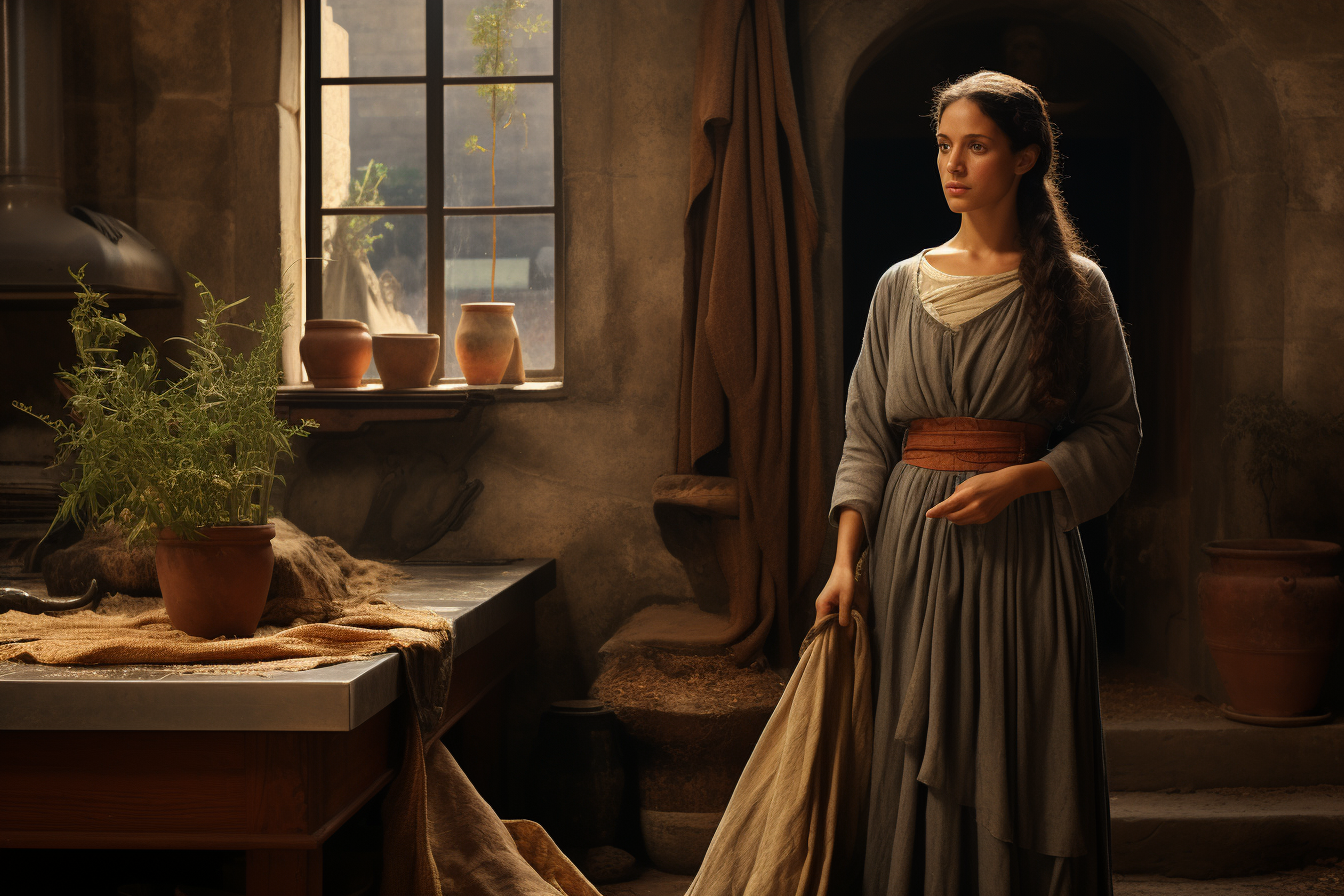
Not long after, Zita became loved by every member of the household. Soon, she was made the chief housekeeper. Despite this, she still carried out her duty with vigor and dedication.St. Zita about to clean a room

Death and Canonization

Zita lived a fulfilled life. She served the Fatinelli household until her death on April 12, 1272. On the night she died, a star rose above her room in the attic. She died at the age of 60. She was dearly loved and adored by the Fatinelli family.

Her body was exhumed in 1580 and found to be incorruptible. The body is displayed in the Basilica di San Frediano for public veneration.

Zita was canonized in 1696 after more than 150 miracles were reported to have taken place due to her intercession.

Veneration

A cult grew in her name after her death. The cult was centered at the Basilica of San Frediano in Lucca. Pope Innocent XII formally approved this cult in 1696. She is known as the patron Saint of domestic workers.

Her feast day is observed on April 27.

Prayer to St. Zita

St. Zita inspires us to take pride in our daily work and do it to the best of our abilities out of Love for God. May we find Jesus in the most menial of tasks. May we always embrace a spirit of obedience and charity, as you did. Pray for us, St. Zita, that we may have a generous heart that gives even when we have little. Place a trust in Jesus deep in our hearts so that we may never experience despair or loss of hope. Please carry the petitions we hold in our hearts to Jesus on our behalf. Mention your intentions here. Amen.

Source: https://www.catholicdoors.com/prayers/novenas/p03684.html

St. Paschal

When they lived: Saint Paschal Baylon lived during the late 16th century, specifically from May 24, 1540, to May 17, 1592.

Where they lived: Saint Paschal was born in Torrehermosa, a small village in the Kingdom of Aragon, which is now part of Spain. He spent most of his life in the region of Valencia.

Notable world events during the time of their life:

  • Scientific Revolution Begins (1543): Copernicus publishes his groundbreaking work “De revolutionibus orbium coelestium,” challenging the prevailing geocentric model of the universe and laying the foundation for modern astronomy.
  • Spanish Armada (1588): The Spanish Armada, a fleet of ships sent by King Philip II of Spain, attempts to invade England but is defeated by the English navy. This event marks a significant shift in the balance of power in Europe.
  • Battle of Lepanto (1571): The naval Battle of Lepanto takes place, where the Holy League, led by the Papal States and various Catholic maritime states, defeats the Ottoman Empire, preventing its further expansion into Europe.
  • Elizabethan Era (1558-1603): The reign of Queen Elizabeth I of England sees a flourishing of arts, exploration, and literature, including the works of William Shakespeare, which continue to impact culture to this day.
  • Treaty of Tordesillas (1494): Although this event predates Paschal’s life, its consequences shape the era. The treaty divides newly discovered lands outside Europe between Portugal and Spain, leading to European colonization of the Americas.
  • First Permanent English Settlement in America (1607): Jamestown, the first permanent English settlement in the Americas, is established in what is now the state of Virginia, marking the beginning of the colonization of North America.

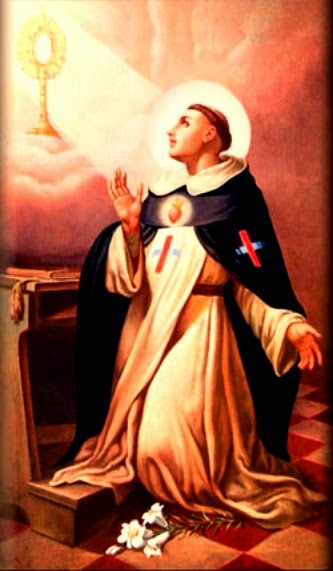
Their patronage: Saint Paschal Baylon is the patron saint of Eucharistic congresses and Eucharistic associations. He is revered for his deep devotion to the Eucharist and his unwavering faith in the real presence of Christ in the Blessed Sacrament. His life story is an inspiring testament to the transformative power of faith and the importance of spiritual communion with the divine.

Early Life

Paschal Baylon was born at Torrehermosa in the Kingdom of Aragon in Spain on May 16, 1540. It was the day of the Feast of Pentecost, and for this reason, his parents named him Paschal. His parents, Martin Baylon and Elizabeth Jubera, were not particularly wealthy individuals.

Early Childhood

He worked as a shepherd from the age of 7 until the age of 24. His life of mortification began when he was a shepherd. He prayed while on duty, and he was attentive to the church bell that rang at the elevation during Mass. He was an extremely honest and responsible young man. When his animals damaged crops in the fields, he took full responsibility and offered to pay the owners damages.

To fight illiteracy, he carried a book when he went to the fields where he looked after sheep. He asked people that he met to teach him how to read the letters in the book. Due to this dedication, Paschal was able to read at a very tender age.

Despite being poor himself, Paschal always helped other poor people wherever he could. At some point, he would give away part of his dinner to the poor. His pious nature influenced people to adore and respect him. He was also an individual with high levels of respect for those he came across.

In 1564, Paschal joined the Friars Minor and went into a life of penance wholeheartedly. He turned down the opportunity to study for the priesthood because he felt that it was not his path. He chose to be a brother instead.

He did not like comfort, and as a result, he wore a coat with steel spikes or a tunic lined with rough pig hair designed to cause discomfort. He walked barefoot in the snow and on the roughest roads. He also slept outside in the cold, occasionally. He adapted to all places and seasons. He was always content and cheerful.

Lifestyle

He was a cook, porter, gardener, and official beggar who went around asking for alms. He lived his life in contemplation and meditation all the time, even at work. He never wasted food. He preferred eating leftovers from the kitchen. At the end of each week, he ate a few boiled vegetables soaked in water with wormwood.

He was a devoted Christian who spent nights at the altar to commune with God through meditation on faith. In 1576, he was sent to France to defend the Real Presence against the opinions of Calvinist preachers. As he was preaching, he was despised, and the Huguenot mob wanted to kill him. They chased him away, throwing stones and dirt at him. He suffered a broken shoulder and bruises.

Date of Death

Paschal fell ill and died on May 17, 1592, at the age of 52. He was buried in Villarreal, where his tomb became a place of pilgrimage where miracles were performed. In 1730, an indigenous Guatemalan claimed to have seen Saint Paschal appear as a skeleton in robes. This event became the basis of the heterodox tradition of San Pascualito.

Pope Paul V beatified Paschal on October 29, 1618, and Pope Alexander VIII canonized Paschal as a saint on October 16, 1690. Today, he is celebrated annually by Catholics.

Patronage

Pope Leo XIII proclaimed the Saint as the seraph of the Eucharist and patron of Eucharistic Congresses and affiliated associations. Pope John XXIII named the Saint as the patron saint of the Sergobe diocese on May 12, 1961.

5 Interesting Facts About St. Paschal

  1. His tomb at Villareal was a source of many miracles, and it became a
    place of pilgrimage.
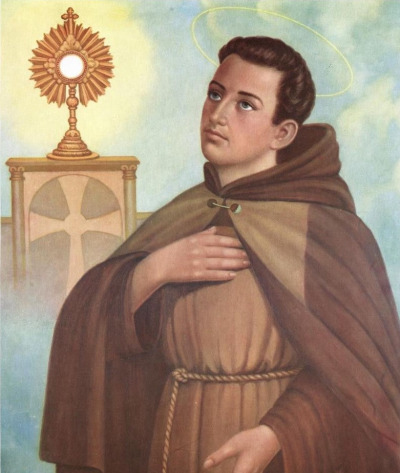
    3. Art often depicts him wearing the Franciscan habit and bearing a
    monstrance to signify his devotion to the Holy Eucharist.
  2. St. Paschal’s grave was desecrated, and anti-clerical leftists had
    His relics burned during the Red Terror at the time of the Spanish Civil War.
    War.
    5. In 1730, an indigenous Guatemalan claimed to have seen Saint Paschal.
    appearing as a skeleton in robes. That was the beginning of the
    heterodox tradition of San Pascualito.

Prayer to St. Paschal

I desire to love you, my Lord, my light, my strength, my deliverer, my God, and my All. What have I in heaven, O Lord,and what do I want besides your love and grace? You are the God of my heart; you are my portion and my inheritance for eternity. Amen. (A Prayer of St. Paschal) St. Paschal, you were filled by the Holy Spirit with a wondrous love for the sacred mysteries of Christ’s Body and Blood. Intercede for us now that we may obtain the grace of profound faith and tender devotion for Jesus in the Most Blessed Sacrament. May we draw from the Eucharist the same spiritual riches you received with great joy, and may our lives reveal the enduring fruit of love, generosity, and goodness to the glory of God our Father. St. Paschal Baylon, lover of the Eucharist, pray for us. Amen.

St. Pantaleon

When they lived:

St. Pantaleon, also known as Saint Panteleimon, lived during the late 3rd century to early 4th century AD. His exact birth and death dates are not widely agreed upon, but he is believed to have lived around 275-305 AD.

Where they lived:

St. Pantaleon was born in Nicomedia, a city located in present-day Turkey. During his life, Nicomedia was an important center of the Roman Empire and served as the capital of the eastern provinces.

Notable world events during the time of their life:

  • Diocletian’s Persecution (303-311 AD): St. Pantaleon’s life coincided with the infamous Diocletianic Persecution, one of the most severe and widespread persecutions of Christians in the Roman Empire. This event had a profound impact on the Christian community, resulting in the martyrdom of many believers, including St. Pantaleon himself.
  • Edict of Milan (313 AD): During St. Pantaleon’s time, the Edict of Milan was issued by Emperor Constantine the Great and his co-emperor Licinius. This edict granted religious tolerance to Christianity, officially ending the persecution of Christians and allowing them to practice their faith openly.
  • Council of Nicaea (325 AD): This significant ecumenical council was convened to address theological disputes within the Christian community, particularly the Arian controversy. Though St. Pantaleon did not directly participate in this event, it had a profound impact on the development of Christian doctrine.
  • Birth of Constantine the Great (272 AD): The birth of Constantine the Great, who would later become the first Roman Emperor to convert to Christianity and play a pivotal role in its legalization and promotion, occurred during St. Pantaleon’s lifetime.
  • Galen’s Medical Contributions: St. Pantaleon’s era saw the influence of Galen, a prominent physician and medical researcher. Galen’s works on anatomy, physiology, and medicine laid the foundation for medical understanding for centuries to come, influencing the development of both Western and Islamic medical traditions.

Their patronage:

St. Pantaleon is widely venerated as the patron saint of physicians, doctors, and healing. His life as a healer and his ultimate martyrdom for his Christian faith make him a symbol of compassion, selflessness, and unwavering devotion. His story resonates with those in the medical profession and those who seek healing, both physical and spiritual. St. Pantaleon’s patronage extends beyond the realm of Catholicism, touching the lives of people from various cultural and religious backgrounds who admire his legacy of service and sacrifice.

Early Life

Once in 275, Izmit, Nicodemia, near the Black Sea, now modern Turkey, bore a gifted physician with the ultimate power of healing, a penitentiary, and later a martyr.

To talk about his patrilineal lineage, his father was Eustorgius, and sources call him a non-devotee till lateral in the life of Pantaleon,but his mother, Eubula, was a fervent Christian.

Sadly, Eubula died while Pantaleon was a juvenile. While she had exposed him to Christianity, Pantaleon did not exercise his faith.

Journey Towards Faith

His father, Eustorgus, recommended him study under a famous practitioner and physician, and ultimately he was appointed by Emperor Maximus as his royal physician.

Regarded in the West in the list of the late-medieval Fourteen Holy Helpers and in the East as one of the Holy Unmercenary Healers, he was a martyr of Nicomedia in Bithynia during the Diocletianic Persecution of 305 AD.

While practicing in court, he met a Christian named Hermolaus, who later became his loyal advisor and a close friend. Hermolaus expounded to him that, though the famous physicians of earlier generations knew how to heal bodies, Jesus Christ was a far more magnificent physician, apt to heal not only bodies but souls by His divine doctrine.

On the way to work, Pantaleon suddenly accomplished extraordinary healing, recovering a child from absolute death following a bite from an aviper. Calling for no additional testimony of the power of the Lord, he was baptized and started an uncompromising path of study of his new faith. He finally treated a blind man. Hearing about his miraculous healing, his father also converted to Christianity.

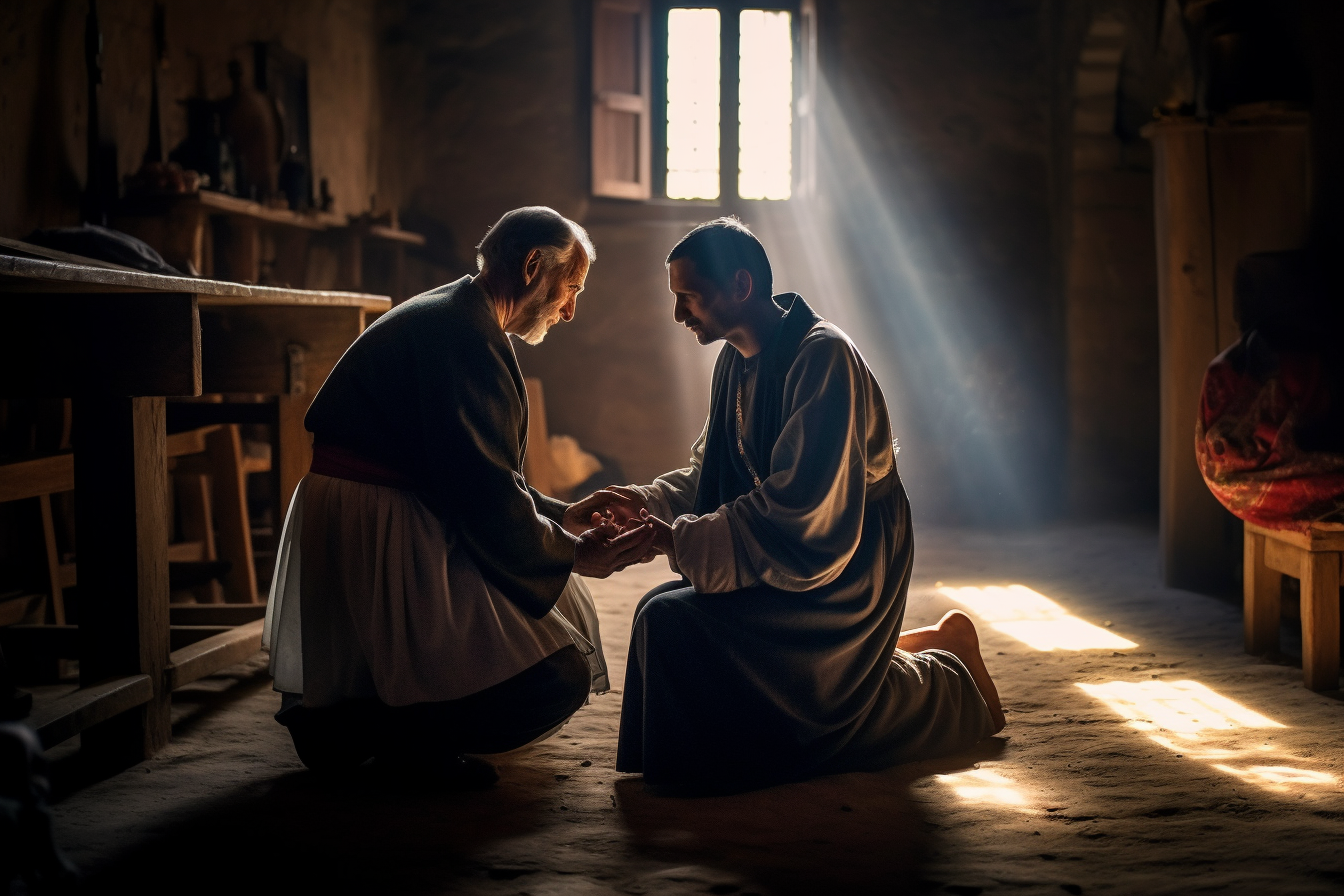
St. Pantaleon healing a blind man

Freeing of Slaves

When his father perished, Saint Pantaleon freed all his slaves on the inherited estate, traded a big part of his belongings, and spent the money to free slaves and the poor.

He treated different sicknesses and quickly became renowned in Nicodemia, growing popular among rival physicians who reported him to the Emperor.

His opponents asked Pantaleon to give up to the pagan Roman gods, but he declined. They then sentenced him to torture and to be killed. Later, he beheaded Saint Pantaleon in 303.

His body was blessed with myrrh and buried on the outskirts of the city. Devotees later translated his remains to Constantinople, where they are revered today. It is claimed that his blood, conserved in a small vial,liquefies on his feast day, becoming oxygenated. Charlemagne again translated some of his relics, including his head, to France and remained in the nunnery of Saint Denys near Paris and Lyons.

Patronage

Saint Pantaleon, the noble’s name, meant ‘all-compassionate one’. He is the patron saint of physicians, apothecaries, midwives, livestock, lottery winners and victories, lottery tickets, and is invoked against headaches, consumption, locusts, witchcraft, accidents, and loneliness. He is also a helper for crying children.

Canonization

His status is Pre-Congregation. The term is used for saints that were canonized a long time ago. The process either took place before or after the establishment of an organization that could keep a record of the exact time of the process.

Sometimes it indicates that beati were canonized by local community bishops, primates, or patriarchs of the saint, usually due to prevalent devotion.

To simplify, it indicates that the dates for beatification and/or canonization are not publicly known due to the absence of a dignified recording system. If there were records, they are not commonly known.

5 Interesting Facts About St. Pantaleon

  • In Italy, Pantaleon promises lottery numbers, victories,
    and winners in dreams.
  • Even though there is proof to suggest that a martyr named
    Pantaleon prevailed; some believe the legends of his life and
    death to be merely a fable.
  • Armenians maintain that the Amaras Monastery in Nagorno-Karabakh
    encloses monuments of St. Pantaleon, which were esteemed in the
    eastern provinces of Armenia.
  • St. Pantaleon is the signature of the character Pantalaimon in
    Philip Pullman’s His Dark Materials series of novels
  • A Russian company renamed the Russian battleship Potemkin to
    Panteleimon after her recovery after the mutiny of 1905.

Prayer to St. Pantaleon

St. Panteleon, who during life didst have great pity for the sick and, with the help of God, often relieved and cured them, I invoke your intercession with God that I may obtain the grace to serve Him in good health by cheerfully fulfilling the duties of my state of life. But if it be His holy will to visit me with illness, pain, and suffering, do thou aid me with thy powerful prayer to submit humbly to His chastisements, to accept sickness in the spirit of penance, and to bear it patiently according to His holy will. Amen.

St. Olympias

When they lived:

St. Olympias, also known as Olympia, lived during the late 4th and early 5th centuries, precisely from around 361 to 408 AD.

Where they lived:

Born in Constantinople (modern-day Istanbul, Turkey), St. Olympias spent the entirety of her life in the Byzantine Empire’s capital. This bustling city, a crossroads of cultures and power, would significantly influence her journey.

Notable world events during the time of their life:

  • The Sack of Rome (410 AD): Olympias lived through the fall of Rome, a pivotal event that marked the first time in almost 800 years that the city had been conquered. This event shook the Western world and reshaped the geopolitical landscape of Europe.
  • Council of Nicaea (325 AD): Though this event occurred before her time, the Council of Nicaea’s reverberations continued during Olympias’ life. The debates and decisions of this ecumenical council played a crucial role in shaping the early Christian Church’s theology and structure.
  • The Huns’ Invasions (4th and 5th centuries): The Huns, a nomadic warrior group from Central Asia, wreaked havoc across Europe during Olympias’ lifetime. Their invasions led to the movement of various tribes and peoples, contributing to the fall of the Western Roman Empire.
  • Theodosian Code (438 AD): Emperor Theodosius II completed the Theodosian Code, a comprehensive compilation of Roman laws that significantly influenced subsequent legal systems in the Byzantine Empire and beyond. This legal document played a crucial role in shaping the administration of justice in the Eastern Roman Empire.
  • Development of Monasticism: The 4th and 5th centuries were pivotal for the development of Christian monasticism. Influential figures like St. Anthony the Great and St. Pachomius laid the foundations for the monastic tradition, which would later become a hallmark of Christian spirituality.

Their patronage:

St. Olympias is revered as the patron saint of widows, the suffering, and the wronged. Her story is a testament to her unwavering dedication to the Christian faith and her commitment to helping the less fortunate. Despite her privileged background, Olympias chose a life of selflessness and service, using her resources to provide for widows, orphans, and those who had been marginalized by society.

Olympias’ impact extended beyond charity work. She played an active role in Church affairs, even in an era when ecclesiastical politics were tumultuous. Her steadfast loyalty to her spiritual mentors, including St. John Chrysostom, showcased her resilience in the face of adversity.

In an age marked by both spiritual fervor and worldly turmoil, St. Olympias’ story emerges as a beacon of compassion, resilience, and unwavering faith. Her legacy reminds us that even in the most challenging of times, individuals can make a lasting impact by embodying the virtues of kindness, justice, and devotion to higher ideals.

Early Life

Olympias, also known as Olympias the Younger, differentiates her from her late paternal aunt, who was once engaged to Roman Emperor Constans. She was of noble birth, born into an illustrious family with Greek ancestry.

Her father was Seleucus, a wealthy Greek rhetorician, and her mother was an Antiochian Greek noblewoman named Alexandra.

Olympias was born around 361. She was said to have been born and raised either in Constantinople or Antioch. She was the heir to a large fortune.

Sadly, Olympias was orphaned and taken into custody by her paternal Christian uncle, Procopius. Her nanny was Theodosia, a good Christian. Together, they raised Olympia into an intelligent, God-fearing young woman.

Young and Rich

In 384 or 385, after about 18 years, she married Nebridus, a Prefect of Constantinople. Their union was short-lived and they had no children. Nebridus died two years after their marriage, leaving Olympia a Young, rich widow.

Young, attractive, and wealthier, many suitors sought to marry her soon after she lost her husband. But Olympias had decided to live the rest of her life as a consecrated widow. Emperor Theodosius had recommended his cousin Elpidius as a suitable match for Olympias, an offer she turned down.

Irritated at her refusal to wed, his cousin, Emperor Theodosius, confiscated her fortune and placed it in the trust of the Urban Prefect Administration until she was 30. Notwithstanding the loss of her wealth,Olympias devoted her life to charity and the service of God.

Passion at the Service of God

Olympias continued to be a generous giver—too helpful, even. She gave everything she had to charity and supported the church. Working in the church and for God was all she lived for.

In 391, following her appeal and boldness of speech, emperor Theodosius restored Olympias to the administration of her fortune. She promptly put the money to use, building hospitals and orphanages, donating to charity and the church, caring for the sick, and sheltering monks running away from persecution in Egypt.

In 398, Olympias built a convent where she and other young women retired to live a monastic life. The community grew in number, and Olympias became a sort of abbess in the community.

At 30, she was consecrated a Deaconess by Nectarius, bishop of Constantinople. Later, when John Chrysostom (St.) became the bishop of Constantinople, he became a spiritual guide for Olympias and her community of sisters.

Fellowship with St. John Chrysostom

Olympias found in John Chrysostom a friend, confident, and spiritual guide. A fiery preacher, John is reputed to shun dinner parties but would accept food prepared by Olympias.

It was John who guided Olympia on how to properly use her enormous fortune for charity. Owing to her large heart, many people tried to take advantage of her, knowing how quickly she gave up a good course.

Olympias and John Chrysostom have in common an ascetic lifestyle and devotion to caring for the poor. Olympias was friends with many notable holy people, including Gregory of Nazianzen and Gregory of Nyssa.

Following a fallout with Empress Eudoxia, John Chrysostom was banished in 404. The Empress had assumed John’s denunciation of extravagance in feminine dressing was aimed at her.

Standing Firm with the Truth

While in exile, Olympias still stood with John, helping in any way she could. She refused to associate with the newly appointed successor, maintaining the unlawfulness of the action against John.

John had always preached against abuse of power by religious and political leaders, which earned him some foes, notably Theophilus, the Patriarch of Alexandra, and the Empress.

Standing with John and being a loyal disciple of his soon-to-be prosecution to Olympias She was slandered and persecuted for refusing to accept Arsacius and his successor, Atticus, who had usurped John’s position.

Atticus, the new bishop, disbanded her community and stopped her charities. Olympias was forced into exile at Nicomedia. She left behind everything she had and the city she had known all her life.

While in exile, John sent letters to comfort her during the persecution against her. She fell sick while still in Nicomedia.

On July 25, 408, she passed away, just about a year after John Chrysostom’s death.

5 Interesting Facts About St. Olympia

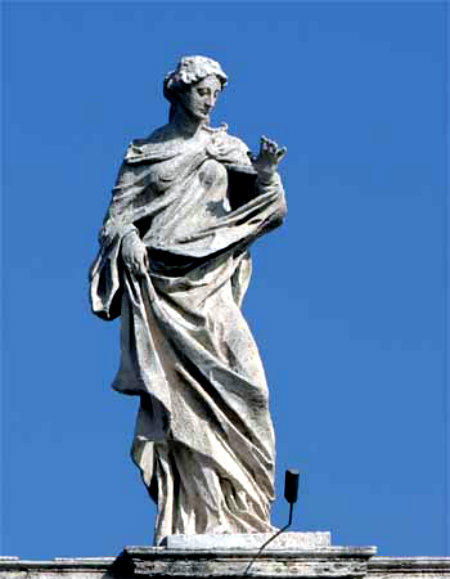
  1. Do you know that St. Olympias is one of the 140 colonnade saints at
    St. Peter’s Square, Basilica of Rome Her statue was erected.
    1667-1668.
  2. Her coffin was thrown into the sea, following the instructions she
    had left behind before her death. She wished her final resting
    place would be decided by God. The coffin was carried by waves to
    Brokthoi, a suburban shore near Constantinople.
  3. Are you willing to stand up for justice, and what is correct at your
    discomfort? St. Olympia stood with the truth even at the
    detriment of her life and comfort.
  4. Not many know that 17 of those correspondences she received from
    John Chrysostom while in exile are still intact.
  5. James 2:26: Faith without work is dead’. St Olympias,
    Through her works, she lived her faith. An exemplary life of preaching
    faith and doing it.

Prayer to St. Olympias

Although there is no official prayer to St. Olympias, from the Roman Missal, a prayer for the Common of Holy Women could be adopted.

God, the exaltation of the lowly, who willed that blessed Olympias should excel in the beauty of her charity and patience, grant, through her merits and intercession, that, carrying our cross each day, we may constantly persevere in love for you. Through our Lord Jesus Christ, your Son, who lives and reigns with you in the unity of the Holy Spirit, one God, forever and ever Amen.

(from The Roman Missal: Common of Holy Men and Women, For a Holy Woman)

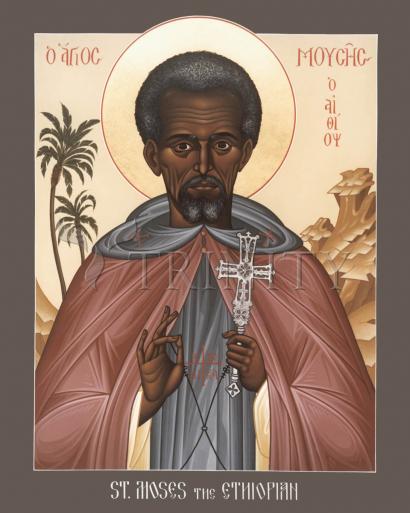
St. Moses

When They Lived:

St. Moses, also known as Moses the Black or Abba Moses, lived during the 4th century. His life spanned from approximately 330 AD to 405 AD.

Where They Lived:

Moses the Black resided in the region of Egypt, particularly in the desert wilderness surrounding the Nile Delta. He spent a significant portion of his life as a monk in the Nitrian Desert, which was a hub of Christian monasticism during that era.

Notable World Events During Their Life:

  • Council of Nicaea (325 AD): Moses the Black lived during a time when the early Christian Church was grappling with theological disputes. The Council of Nicaea in 325 AD was a significant event that addressed the nature of Christ’s divinity and formulated the Nicene Creed, shaping the foundations of Christian belief.
  • Fall of the Western Roman Empire (476 AD): Moses’s life coincided with the decline of the Roman Empire. In 476 AD, the last Roman emperor was overthrown, marking the end of the ancient Western Roman Empire and ushering in the medieval period in Europe.
  • Invasion of the Huns (375-454 AD): The migration and invasions of the Huns, a nomadic warrior culture, had a profound impact on the Eastern Roman Empire and its neighboring regions during Moses’s lifetime. These events reshaped political dynamics and territorial boundaries.
  • Life of St. Augustine (354-430 AD): While not a contemporary of Moses, the life and writings of St. Augustine of Hippo intersected with Moses’s era. St. Augustine’s influential theological works, such as “Confessions” and “City of God,” provided insights into the Christian thought of the time.
  • Founding of Constantinople (330 AD): Moses the Black witnessed the founding of Constantinople (modern-day Istanbul) by Emperor Constantine the Great. This city’s establishment as the new Eastern Roman capital would have had political, cultural, and religious implications for the Christian world.

Their Patronage:

St. Moses the Black is recognized as the patron saint of those who have turned their lives around, seeking redemption and a path of spiritual transformation. His life story, marked by a dramatic conversion from a life of crime to one of asceticism and holiness, serves as an inspiring example of the power of redemption and the capacity for change.

Intriguing Narrative:

Moses the Black’s life is a remarkable journey from a life of crime to sainthood. Born into slavery in Africa, he escaped and became a feared bandit and criminal. However, a chance encounter with a group of monks in the desert led him on a path of self-discovery and spiritual awakening. Over time, Moses embraced monasticism and lived as a desert hermit, renowned for his wisdom, humility, and deep spirituality.

Early Life

Born in 330 AD in Ethiopia, Saint Moses is known by several names. The names he is also known for include Moses the Black, Abba Moses the Robber, the Ethiopian, and the Strong (Starodubcev, 2019).

He is highly respected in several branches of Christianity, including the Eastern Orthodox Church, the Oriental Orthodoxy, the Roman Catholic Church, the Eastern Catholic Churches, the Anglican Communion, and Lutheranism (Starodubcev, 2019). The major shrine of Saint Moses is in Paromeos Monastery, Church of the Virgin Mary, in Scetes, Egypt.

Before his conversion to Christianity, Saint Moses worked as a government official in Egypt (Starodubcev, 2019). However, after being found guilty of theft and suspected of murder, Saint Moses was immediately dismissed from being a government official (Starodubcev, 2019). After a life of crime, what made Saint Moses turn to Christianity? Let’s read on and investigate further.

From Sinner to Ascetic

While attempting to rob someone in the early hours of the morning, a dog hindered Moses from succeeding in the robbery (Gasperetti, 1952). As a result of this, Moses swore vengeance on the owner of the dog. Moses then proceeded to swim down the river, close to the owner’s hut, with his weapons in his mouth (Gasperetti, 1952). Again, alerted by the dog,the owner hid away from Moses, and Moses became frustrated. In this moment of frustration, Moses proceeded to slaughter some of the sheep belonging to the owner (Gasperetti, 1952).

The owner immediately reported Moses to the local authorities, and Moses was soon on the run. Extremely tired, Moses sought refuge with monks in a colony in the desert, now called Scetes, near Alexandria in Egypt (Gasperetti, 1952). Moses soon became heavily influenced by the monks and their ways of life, especially their dedication, peace, and commitment to their faith. As a result of this, Moses decided to turn a new leaf and soon became a Christian (Gasperetti, 1952). After a few months of learning the teachings of the monks, Moses was baptized and joined the monastic community in Scetes, becoming a notable desert father. The Desert Fathers, in the Christian faith, were the first early Christian hermits, monks, and ascetics (Gasperetti, 1952). They lived mainly in the desert in Scetes, Egypt, around the third century AD.

Life as a Monk in the Monastic Community

Moses struggled greatly with adapting to the monastic life he found himself in (Sister Felicity, 1964). The main reason for this The sense of adventure within Moses remained with him. One night, Moses was brutally attacked by a group of robbers in his desert cell (Sister Felicity, 1964). Moses fought back and took the robbers to the chapel,where other brothers in the monastery were busy with their prayers. After much discussion, the robbers repented for their sins and soon joined the community, becoming brothers later (Sister Felicity, 1964).

Moses believed he was not perfect enough to be a monk until one morning, when the abbot of the monastery spoke to him. He lifted Moses hopes of becoming a monk (Sister Felicity, 1964). It was from this day on that Moses proved himself and found that he was effective as a prophetic and spiritual leader. One notable moment in which this can be seen is when a fellow brother committed a fault and Moses was called to attend a meeting to discuss an appropriate penance for the brother (Sister Felicity, 1964).

Moses refused to attend this meeting, and when called to another meeting regarding the same subject matter, Moses took a leaking jug filled with water on his shoulder to the meeting. Upon arrival, the brothers questioned Moses about the leaking jug (Sister Felicity, 1964). Moses proceeded to explain to the brothers that his sins are unseen by him behind him, but he is here to judge the sins of another brother. After Moses said this, the other brothers forgave the monk.

Soon after this, Moses became the spiritual leader of the hermits in the Western Desert (Sister Felicity, 1964). He led them with pride in his heart, and soon he was ordained as a priest.

Death

Saint Moses passed away at the age of 75 years old in 405 AD (Kravchenko, 2021). He passed away in the Natron Valley, Egypt. This was following an attack on the monastery by a group of Berbers. Instead of taking up weapons, Saint Moses decided to remain behind and was joined by seven other brothers in a violent death by the robbers (Kravchenko, 2021). Together, they were martyred by the bandits, and their legacy lives on.

Today, St. Moses is celebrated as the saint of Africa and non-violence.

5 Interesting Facts About St. Moses

  1. Saint Moses is known as a man of peace for his humility and
    example set by repenting for the awful crimes he committed while being
    a bandit
  2. During his ministry, Saint Moses called people to reconciliation.
    and forgiveness by word and example
  3. Before becoming a Christian, Saint Moses was the leader of a gang of
    bandits that roamed the Nile Valley, spreading terror and violence.
    wherever they could.
  4. Saint Moses was trained by Abba Isidore the Priest to become a
    monk and later, an ordained priest
  5. Saint Moses started out his life as a slave in the home of an
    Egyptian governor.

Prayer to St. Moses

Almighty God, whose blessed Son guides our footsteps in the way of peace: Deliver us from paths of hatred and violence, that we, following the example of your servant Moses, may serve you with singleness of heart and attain to the tranquility of the world to come, through Jesus Christ our Lord, who lives and reigns with you in the unity of the Holy Spirit, one God, now and forever. Amen.

Reference List

Starodubcev, T. (2019). St. Moses, the Ethiopian or the black Cult and representation in the Middle Ages Zograf, pp. 1–22. DOI:10.2298/ZOG1943001S.

Gasperetti, E. (1952) Saint Moses the Black, Negro History Bulletin, 15(8), 167–169. Retrieved August 2, 2021, from [http://www.jstor.org/stable/44212567] {.ul}.

Sister Felicity (1964) St. Moses the Black Life of the Spirit (1946–1964), 19 (214), 36–38 Retrieved August 2, 2021, from [http://www.jstor.org/stable/43706454] {.ul}

Kravchenko, E.V. (2021). The Matter of Race: The Brotherhood of St. Moses the Black and the Retelling of African American History through Orthodox Christian Forms Journal of the American Academy of Religion, 89(1), pp. 298–333. DOI:[https://doi.org/10.1093/jaarel/lfab025] {.ul}

St. Michael de Sanctis

When they lived: St. Michael de Sanctis, also known as St. Miguel de los Santos, lived from September 29, 1591, to April 10, 1625.

Where they lived: St. Michael de Sanctis was born in the town of Valladolid, located in present-day Spain. He spent a significant part of his life in various monastic communities.

Notable world events during the time of their life:

  • Thirty Years’ War (1618-1648): This prolonged conflict in Europe had significant political and religious ramifications, impacting various regions and powers across the continent.
  • Scientific Revolution: During St. Michael de Sanctis’ lifetime, the Scientific Revolution was unfolding. This period saw a surge in scientific discoveries, including the development of the telescope by Galileo Galilei, the formulation of Kepler’s laws of planetary motion, and advancements in anatomy and physics.
  • Exploration and Colonization: The Age of Exploration was continuing during St. Michael de Sanctis’ time, with European nations exploring and colonizing new lands. The establishment of settlements in the Americas, Africa, and Asia was reshaping global geopolitics and trade.
  • English Civil War (1642-1651): While St. Michael de Sanctis passed away before the conflict began, his lifetime witnessed the early tensions that eventually led to the English Civil War, which had profound effects on England’s political and social landscape.
  • Foundation of Harvard University: In 1636, Harvard University was established in Massachusetts, USA, becoming the oldest institution of higher education in the United States. This event marked a significant step in the development of education in the New World.

Their patronage: St. Michael de Sanctis is known as the patron saint of those struggling with temptation, mental illness, and mental disorders. He is often invoked by individuals seeking strength to overcome inner struggles, anxiety, and emotional turmoil. St. Michael de Sanctis’ own experiences of inner battles and his unwavering faith make him a relatable and inspiring figure for those facing similar challenges.

Making it interesting: In an era characterized by global conflicts, scientific advancements, and the expansion of empires, St. Michael de Sanctis’ story stands out as a beacon of hope and resilience. Born in a small town in Spain, he navigated the tumultuous world around him while grappling with his own inner demons. At a time when exploration and curiosity were reshaping the understanding of the natural world, St. Michael embarked on a journey of self-discovery and spiritual enlightenment. His struggles with temptation and mental turmoil mirror the broader societal upheavals of his time, making him a relatable figure for modern individuals wrestling with their own internal conflicts.

Early Life

Saint Michael de Sanctis, also known as Michael of the Saints to many,might have lived a brief life but left a large impact on the Church.

He spent his life living in piety and holiness.

Saint Michael was born Michael Argemir. He was born on September 29, 1591, in Vic, Spain. His parents, Enrique Argemir and Monserrat Margarita Mitjana, played vital roles in his quest for spirituality.

From a very young age, Saint Michael was dedicated to Christianity. He made sure to pray, fast, and even vow to remain a virgin.

When he was 6 years old, Saint Michael told his parents about his interest in becoming a monk. They saw how dedicated he was to religion and agreed to his wishes.

Saint Michael’s mother informed him about Saint Francis of Assisi. Michael was so impressed by the Saint’s piety that he tried to emulate him.

Even at a young age, Saint Michael began to practice mortification. He prayed for long hours, fasted for days at a time, and was even said to have restrained himself from eating meat.

Although his parents were impressed, they grew alarmed at his extremes and restrained him.

Some years later, but still at a young age, Saint Michael was orphaned. This caused him to be much closer to God than he had initially been.

Saint Michael was taken to serve as an apprentice to a trader after his parents died.

Dedication and Devotion

Saint Michael de Sanctis excelled at work. He spent his free time praying, meditating, preaching, and even helping the needy.

When he was twelve years old, Circa 1603, he came to Barcelona on a quest to become a part of the Trinitarians. After spending three years with the Trinitarian Friars, he took his vows in Saint-Lambert Church in Zaragoza around 1607.

It was with the Trinitarians that he assumed the name Michael de Sanctis.

He enjoyed his practice until he met with a Discalced Trinitarian priest one day. Saint Michael was awed by their strict practices and sought to become a priest himself.

After receiving permission from his superior, Saint Michael joined the Church of the Discalced Trinitarians. He said his vows at Alcalá, after which he was made to undertake the education of the Friars.

He was ordained a priest and bestowed authority over the community.

Legacy

Saint Michael de Sanctis was revered for his humility, love for the people, and dedication to the Church.

Not only does tradition state that Saint Michael could pray the sick back to health, but some also claim he often slid into trances. During these trances, he was said to have been seen levitating on several occasions.

In one story set in Cordova, Saint Michael was reported to have been seen being lifted in the air above the choir stand, over a field, and coming to rest in the church tower. He was also said to have levitated in Salamanca.

These reports of levitation were said to have been indices of ecstasies during prayer. Even before his death, he was called a Saint by many.

Saint Michael was twice appointed Superior of the Monastery in Valladolid. He took on leadership with a strict yet humble hand.

Death and Canonization

Saint Michael de Sanctis died on April 10, 1625, at the age of 33. He passed away at the Valladolid monastery in the Kingdom of Spain.

Many miracles are attributed to Saint Michael, even after his death.

He received beatification from Pope Pius VI on May 24, 1779. He was canonized on June 8, 1862, by Pope Pius IX.

Saint Michael de Sanctis is celebrated every year on the day of his death by the Roman Catholic Church.

5 Interesting Facts About St. Michael de Sanctis

  1. Did you know that Saint Michael de Sanctis took a vow of chastity?
    at the age of 8?
  2. Did you know that Saint Michael was partial to the Rosary and the Virgin Mary?
    Mary?
  3. Did you know that Saint Michael is said to be one of the patron saints?
    saints of cancer patients?
  4. Did you know that in his death, Saint Michael was said to have cured
    Frances Sanz of cancerous tumors?
  5. Did you know that the town of Saint-Michel-des-Saints in Canada is
    named after Saint Michael de Saints?

Prayer to St. Michael de Sanctis

O glorious Saint Michael, Seraph inflamed with the most ardent love of Jesus in the Blessed Sacrament, who did spend your nights and days in His Real Presence and did find there your dearest joys, so that you did swoon away for very love: vouchsafe, I pray to you, to obtain for me a lively faith, a firm hope, and an ardent love toward this inestimable Treasure, this precious Pledge of glory everlasting, in order that I may be able to behold Him face in an eternity of bliss. Amen.

Source:[https://www.catholicdoors.com/prayers/novenas/p03883.htm]{.ul}