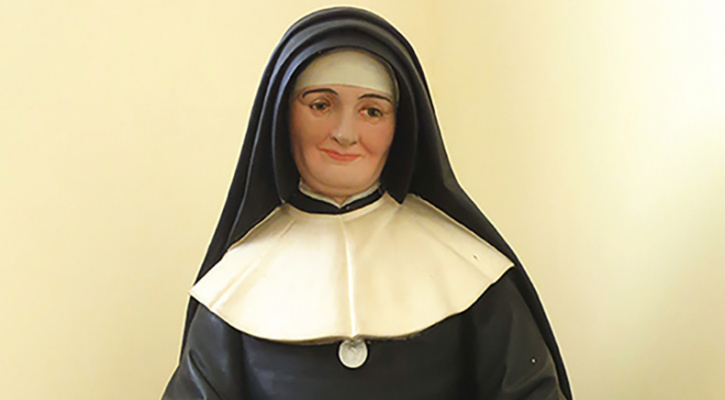
St. Marian

When they lived:

St. Marian’s life graced the pages of history during the early 3rd century, around the years 240 to 290 AD.

Where they lived:

St. Marian’s footsteps echoed in the ancient city of Antioch, situated in the Roman province of Syria, a bustling metropolis renowned for its cultural diversity and strategic significance.

Notable world events during the time of their life:

  • Crisis of the Third Century (235-284 AD): St. Marian lived through a tumultuous period marked by political instability, economic decline, and military struggles within the Roman Empire. This era saw multiple emperors rise and fall, contributing to widespread chaos and uncertainty.
  • Galen’s Medical Pioneering (129-216 AD): Amid the chaos, the renowned physician Galen’s works laid the foundation for modern medicine. His contributions to anatomy, physiology, and pharmacology significantly advanced the understanding of the human body and medical practices during St. Marian’s lifetime.
  • Diocletian’s Reforms (late 3rd century AD): St. Marian lived through the reign of Emperor Diocletian, who attempted to stabilize the Roman Empire through economic reforms, administrative restructuring, and religious policies. His efforts reshaped the empire’s governance and religious landscape.
  • Expansion of the Silk Road: St. Marian’s era witnessed the expansion of the Silk Road trade network, fostering cultural exchange between the East and West. The exchange of goods, ideas, and technologies along this ancient route had a profound impact on global civilizations.
  • First Recorded Pandemic (Antonine Plague, 165-180 AD): Though preceding St. Marian’s time by a few decades, the Antonine Plague’s effects lingered. This early pandemic, possibly caused by either smallpox or measles, left a scar on the Roman Empire and contributed to its changing dynamics.

Their patronage:

St. Marian stands as the patron saint of resilience and steadfastness in the face of adversity. Their life embodies the spirit of endurance and faith during times of upheaval, drawing strength from their unwavering commitment to their beliefs. St. Marian’s legacy serves as an inspiration for those navigating challenges in their own lives, teaching us that even in the midst of chaos, the light of hope and determination can shine brightly.

Early Life History

Marian, known as Mary, the virgin mother of Jesus, was born on September 8, 18 BC. She was a 1st-century Galilean Jewish Woman from Nazareth. According to the apocryphal Gospel of James, Mary was the daughter of St. Joachim and St. Anne. It is stated that Anne had been barren for a long time, and she was of advanced age when she gave birth to Mary.

When Mary was 3 years old, she was given to be of service in the Templein Jerusalem. However, the idea that she was allowed in the Holy of Holies is impossible, as this would have constituted blasphemy for ancient Jews.

Furthermore, some apocryphal accounts state that Mary was betrothed to Joseph when she was between 12 and 14 years old. Joseph was of advanced age. According to ancient Jewish custom, Mary could have been betrothed when she was about 12 years old.

Miracle Conception

The angel Gabriel appeared to Mary, who was a virgin at that time, and informed her that the Holy Spirit would make her conceive and that she would give birth to Jesus, the son of God. The angel told Mary to name her son Yeshua, which means salvation.

Just before the betrothal ceremony, Joseph discovered that Mary was pregnant. He planned to secretly leave her, but the angel of God told him not to leave her because the pregnancy was by the Holy Spirit. He told him not to hesitate to take Mary as his wife, and this paved the way for their marriage.

Mary was later told by the angel Gabriel that her relative Elizabeth, the mother of John the Baptist, was pregnant. She had been barren for a long time and was of advanced age. Elizabeth was the wife of a priest named Zechariah. Mary visited her, and upon her arrival, she was addressed by Elizabeth as the mother of her Lord.

The Roman Emperor Augustus declared that a census was to be held. Therefore, Joseph had to return to Bethlehem, his hometown, to register for a Roman census. He went to Bethlehem with Mary, and on arrival, Mary gave birth to Jesus in a manger because the local inn was full.

According to the gospel of Matthew, Joseph was warned in a dream that King Herod wanted to kill all infant boys, including baby Jesus. Herod had been informed that a newborn child was to be a king, and he felt threatened. Joseph and Mary fled by night to Egypt and lived there for some time. When Herod died, they returned to Nazareth in Galilee and lived there.

Mary was mentioned a few times in the New Testament when she was with Jesus. She was present when Jesus performed his first miracle during a wedding at Cana. At her suggestion, Jesus changed water into wine. She was also present among the women at the crucifixion, standing near the disciple whom Jesus loved, along with Mary of Clopas and Mary Magdalene.

Death of Mary

Mary lived for 11 years after the death of Jesus and died in 41 AD. On June 25, 1997, Pope John Paul II said that Mary died of natural causes before her assumption into heaven.

Feast Day

There are numerous feast days for St. Mary. However, there are two prominent feasts in the General Roman Calendar. On January 1, there is Mary, the Holy Mother of God’s feast day. On February 2, there is the purification of the Blessed Virgin Mary, also known as Candlemas.

Differences in feasts are influenced by doctrinal issues. A good example is the Feast of the Assumption. There is a lack of agreement among all Christians on the circumstances of the death or Assumption of Mary. Therefore, the feast of assumption is celebrated among some denominations but not others.

Patronage

Mary serves as the patron saint of all human beings, watching over them with motherly care. This is due to her role as the mother of Jesus Christ, the savior of the world.

5 Interesting Facts About St. Marian

  • Mary was 12 years old when she was engaged to Joseph and 13 when she
    gave birth to Jesus.
  • She was a virgin when she gave birth to Jesus. The Holy Spirit made
    Mary conceive.
  • Mary was instrumental in calling Jesus to perform his first miracle at
    a wedding in Cana. He turned water into wine.
  • According to Eastern Christian teachings, Mary’s tomb was found
    empty after her body and soul ascended to heaven.
  • Mary, just like her husband Joseph, was a descendant of King David.

Prayer to St. Marian

Hail Mary, full of grace; the Lord is with thee; blessed art thou among women, and blessed is the fruit of thy womb, Jesus. Holy Mary, Mother of God, pray for us sinners, now and at the hour of our death. Amen.
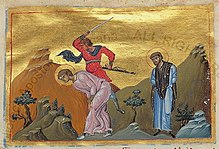
St. Alphege

St. Alphege: A Historical Perspective

When They Lived:

St. Alphege, also known as Alphege of Canterbury, lived from c. 954 to April 19, 1012.

Where They Lived:

St. Alphege lived primarily in England, particularly in the region of Canterbury.

Notable World Events During Their Life:

  • Viking Invasions: St. Alphege’s life was marked by the Viking Age, a tumultuous period characterized by repeated Viking invasions and raids across Europe.
  • Battle of Maldon (991): The Battle of Maldon was a significant conflict during St. Alphege’s lifetime, where the Anglo-Saxons faced off against Viking raiders.
  • Conversion of Vladimir the Great (988): The conversion of Vladimir the Great, ruler of Kievan Rus, to Christianity marked a momentous shift in the religious and geopolitical landscape of Eastern Europe.
  • Foundation of the University of Al Quaraouiyine (859): The establishment of the University of Al Quaraouiyine in Morocco stands as a testament to the growing importance of knowledge and education during St. Alphege’s time.
  • Canute the Great’s North Sea Empire: Canute the Great’s reign impacted the political dynamics of the region and influenced St. Alphege’s time.

Their Patronage:

St. Alphege is recognized as the patron saint of Greenwich in London and also of kidnap victims.

His patronage of kidnap victims comes from his own experience of being captured by Viking raiders in 1011. During his captivity, he exhibited unwavering faith and charity, leaving an enduring legacy that continues to inspire those facing adversity.

St. Alphege’s life and the events of his time are a testament to the challenges, triumphs, and spiritual resilience of an era marked by both turmoil and transformation. His story serves as a reminder of the power of faith, compassion, and courage in the face of daunting circumstances.

Early Life

Saint Alphege was born in Weston, Summerset, England. He was born around the year 953 A.D.

No detailed account mentions the names of his parents or what he did at a young age.

Saint Alphege joined a monastery in his early life and became a monk. He was first said to have joined the monastery at Deerhurst and spent some time there.

He moved to Bath, still in England, where he was said to have become an an anchorite.

Dedication and Devotion

Saint Alphege was a devoted young man who took great pleasure in studying the word of God. He was said to have spent time alone praying or been seen preaching in groups.

Although he was humble, he was also very austere. He took care not to get too comfortable with things he considered vanity.

Some parts of history claim that Alphege joined Glastonbury Abbey, where he became a monk. Not all historians agree with this claim, however.

Tradition has it that Saint Alphege became an abbot in Bath between the years 977 and 982.

Some historians account for the gap in the years by claiming that Alphege lived in Gloucester, where he was a monk. After asking to be allowed, it was said that he had left the Deerhurst monastery and gone into seclusion.

Several accounts claim he shared power as an abbot with his predecessor.

Saint Alphege was very respected. He was revered for his holiness and love for the Church. This caused him to be elected Bishop of Winchester around 984.

Some people account his appointment as a result of Archbishop Dunstan of Canterbury, who respected Alphege.

Saint Alphege received his vow of consecration on the 19th of October, 984.

As bishop, he commands authority in favor of establishing religious institutions. He was also said to have been in charge of the building of the organ in the Cathedral.

This huge instrument was said to have produced music that could be heard from more than a mile away.

Saint Alphege was also said to have promoted the cult of Swithun and that of his predecessor, Thelwold. He did this by transferring the reliquaries that belonged to Thelwold to a more befitting cathedral at Winchester.

Saint Alphege was also noted to have reached a treaty with a Viking named Olaf Tryggvason. Olaf was so impressed with Saint Alphege’s beliefs that it is said that he converted to Christianity.

Legacy

Around 1006, Saint Alphege was appointed Archbishop of Canterbury. In 1007, he traveled to Rome to accept the pallium that represented his status as the Archbishop. The pallium was given to him by Pope John XXIII.

Saint Alphege was, however, robbed on his way home.

Back at Canterbury, he ordered the writing of The Second Life of Dunstan to stimulate Dunstan’s court. Saint Alphege also helped with the implementation of new practices in the liturgy for Witenagemot’s sake.

Around 1011, the Danes attacked England. It is estimated that between September 8 and September 29, they raided Canterbury. They were said to have been helped by Lfmaer, a man who was once saved thanks to Saint Alphege.

Alphege was kidnapped and held for seven months. After he was removed from Canterbury, the cathedral was robbed and burned down.

Death and Canonization

Saint Alphege was imprisoned and tortured. He was told that he was going to be released if his people paid a ransom of about four thousand pounds.

Alphege refused to pay the ransom. He was killed in Greenwich on the 19th of April, 1012.

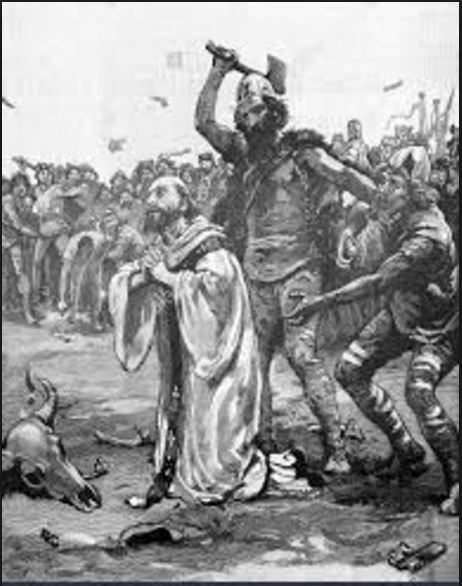
Saint Alphege was said to have been beaten to death with an ax. He died as a martyr.

Saint Alphege was canonized by Pope Gregory VII in 1078. He is celebrated on the 19th of April.

5 Interesting Facts About St. Alphege

  1. Did you know that Saint Alphege is the patron saint of Greenwich and
    kidnap victims?
  2. Did you know that the Church organ requires the strength and skill of
    24 men to be built?
  3. Did you know that the Viking Olaf Tryggvason was said to have
    never fought another battle against the English, thanks to Saint
    Alphege?
  4. Did you know that Saint Alphege took Swithun’s head as a relic?
    him to Canterbury in 1006?
  5. Did you know that Saint Alphege’s Church is recognized as the site
    of the Saint’s death?

Prayer to St. Alphege

Lord Jesus Christ, who willingly walked the way of the cross, strengthen your church through the example and prayers of your servant Alphege to hold fast the path of discipleship; for with the Father and Holy Spirit, you live and reign, one God, forever and ever. Amen.

Source:[http://satucket.com/lectionary/Alphege.htm]{.ul}

St. Apollonius the Apologist

When they lived: St. Apollonius the Apologist is believed to have lived during the late 2nd century to the early 3rd century, specifically around the years 160 to 240 AD.

Where they lived: St. Apollonius lived primarily in Athens, Greece, during a time when it was a hub of intellectual and philosophical activity.

Notable world events during the time of their life:

  1. Antonine Plague (165-180 AD): The Antonine Plague, possibly caused by either smallpox or measles, spread across the Roman Empire, causing significant death and social disruption.
  2. Decian Persecution (249-251 AD): During this period, the Roman Emperor Decius initiated a widespread persecution of Christians.
  3. Crisis of the Third Century (235-284 AD): The Roman Empire faced a series of political, military, and economic crises during this time.
  4. Invention of the Steam Engine (1st century AD): The invention of the aeolipile, an early steam engine, by the engineer Hero of Alexandria.
  5. Life of Origen (185-254 AD): Origen of Alexandria, a prominent early Christian theologian, lived during a similar timeframe as St. Apollonius.

Patronage: St. Apollonius the Apologist is considered a patron saint of intellectuals, philosophers, and scholars.

Early Life

There are various sources that document Saint Apollonius’ life. These sources, however, do not provide much detail about the great Saint.

Saint Apollonius was born in Rome on an unknown date. What is for sure is that he was born sometime in the 2nd century.

There is no document detailing the Saint’s early life. There is no known record about his parents, siblings, or where he gained an early formal record.

Saint Apollonius was a hardworking Roman citizen. He was well-learned and well-spoken. He was not only intelligent, but he was also a devout Christian.

He was said to be extremely talented and well-educated on subjects like philosophy.

Saint Apollonius was a senator. He controlled lands and slaves that inhabited the lands. He was a distinguished member of Roman society.

Saint Apollonius was so deeply invested in Religion that he took a special liking to Jewish writings about the Church. He spent time gathering extensive knowledge about the religion.

Dedication and Devotion

Impressed by the writings and in awe of God, he allowed himself to be baptized. He was said to have spent his time praying or meditating on the writings and the scripture.

In those times, the early Church was being persecuted. The persecutions were, however, sanctioned by Emperor Commodus out of respect for his mistress, Empress Marcia. Empress Marcia was a devout Christian.

The Christians experienced peace for some time as trouble quieted, but it was only for a while. Soon, these persecutions started again.

One day, One of Saint Apollonius’ slaves accused him of practicing Christianity. After this was brought to the attention of the authorities, the Praetorian Prefect, Sextus Tigidius Perennis, ordered the arrest of Apollonius.

The slave who had made the accusation was also arrested. As the law had commanded, the slave was put to death for being an informant. He had his legs broken before he was executed.

Legacy

Saint Apollonius was not only investigated but also called to hearings. In these hearings, he was allowed to speak freely and convince the people that he was not wrong for being a Christian.

Saint Apollonius was offered freedom on the basis that he would denounce Christianity. A man of Faith, he refused and instead chose to debate his way to freedom, much to the chagrin of his friends.

Saint Apollonius acted as he deserved. An eloquent speaker that he was, he spoke at length on the advantages of his faith. He offered facts to support his beliefs.

An avid reader, he showed the authorities that pagan worship was wrong. He claimed the scriptures showed what true religion was.

Despite his many facts, the court found Saint Apollonius guilty of Christianity. He was condemned to death.

Death and Canonization

Saint Apollonius was beheaded around the year 186. He died as a martyr for the sake of religion.

Although he was condemned, years later, his arguments and apologies were found to be very important to the Church.

Saint Apollonius was not recognized as a Saint and Martyr until the Middle Ages. He was canonized Pre-Congregation.

Saint Apollonius is celebrated by the Roman Catholic Church on the 18th of April and on the 23rd of July by the Eastern Orthodox Church.

5 Interesting Facts About St. Apollonius

  1. Did you know that Saint Apollonius is the patron Saint of
  2. Did you know that in some accounts, Saint Apollonius had legs?
    crushed before he was executed?
  3. Did you know that Saint Apollonius was confused for other saints?
    like Apollo of Alexandria and The Apollonius in literary works?
  4. Did you know that Saint Apollonius directly debated Sextus Tigidius?
    Perennis’ view of religion in the court He was not afraid to talk.
    about his faith even in the face of enemies and death.
  5. Did you know that Saint Apollonius was investigated by the Prefect?
    Perennius and a group of senators? On both accounts, there was
    Nothing bad was found against him.

Prayers to St. Apollonius

Lord God, you call us to live a life of holiness and sanctity. Through the example of St. Apollonius, we may be strengthened to proclaim our faith to those who do not know it. We ask this through Christ our Lord. Amen.

Source:[https://www.google.com/amp/s/vitaesanctorum.wordpress.com/2013/04/18/st-apollonius-the-apologist/amp/]{.ul}

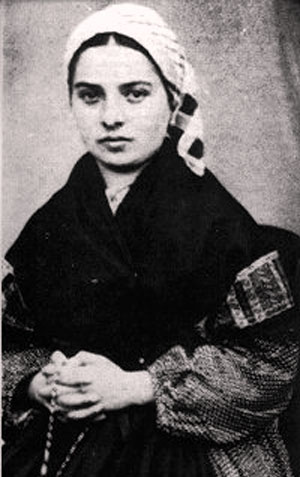
St. Bernadette

When They Lived:

St. Bernadette, born as Marie-Bernarde Soubirous, graced the world with her presence from January 7, 1844, to April 16, 1879.

Where They Lived:

Bernadette’s life unfolded in the quaint town of Lourdes, nestled in the foothills of the Pyrenees mountains in France. Her humble abode was the setting for her remarkable encounters.

Notable World Events During Their Life:

  1. California Gold Rush (1848-1855): As Bernadette was growing up, the world witnessed a surge of adventurers flocking to California in pursuit of gold, reshaping the region’s history and economy.
  2. Publication of “On the Origin of Species” (1859): Charles Darwin’s groundbreaking work introduced the theory of evolution, sparking intense debates about the origins of life and challenging traditional religious perspectives.
  3. American Civil War (1861-1865): While Bernadette remained secluded in Lourdes, the United States was embroiled in a devastating civil war over issues of slavery, unity, and states’ rights.
  4. Completion of the Suez Canal (1869): The inauguration of the Suez Canal connected the Mediterranean Sea to the Red Sea, revolutionizing global trade and travel routes.
  5. Franco-Prussian War (1870-1871): Europe was shaken by conflict as the French Empire clashed with the emerging German states, ultimately leading to the unification of Germany and the fall of Napoleon III.
  6. Telephone Invention (1876): Alexander Graham Bell’s invention of the telephone marked a revolutionary step in communication, bridging distances and changing the world forever.

Their Patronage:

St. Bernadette Soubirous is renowned as the patron saint of illness, poverty, and ridiculed people. Her life was a testament to unwavering faith in the face of suffering and skepticism. Despite the adversities she faced due to her health and the skepticism surrounding her visions, she remains an inspiring figure for those battling illness and adversity.

Early Life

Saint Bernadette Soubirous, also known as Saint Bernadette of Lourdes, was born on the 7th of January, 1844. She was born in Lourdes, Hautes-Pyrénées, in the Kingdom of France.

Saint Bernadette was the eldest of nine children. A little while after she was born, she was baptized in Saint Pierre’s, a local parish in their vicinity. She was baptized on the 9th of January, which also happened to be her parents anniversary.

Her father was a poor miller named François Soubirous, and her mother was Louise. Thanks to the challenging times and the crashing economy of the French kingdom, the family had little to survive on.

Although poor, her parents made sure to provide for the family. Bernadette grew to be a petite young girl who showed an obvious interest in religion.

Tragedy struck when Saint Bernadette contracted cholera in her youth. It is reckoned that the early onset of Cholera led her to forever battle severe asthma.

Saint Bernadette received early formal education at the Sisters of Charity, after which she sought Christian education in Nevers.

Her illness limited her learning abilities. She mainly spoke Occitan, the language of the locals, and had limited writing and reading abilities.

Dedication and Devotion

The Soubirous family’s finances dwindled to the point that they had to live in a basement with one room. The basement was formerly used as a jail. It was provided to them for free by Saint Bernadette’s mother’s cousin.

While out one afternoon on February 11, 1858, with Toinetter’s sister and a group of friends, something extraordinary happened.

Near the Grotto of Massabielle, Saint Bernadette had her first vision. Legend has it that as Bernadette took her shoes off to cross the water,time stood still. Suddenly, from the alcove, a figure cloaked in dazzling white light came out.

Of course, her sister and friends had seen nothing. People assumed the figure was no other person than the Blessed Virgin, even though Bernadette called it an aquer.

This would mark the beginning of further visions in her life. On the 14th of February, Bernadette, her sister, and friends once again returned to the grotto.

She once again saw the apparition, but the others didn’t. This time, the apparition disappeared after the girls threw holy water into the alcove.

On the 18th of February, Saint Bernadette had another vision. In this one, she was instructed to go back to the site of her first vision every day for a few days.

Legacy

Following other visions, Saint Bernadette received various instructions from the figure of light.

She prayed and fasted as instructed. She ate and drank the muddy springs the figure told her to, causing them to become clear. She even relayed the message of the need to build a church to the townspeople.

At first, people were skeptical. They did not believe that this sick child could be visited by that kind of power. Some people even thought she was insane, especially since she continued to call the figure Theaquer.

It wasn’t until the 16th vision that the figure introduced itself as the “Immaculate Conception”.

Embarrassed by her supposed antics, Saint Bernadette’s mother forbade her from speaking on the matter. The young girl didn’t listen and stuck to her story.

Due to her insistence, Several Churches were built in the town. Some of the churches include the Sanctuary of Our Lady of Lourdes and the Basilica of Saint Pius X.

These great churches were not only constructed to accommodate thousands but also ended up being pilgrim sites in the years following the death of Saint Bernadette.

Tired of the fame, Saint Bernadette escaped to a local school in Nevers. On the 29th of July, 1866, she became a member of the Sisters of Charity and moved to the motherhouse.

There, she assumed the name Marie-Bernarde. Although unable to take part in the strenuous activities of the convent, she continued to pray, preach, fast, and meditate.

Death and Canonization

  1. She died in Nevers while Praying the rosary.
    After her death, her claims of visions continued to be reviewed and
    respected. She was canonized on December 8 by Pius XI.
    Her body was said to have been moved three times, and in all cases, it
    was noted to be corrupt.
    Saint Bernadette is commemorated on the 16th of April.

5 Interesting Facts About St. Bernadette

  1. Did you know that Saint Bernadette was not as fluent in French as
    people thought?
  2. Did you know that Saint Bernadette is the patron saint of Lourdes?
    illness, people who are embarrassed because of their faith, and
    against poverty?
  3. Did you know that Saint Bernadette was plagued by visions of the
    white figure 18 times?
  4. Did you know that there is no scientific explanation for how Saint
    Bernadette cleared the spring that had once been muddy.
  5. Did you know that Saint Bernadette was committed to her patron?
    Saint, Saint Bernard?

Prayer to St. Bernadette

O Saint Bernadette, who, as a meek and pure child, did eighteen times at Lourdes contemplate the beauty of the Immaculate Mother of God and receive her messages, and who afterward wished to hide yourself from the world in the convent of Nevers and to offer thyself there as a victim for the conversion of sinners, obtain for us the grace of purity, simplicity, and mortification that we also may attain to the vision of God and of Mary in Heaven. Amen.

Source:[https://www.discerninghearts.com/catholic-podcasts/prayer-of-st-bernadette-and-the-miracles-of-lourdes/]{.ul}

St. Lydwine

When They Lived:

St. Lydwine, also known as Lydwine of Schiedam, lived from 1380 to 1433.

Where They Lived:

St. Lydwine was born, lived, and died in the town of Schiedam, located in the Netherlands.

Notable World Events During Their Lifetime:

  • Hundred Years’ War (1337-1453): A prolonged conflict between England and France that reshaped Europe.
  • Renaissance (14th-17th century): A cultural and intellectual revival that transitioned from the Middle Ages to the modern era.
  • The Council of Constance (1414-1418): A church council that reformed the Catholic Church and resolved the Papal Schism.
  • The Printing Press: Johannes Gutenberg’s invention revolutionized the spread of knowledge.
  • The Ottoman Empire’s Expansion: Expansion of territories with implications for Europe’s landscape.
  • The Great Western Schism (1378-1417): A split within the Catholic Church with competing popes.

Patronage:

St. Lydwine is the patron saint of those who suffer from chronic illness and bodily afflictions. She is also invoked by those seeking relief from prolonged pain and suffering. Her life story is a source of inspiration for Catholics and a testament to human endurance and faith in adversity.

Early Life

There are various accounts of Saint Lydwine. These various accounts differ in major parts of her life, but all accounts talk about her perseverance and love for God.

Saint Lydwine, also called Lidwid, Lidwina, and Lydwine of Schiedam, was born in Schiedam, County of Holland, in the Holy Roman Empire. She was born on April 18, 1380.

Although there are several biographical recounts of this saint, there seems to be no mention of her mother. Her father, who is not named, is only said to be an artisan.

Saint Lydwine was said to have had eight siblings. She was a bubbly young girl who loved her neighbors, but most of all, she loved God. Even at a young age, she was said to have taken time out of her daily life to say her prayers.

The most popular account of Saint Lydwine’s story states that at the age of 15, Circa 1396, she was struck by an unfortunate event that would make her revered till today.

At the age of 15, Saint Lydwine was said to have been ice skating with friends. One of these friends bumped into her, causing her to fall and break a rib.

Although initially looking like something that could easily be treated,her injury worsened. After some time, an abscess formed at the site of the injury and grew worse as the day went by.

Dedication and Devotion

Saint Lydwine became bedridden, and her days were filled with gloom and pain. Regardless, it was said that she didn’t let this affect her competence.

Saint Lydwine remained cheerful. She prayed and fasted, asking God to let her cup of pain pass over.St. Lydwine praying for healing

It seemed God didn’t hear her because the abscess burst and spread throughout her body. Her body became gangrenous and began to affect her organs.

Pieces of Lydwine’s body were said to have fallen out, and she continued to bleed from her mouth, nose, ears, and eyes. It grew increasingly difficult for her to function.

At some point in time, Saint Lydwine became paralyzed and couldn’t be moved from her bed. During this trying time, she prayed to God, and it was shown to her that this was God’s plan for her.

Several maladies befell her, but she became cheerful because she believed God was with her. Because of her sores and festering wounds, no one wanted to be associated with her, but she did not complain.

In addition to her sufferings, Saint Lydwine was said to have suffered from stigmata. These injuries on her hands and feet bore an eerie resemblance to Jesus’.

Some people claimed she faked the stigmata, but after seeing it for themselves and hearing her preach about the love of God even in her pain, they were convinced.

Saint Lydwine was especially devoted to the Virgin Mary. She continued to fast and pray, and soon she became popular for her healing powers.

Legacy

Saint Lydwine was said to have been blessed with spiritual gifts. Not only was she a miraculous healer who prayed for the sick people’s health to return, but she was also said to suffer from visions of heaven and hell.

Some traditions even claim she had encounters with apparitions that she was convinced were Jesus Christ.

Lydwine suffered from nausea, headaches, pain, fever, and even blindness, but these didn’t stop her from carrying out her prayers and fasting with enthusiasm.

She was visited by the rich and famous. She was also said to have been tested by a skeptical priest who left her home with new respect and admiration for her.

Death and Canonization

  1. She was buried in a chapel in her hometown. Her tomb became a
    popular pilgrimage.

5 Interesting Facts About Saint Lydwine

  1. Did you know that Saint Lydwine is the patron saint of the
    chronically ill, Ice skaters, and Schiedam?
  2. Did you know that Saint Lydwine was said to be the first-ever
    recorded patient suffering from multiple sclerosis?
  3. Did you know that some accounts concerning Saint Lydwine’s state that
    She was impregnated by a priest in the area. It claims that this
    was the reason why she had a ‘swollen’ body.
  4. Did you know that a written document from Saint Lydwine’s hometown
    Schiedam testifies to her extreme piety by fasting and praying for
    long hours at length? This document is said to be in existence.
    till today.
  5. Did you know that Saint Lydwine was said to have survived on bites?
    of apples, dates, sips of wine, and for some time, the Holy
    Sacrament?

Prayer to Saint Lydwine

O Glorious Saint Lydwine of Schiedam, you were chosen by Christ to suffer immense pain for poor sinners and to offer up all your sufferings to Him. Intercede on our behalf and help us through our small sufferings that cannot be compared to yours. Grant us the grace to trust completely in Jesus even during times of deep sorrow and confusion. Help us to always place our petitions in the hands of the Blessed Virgin Mary, who on our behalf will offer up our petitions to Jesus, like she did kindly for you. May we be given the grace to persevere in our sufferings until the Lord calls us home to enjoy the Glory of Heaven. Amen. Saint Lydwine, whose life was filled with intense suffering for poor sinners, pray for us!

Source:[http://sacrocordejesu7.blogspot.com/2015/04/feast-day-of-saint-lydwine-schiedam.html?m=1]{.ul}

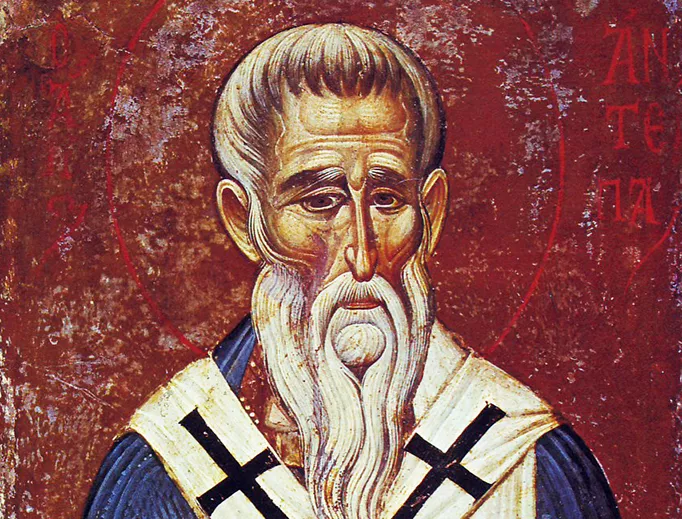
St. Antipas

St. Antipas: A Glimpse into a Time of Faith and Turmoil

When They Lived:

St. Antipas, also known as Antipas of Pergamum, lived during the late 1st century and early 2nd century AD. He is believed to have been born around 62 AD and passed away in the year 92 AD.

Where They Lived:

St. Antipas resided in the ancient city of Pergamum, which was situated in what is now modern-day Turkey. Pergamum was renowned for its rich history, cultural significance, and proximity to important trade routes of the time.

Notable World Events During the Time of Their Life:

  1. The Great Fire of Rome (64 AD): A catastrophic fire that ravaged Rome, Emperor Nero was rumored to have fiddled while the city burned. This event led to the persecution of Christians, marking a tumultuous period for early believers like St. Antipas.
  2. Construction of the Colosseum (70-80 AD): The construction of the iconic Roman Colosseum took place during this period. The arena would later witness countless gladiatorial contests and public spectacles, becoming a symbol of Roman entertainment.
  3. Completion of the Mishnah (c. 200 AD): Although slightly later than St. Antipas’ time, the compilation of the Mishnah—an essential text in Jewish law—began during this period. This marked a significant milestone in Jewish scholarship and religious preservation.
  4. Pliny the Younger’s Correspondence (c. 100 AD): The Roman author Pliny the Younger’s letters provide valuable insights into the social, political, and cultural aspects of the time. His writings shed light on early Christian practices and interactions with Roman authorities.
  5. Halley’s Comet Appearance (87 AD): Halley’s Comet made a notable appearance during St. Antipas’ lifetime. This celestial event sparked curiosity and speculation, reflecting the growing interest in scientific observation.

Their Patronage:

St. Antipas is recognized as the patron saint of dentists and those suffering from dental issues. This unique patronage stems from a hagiographical account in which St. Antipas supposedly had his teeth violently extracted during his martyrdom, drawing a connection between his suffering and dental ailments.

  • When he lived: Saint Antipas lived in the first century AD. While the exact dates of his birth and death are not firmly established, he is believed to have been martyred during the reign of the Roman Emperor Nero (54–68 AD) or Emperor Domitian (81–96 AD).
  • Where he lived: He lived in Pergamum, a significant city of the Roman province of Asia, which corresponds to modern-day Turkey.
  • Notable world events during the time of his life: This was a period of significant change in the ancient world. In the mid-first century AD, the Roman Empire was at the height of its power. Nero became Emperor in 54 AD, and his rule was marked by extravagance, tyranny, and the Great Fire of Rome in 64 AD. In the Far East, Buddhism was spreading in China. Meanwhile, the construction of the famous Nabataean rock city of Petra was completed in present-day Jordan. Back in Rome, the Flavian Amphitheater, better known as the Colosseum, began construction under the reign of Emperor Vespasian around 70 AD.
  • His patronage: Saint Antipas is known as the patron saint of toothaches and diseases of the teeth.

Saint Antipas, an intriguing figure from the annals of early Christian history, is a compelling testament to the power of faith. His life and martyrdom provide a timeless example of resolute commitment to one’s beliefs, even in the face of extreme adversity.

St. Antipas in Holy Scripture

The Bible makes a single, albeit impactful, reference to Saint Antipas in the Book of Revelation (2:13), identifying him as a martyr and faithful witness to Christ Jesus. Despite his brief mention in the scriptures, the portrayal of Antipas resonates powerfully. He is described as a minister laboring in Pergamum, where Satan had his seat, an indication of the immense spiritual adversity that the saint encountered.

The Bishop of Pergamum

While historical records do not provide concrete evidence, traditional Eastern Orthodox Christian narratives describe Antipas as the Bishop of the Christian church at Pergamum. Appointed by John the Apostle during Emperor Nero’s reign, Antipas is believed to have spent his years faithfully ministering, witnessing, and upholding the Christian faith in the heart of a city known for its deeply rooted pagan beliefs.

Despite the mounting pressures and threats to his life, Saint Antipas remained undeterred in his faith. This unwavering commitment is beautifully encapsulated in his reputed response when cautioned that the entire world was against him: “Then I am against the whole world!”

Martyrdom of Saint Antipas

The climax of Antipas’s commitment to his faith came when he was martyred under the reign of either Nero or Domitian. According to tradition, he was burned to death on a brazen bull-shaped altar because he would not renounce his faith in Christ Jesus. His martyrdom remains an inspiring testimony to the power of faith in the face of overwhelming opposition.

The Miracle of Saint Antipas

Even in death, Saint Antipas continued to inspire the faithful. According to tradition, a unique phenomenon referred to as the “manna of the saints” is associated with him. It is believed that oil, seen as a blessing, secretes from his relics, further accentuating the saint’s miraculous nature.

Saint Antipas, the Protector

Known as a healer, Saint Antipas is invoked for relief from toothache and diseases of the teeth. This association offers us a relatable facet of the saint, who is seen as a protector and healer, providing comfort in everyday struggles.

The Feast of Saint Antipas

On April 11, Eastern Christianity commemorates the feast day of Saint Antipas, remembering his unwavering faith and sacrifice.

Saint Antipas and Pergamum

It’s important to note that the spiritual legacy of Saint Antipas is deeply intertwined with the city of Pergamum, a significant historical city known for its wealth, power, and influence in ancient times. Once a bustling center for science, literature, and art, Pergamum played a vital role in Western civilization’s development. Yet, amidst its grandeur, it was also a battleground for spiritual warfare, a testament to Antipas’s courage and determination.

Conclusion

In conclusion, while specific details about Saint Antipas’s life are sparse and rooted in tradition, the known aspects of his life provide a powerful image of an unyielding Christian martyr. His legacy continues to inspire the faithful, reminding us of the power of unwavering faith and the everlasting influence of saintly lives.

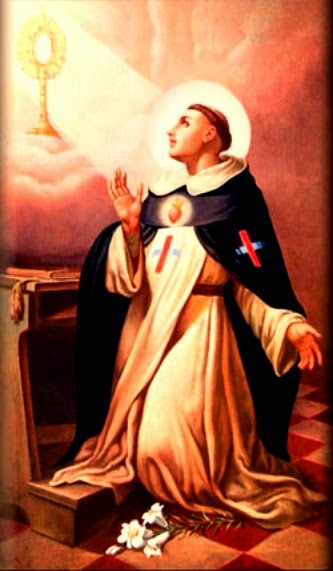
St. Michael de Sanctis

When they lived: St. Michael de Sanctis, also known as St. Miguel de los Santos, lived from September 29, 1591, to April 10, 1625.

Where they lived: St. Michael de Sanctis was born in the town of Valladolid, located in present-day Spain. He spent a significant part of his life in various monastic communities.

Notable world events during the time of their life:

  • Thirty Years’ War (1618-1648): This prolonged conflict in Europe had significant political and religious ramifications, impacting various regions and powers across the continent.
  • Scientific Revolution: During St. Michael de Sanctis’ lifetime, the Scientific Revolution was unfolding. This period saw a surge in scientific discoveries, including the development of the telescope by Galileo Galilei, the formulation of Kepler’s laws of planetary motion, and advancements in anatomy and physics.
  • Exploration and Colonization: The Age of Exploration was continuing during St. Michael de Sanctis’ time, with European nations exploring and colonizing new lands. The establishment of settlements in the Americas, Africa, and Asia was reshaping global geopolitics and trade.
  • English Civil War (1642-1651): While St. Michael de Sanctis passed away before the conflict began, his lifetime witnessed the early tensions that eventually led to the English Civil War, which had profound effects on England’s political and social landscape.
  • Foundation of Harvard University: In 1636, Harvard University was established in Massachusetts, USA, becoming the oldest institution of higher education in the United States. This event marked a significant step in the development of education in the New World.

Their patronage: St. Michael de Sanctis is known as the patron saint of those struggling with temptation, mental illness, and mental disorders. He is often invoked by individuals seeking strength to overcome inner struggles, anxiety, and emotional turmoil. St. Michael de Sanctis’ own experiences of inner battles and his unwavering faith make him a relatable and inspiring figure for those facing similar challenges.

Making it interesting: In an era characterized by global conflicts, scientific advancements, and the expansion of empires, St. Michael de Sanctis’ story stands out as a beacon of hope and resilience. Born in a small town in Spain, he navigated the tumultuous world around him while grappling with his own inner demons. At a time when exploration and curiosity were reshaping the understanding of the natural world, St. Michael embarked on a journey of self-discovery and spiritual enlightenment. His struggles with temptation and mental turmoil mirror the broader societal upheavals of his time, making him a relatable figure for modern individuals wrestling with their own internal conflicts.

Early Life

Saint Michael de Sanctis, also known as Michael of the Saints to many,might have lived a brief life but left a large impact on the Church.

He spent his life living in piety and holiness.

Saint Michael was born Michael Argemir. He was born on September 29, 1591, in Vic, Spain. His parents, Enrique Argemir and Monserrat Margarita Mitjana, played vital roles in his quest for spirituality.

From a very young age, Saint Michael was dedicated to Christianity. He made sure to pray, fast, and even vow to remain a virgin.

When he was 6 years old, Saint Michael told his parents about his interest in becoming a monk. They saw how dedicated he was to religion and agreed to his wishes.

Saint Michael’s mother informed him about Saint Francis of Assisi. Michael was so impressed by the Saint’s piety that he tried to emulate him.

Even at a young age, Saint Michael began to practice mortification. He prayed for long hours, fasted for days at a time, and was even said to have restrained himself from eating meat.

Although his parents were impressed, they grew alarmed at his extremes and restrained him.

Some years later, but still at a young age, Saint Michael was orphaned. This caused him to be much closer to God than he had initially been.

Saint Michael was taken to serve as an apprentice to a trader after his parents died.

Dedication and Devotion

Saint Michael de Sanctis excelled at work. He spent his free time praying, meditating, preaching, and even helping the needy.

When he was twelve years old, Circa 1603, he came to Barcelona on a quest to become a part of the Trinitarians. After spending three years with the Trinitarian Friars, he took his vows in Saint-Lambert Church in Zaragoza around 1607.

It was with the Trinitarians that he assumed the name Michael de Sanctis.

He enjoyed his practice until he met with a Discalced Trinitarian priest one day. Saint Michael was awed by their strict practices and sought to become a priest himself.

After receiving permission from his superior, Saint Michael joined the Church of the Discalced Trinitarians. He said his vows at Alcalá, after which he was made to undertake the education of the Friars.

He was ordained a priest and bestowed authority over the community.

Legacy

Saint Michael de Sanctis was revered for his humility, love for the people, and dedication to the Church.

Not only does tradition state that Saint Michael could pray the sick back to health, but some also claim he often slid into trances. During these trances, he was said to have been seen levitating on several occasions.

In one story set in Cordova, Saint Michael was reported to have been seen being lifted in the air above the choir stand, over a field, and coming to rest in the church tower. He was also said to have levitated in Salamanca.

These reports of levitation were said to have been indices of ecstasies during prayer. Even before his death, he was called a Saint by many.

Saint Michael was twice appointed Superior of the Monastery in Valladolid. He took on leadership with a strict yet humble hand.

Death and Canonization

Saint Michael de Sanctis died on April 10, 1625, at the age of 33. He passed away at the Valladolid monastery in the Kingdom of Spain.

Many miracles are attributed to Saint Michael, even after his death.

He received beatification from Pope Pius VI on May 24, 1779. He was canonized on June 8, 1862, by Pope Pius IX.

Saint Michael de Sanctis is celebrated every year on the day of his death by the Roman Catholic Church.

5 Interesting Facts About St. Michael de Sanctis

  1. Did you know that Saint Michael de Sanctis took a vow of chastity?
    at the age of 8?
  2. Did you know that Saint Michael was partial to the Rosary and the Virgin Mary?
    Mary?
  3. Did you know that Saint Michael is said to be one of the patron saints?
    saints of cancer patients?
  4. Did you know that in his death, Saint Michael was said to have cured
    Frances Sanz of cancerous tumors?
  5. Did you know that the town of Saint-Michel-des-Saints in Canada is
    named after Saint Michael de Saints?

Prayer to St. Michael de Sanctis

O glorious Saint Michael, Seraph inflamed with the most ardent love of Jesus in the Blessed Sacrament, who did spend your nights and days in His Real Presence and did find there your dearest joys, so that you did swoon away for very love: vouchsafe, I pray to you, to obtain for me a lively faith, a firm hope, and an ardent love toward this inestimable Treasure, this precious Pledge of glory everlasting, in order that I may be able to behold Him face in an eternity of bliss. Amen.

Source:[https://www.catholicdoors.com/prayers/novenas/p03883.htm]{.ul}

St. Julie Billiart

When They Lived

St. Julie Billiart lived from July 12, 1751, to April 8, 1816.

Where They Lived

St. Julie Billiart was born in Cuvilly, a small village in northern France. She spent most of her life in the region of Picardy, particularly in Amiens.

Notable World Events During Their Life

  • American Revolution (1775-1783): The United States’ struggle for independence from British rule.
  • French Revolution (1789-1799): Social and political upheaval in France and beyond.
  • Industrial Revolution: Rapid advancements in technology, urbanization, and mechanization.
  • Napoleonic Era: Political change and military campaigns under Napoleon Bonaparte.
  • Birth of Mary Shelley and the Frankenstein Novel (1797-1818): Mary Shelley’s birth and the iconic novel “Frankenstein.”
  • Discovery of Uranus (1781): Astronomer William Herschel’s discovery of Uranus.
  • Louisiana Purchase (1803): The United States’ acquisition of a vast territory.

Their Patronage

St. Julie Billiart is the patron saint of those who suffer from bodily ills, illnesses, and disease. She is also invoked for healing and protection against physical ailments. Additionally, she is the patroness of those ridiculed for their piety and dedication to faith.

St. Julie Billiart’s Remarkable Life

St. Julie Billiart’s life unfolded against the backdrop of revolutionary changes in both politics and technology. Born into a modest family in rural France, she faced personal challenges early on, including an accident that left her partially paralyzed. Undeterred, Julie remained steadfast in her faith and dedicated herself to teaching children in her village, fostering their spiritual and intellectual growth.

The Young Teacher

Marie Rose Julie Billiart was born on July 12, 1751, in Cuvilly-Picardy, Northern France. Her parents were simple, well-to-do farmers. She was the sixth of seven children, with only three surviving adulthood: her father, Jean Francois Billiart, and mother, Marie Louise Antonette.

Julie showed interest in God’s work as a child. By the age of seven, she had learned catechism by heart. Julie would gather her playmates and farm laborers to hear her recite the catechism and teach them. When her family lost their money, she took to farming to earn money as a teen.

It was apparent that Julie was way ahead of her peers in matters of religion. Her Parish Priest, Father Dangicourt, made an exception for her to receive the First Holy Communion at nine instead of the stipulated age of thirteen as practiced at that time. At age 14, Julie privately took the oath of chastity before God.

Broken but Not Crushed

Julie was a child to look out for with the simple education she obtained from the local school run by uncle Thibault Gillibiert and her advanced knowledge of religious matters. Growing up, she was known as the “Saint of Cuvilly” for her virtues and piety.

A sad occurrence at home in 1774 when she was 22 threatened to break her heart, but Julie wouldn’t let it crush her spirit.

An unknown assailant had shot at her father in a missed attack on his life, and witnessing this event sent Julie into a nervous shock. Inadequate medical treatment resulted in the paralysis of her legs. For many years, Julie was confined to a bed.

Nevertheless, from her bed, Julie instructed children to prepare for the First Holy Communion, make altar linen and cloths, and offer great advice to all who came to her. Many recognized her gifts and will beseech her bed.

Julie the Rebel?

In 1989, the French Revolution broke out. Following the aftermath of the revolution, the civil constitution was constituted. Church properties were sold off, and priests were forced to swear allegiance to the civil law, stripping the church of all its power and jurisdiction over church matters.

Refusal to comply with the directives of the new civil law by any clergy person attracts punishment, some death or banishment as the court may deem fit.

But Julie defied the new law, and at the risk of her life, she hid fugitive priests who had refused to swear their allegiance to the law. When the authorities became aware of the help she had been rendering to non-compliant priests, they sought to kill her.

With the help of her friends, Julie was smuggled out of Cuvilly in a cart to Compiegne. She hid in different houses at Compiegne despite her growing suffering and pain from being paralyzed. Later, she moved to Amiens.

New Dawn

At Amiens, Julie met Francoise Blin de Bourdon, a noblewoman and religious woman. Together, they devoted themselves to working for God and fighting for the poor.

On February 2, 1804, Julie, Francoise, and Catherine Duchatel took the oath of chastity. With the approval of the bishops of Amiens, Julie and Francoise founded the Congregation of Sisters of Notre Dame. The congregation was devoted to the Christian education of the girl child, the poor, and training catechists.

Remarkably, on June 1, 1804, the fifth day Julie was offering novena to the Sacred Heart of Jesus for no particular intention, guided by Fr. Enfantin to take a walk of faith, Julie was cured on the spot of her paralysis.

In the following years, Julie traveled the roads of France and Belgium, founding communities with her sisters and setting up schools for young girls deprived of education at the time. She brought hope and the goodness of God into society by preparing vulnerable young children to face life’s duties.

Setbacks encountered in France made Julie move the motherhouse of the congregation to Namur, Belgium.

End of the Journey

Julie spent the rest of the years tirelessly caring for others and running from war hostilities in France.

She took ill, and on May 13, 1816, she departed the world at the motherhouse in Namur, Belgium.

She was beatified on May 13, 1906, by Pope Pius X, and on June 22, 1969, Julie was canonized as a saint by Pope Paul V.

5 Interesting Facts About St. Julie Billiart

  1. Julie spent a total of 22 years as a paralytic before her miraculous
    Healing took place.
  2. In her lifetime, Julie founded 15 convents in France and Belgium.
    made one hundred and twenty journeys in keeping correspondences
    with her spiritual daughters in different places.
  3. Are you aware Julie’s patronage is invoked against poverty, bodily
    ills, and diseases? She worked tirelessly to lift the poor and
    Never once in the 22 years of her affliction with paralysis did she
    thought God had given up on her.
  4. No condition was ever enough to keep me away from the Eucharist. For
    all the years confined in bed, Julie received Holy Communion.
    daily.
  5. Guess the first college in California authorized to bequeath
    Bachelor’s degree to women in the US? Yes, you’re right. Notre
    Dame de Namur University, founded by the congregation of Notre
    Dame. Her legacy lives on.

Prayer to St. Julie Billiart

Saint Julie, Through your incredible devotion to the sacred heart of Jesus, you were miraculously cured and favored by many graces. Through your powerful intercessions, Obtain for us above all things great trust in God in all the difficulties of life. The strength to accomplish in all things The adorable will of God and the special grace we now ardently ask of you

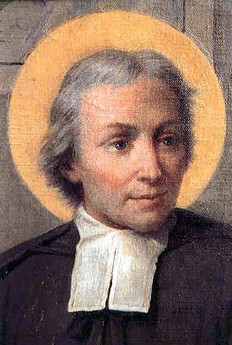
St. John Baptist de la Salle

When They Lived:

St. John Baptist de la Salle lived from April 30, 1651, to April 7, 1719.

Where They Lived:

St. John Baptist de la Salle was born in Reims, France, and spent most of his life in various cities in France, primarily in the city of Rouen where he founded the Institute of the Brothers of the Christian Schools (commonly known as the De La Salle Brothers).

Notable World Events During Their Time:

  • Scientific Revolution (17th century): St. John Baptist de la Salle’s lifetime coincided with the Scientific Revolution, a period marked by significant advancements in astronomy, physics, mathematics, and other fields.
  • Glorious Revolution (1688): The overthrow of King James II of England by a group of English Parliamentarians, leading to political and religious changes.
  • Age of Enlightenment: A cultural movement emphasizing reason, science, and individual rights, challenging traditional authorities.
  • Great Northern War (1700-1721): A war involving several European powers that reshaped the geopolitical landscape of Northern and Eastern Europe.

Their Patronage:

St. John Baptist de la Salle is the patron saint of teachers, educators, and the Institute of the Brothers of the Christian Schools. He is also considered a patron of those who work in the field of special education due to his innovative teaching methods that catered to the needs of all students, regardless of their background or abilities.

Road to Priesthood

La Selle was offered to God by his parents at the age of 11, and he grew up devoted to religion. At the age of sixteen, he was named canon of Rheims Cathedral. He later went on to join the seminary of Saint-Sulpice in Paris on October 18, 1670.

However, due to the deaths of his parents, with the mother passing away in 1671 and his father the following year, he had to leave the seminary so that he could assume the role of family head at the age of 21. Fortunately, he was able to complete his theological studies on April 9, 1678, at the age of 26.

He helped the Sisters of the Child Jesus take care of the sick and educate girls from poor backgrounds and later went on to be their chaplain and confessor. After his work in the school system, he began new religious systems, the first one being the Institute of the Brothers of the Christian Schools, also known as the De La Selle Brothers.

Teacher of the Youth

La Selle’s responsibility for the education of the youth began when he was responsible for the education of his six siblings after the death of his parents. It was further cultivated when he worked with the Sisters of the Child Jesus, as he was also helping in the education of girls from poor backgrounds.

In the year 1679, he helped Adrian Nyel open a school, and shortly afterward, they also got someone who also wanted to sponsor them in opening another school for the poor, and that is how it became his life’s work.

All his work was mostly motivated by his plight for the poor, and he strongly believed that education was the way to bring hope and opportunities to the poor. He strongly dedicated his life to advancing the education of the poor children in Reims, and he took steps to provide leadership and training to the struggling teachers.

The first training for the teachers was in 1680, when he invited them for formals at his home, taking that opportunity to teach them table manners and instruct them in their work. He went further to invite the teachers to live with him, something that did not sit well with his relatives as this crossed the social classes. All this resulted in scandals, and LaSelle ended up losing his family home, resulting in him having to rent the house in which he ended up staying with a handful of the teachers.

La Selle even resigned as Canon so that he could fully dedicate his life to establishing schools and training teachers. Another display of his heart for the poor was when he sold his inheritance and sent the money to the province of Champagne, where a famine was causing hardships.

He went on to be the founder of the De La Selle Brothers, which was a Roman Catholic teaching religious institute that did not include any priests. In 1658, he became the founder of the first school that trained teachers in Rheim, France.

Death and Legacy

  1. He was also proclaimed a saint on May 15, 1950, and that was after
    He was inserted in the General Roman Calendar in 1904 to be celebrated.
    on the 15th of May. He is known as the Patron Saint of all teachers of
    the Youth. His feast day was moved to April 7, 1969.

5 Interesting Facts About St. John Baptist de la Salle

  1. Originally, he had no intention of working with the youth until he met
    Monsieur Adrien Nyel
  2. He sold his inheritance and gave away the money.
  3. His mother was related to Claude Moet, who is the founder of Moet.
    and Chandon.
  4. He was surprised by his achievements, as he did not believe he
    could achieve much.
  5. His father was in the legal profession.

Prayer to St. John Baptist de la Salle

Father, You chose Saint John Baptist de la Salle to give young people a Christian education. Give your Church teachers, who will devote themselves to helping your children grow as Christian men and women, Through our Lord Jesus Christ, your Son, who lives and reigns with you in the unity of the Holy Spirit, one God, for ever and ever Amen.

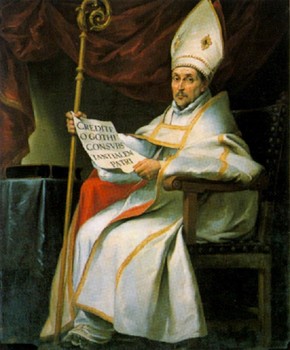
St. Isidore of Seville

When they lived: St. Isidore of Seville, also known as Isidore the Elder, lived from around 560 AD to April 4, 636 AD. He was a prominent scholar, theologian, and archbishop during the Visigothic period in Spain.

Where they lived: St. Isidore lived in the city of Seville, located in present-day Spain. During his time, Seville was a thriving cultural and religious center in the Visigothic Kingdom.

Notable world events during the time of their life:

  • Justinian’s Plague (541-542 AD): This devastating pandemic, also known as the Plague of Justinian, swept through the Eastern Roman Empire, including parts of Spain. It is estimated to have killed a significant portion of the population, altering the course of history.
  • Rise of Islam (7th century AD): The birth of Islam and the rapid expansion of the Islamic Empire had a profound impact on the geopolitical landscape of the Mediterranean world. While St. Isidore lived a few decades before Islam’s emergence, its influence would soon reach Spain.
  • Byzantine-Sassanid Wars (602-628 AD): A series of conflicts between the Eastern Roman (Byzantine) Empire and the Sassanian Persian Empire that led to significant territorial changes in the Middle East. These wars had repercussions throughout the Mediterranean region.
  • First Council of Toledo (589 AD): This council was a significant event in the history of the Visigothic Church. It aimed to unify religious practices, address heresies, and establish canons that would shape the development of the Spanish Church.
  • Gregory the Great’s Papacy (590-604 AD): Pope Gregory I, known for his theological contributions and efforts to consolidate papal authority, had a lasting impact on the Western Church. His works and teachings influenced scholars like St. Isidore.

Patronage:

  • Internet and Computers: In the modern age, St. Isidore’s association with knowledge and learning has led to his designation as the patron saint of the internet and computers. This symbolic connection highlights his historical role in preserving and advancing knowledge.
  • Students and Scholars: St. Isidore’s prolific writings, including his influential “Etymologies” (also known as “Origins”), earned him the reputation of a great scholar. He is invoked by students and scholars seeking guidance in their academic pursuits.
  • Farmers and Rural Life: St. Isidore’s deep connection to rural life comes from his upbringing in a farming family. He is seen as a protector of crops and animals, reflecting his humble origins and his devotion to the well-being of rural communities.
  • Archivists and Libraries: Given his extensive literary contributions and efforts to collect and organize knowledge, St. Isidore’s patronage extends to archivists, librarians, and anyone involved in preserving and managing information.
  • Historians: St. Isidore’s writings provide valuable insights into the history, culture, and religious practices of his time, making him an inspiring figure for historians and those interested in the past.

The Two Brother Bishops of Seville

St. Isidore of Seville was born in Cartagena, Spain, around the year 560. His brother, Leander, the Archbishop of Seville, was an important influence on him. Isidore developed a commitment to study, prayer, and intense work for the good of the Church. In turn, Isidore joined his brother’s mission to convert the generally heretical Visigoths who had invaded Spain.

When Leander died around the year 599, Isidore succeeded him as Seville’s archbishop. Isidore inherited his brother’s responsibility for Church affairs during an intense period of change as the institutions of the Western Roman Empire gave way to the culture of the barbarian tribes. For thirty-seven years, he led the Spanish Church through a period of intense religious development and renewal. He also organized representative councils that established the structure and discipline of the Church in Spain.

Preserver of Knowledge and Civilization

In 633, at the Council of Toledo, Archbishop Isidore obtained a decree that required the establishment of a school in every diocese. These schools taught almost every branch of knowledge, which includes the liberal arts, law, medicine, Hebrew, and Greek. This reflected the bishop’s broad interest. Isidore’s establishment of cathedral schools laid the foundation for medieval universities and for education in the West.

For the welfare of the Church and civilization, the archbishop was determined to preserve the wisdom and knowledge of the past. He carefully maintained the fruitful synthesis of classical Roman culture and the Christian faith. He was also serious about preventing false teachings from destroying the unity of the Church in Spain.

Lover of the Poor

With Isidore leading, a series of local councils reinforced the orthodoxy of the Church of Spain against the erroneous teachings about Jesus Christ and the Holy Trinity. He firmly emphasized that the systematic and extensive education of the clergy was a necessary means of guarding the faithful against many heresies. Isidore was known as a prolific writer and a diligent leader of the Church. Above all, he did not neglect the poor. He served and helped them. Throughout his life, Isidore lived alone so that he could help the poor.

His writings attest to this love and compassion he had for the poor: “Indeed, just as we must love God in contemplation, so we must love our neighbor with action. It is therefore impossible to live without the presence of both the one and the other form of life, nor can we live without experiencing both the one and the other.” In the last months of his life, Isidore offered a moving testament to these words. He intensified his charitable outreach to the less fortunate. Many people from various places who were in need flocked to his residence as he offered his last works of mercy on earth.

On April 4, 636, the holy Archbishop Isidore died in peace. His feast day is April 4. He was canonized as a saint by the Roman Catholic Church in 1598 and declared a Doctor of the Church in 1722.

5 Interesting Facts About St. Isidore of Seville

  • St. Isidore of Seville had three siblings: Leander, Fulgentius (both of whom became bishops), and Florentina, who became a nun. They were also canonized as saints.
  • St. Isidore of Seville compiled the Etymologiae, the first encyclopedia written from a Catholic perspective.
  • St. Isidore of Seville is sometimes called “the schoolmaster of the Middle Ages” because his books and schools helped shape the education and culture of medieval Europe.
  • Shortly before his death, St. Isidore of Seville had two friends clothe him in sackcloth and rub ashes on his head so that he could come before God as a poor penitent.
  • Pope John Paul II named St. Isidore of Seville the patron saint of internet users.

Prayer to St. Isidore of Seville

Graciously hear the prayers, O Lord, which we make in commemoration of Saint Isidore, that your Church may be aided by his intercession, just as she has been instructed by his heavenly teaching. Through our Lord Jesus Christ, your Son, who lives and reigns with you in the unity of the Holy Spirit,God, for ever and ever Amen.