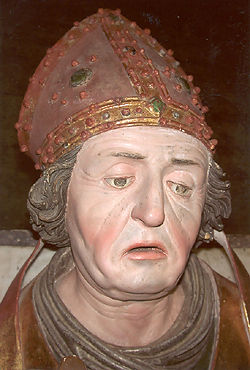
St. Richard of Wyche

When they lived:

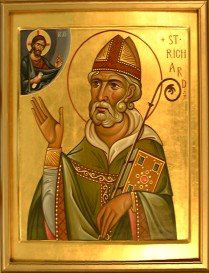
St. Richard of Wyche, also known as Saint Richard of Chichester, lived during the late 12th and early 13th centuries. He was born in 1197 in Droitwich, England, and passed away on April 3, 1253, in Dover, England.

Where they lived:

St. Richard primarily lived in England during a tumultuous period in the country’s history.

Notable world events during the time of their life:

  • Magna Carta (1215): During St. Richard’s lifetime, the Magna Carta was sealed by King John of England in 1215. This historic document laid the foundation for the principles of constitutional law, limiting the power of the monarchy and establishing certain rights and liberties for the people.
  • Albigensian Crusade (1209-1229): This was a significant religious and political conflict in southern France. It was a part of the larger Albigensian heresy, where the Catholic Church sought to suppress the Cathar movement. St. Richard’s life would have been influenced by the wider struggles within the Catholic Church.
  • Fourth Lateran Council (1215): This ecumenical council, convened by Pope Innocent III, addressed various issues within the Catholic Church, including matters of doctrine and discipline. It played a pivotal role in shaping the Church’s institutional framework and theology during St. Richard’s time.
  • Innocent III’s Papacy: Pope Innocent III, who served from 1198 to 1216, was a powerful and influential figure in the Catholic Church. His papacy witnessed significant developments in canon law, theology, and church-state relations.
  • The Mongol Empire’s Expansion (Early 13th Century): During St. Richard’s lifetime, the Mongol Empire, led by Genghis Khan and his successors, was rapidly expanding across Asia and into Eastern Europe. This marked a significant shift in the global balance of power.

Their patronage:

St. Richard of Wyche is the patron saint of several noteworthy causes and groups:

  • Patron Saint of Sussex: St. Richard is revered as the patron saint of Sussex, a county in southern England. He is deeply respected by the local population for his piety and contributions to the region.
  • Patron Saint of Coachmen and Laborers: St. Richard is also the patron saint of coachmen and laborers. This patronage reflects his humble and hardworking nature during his life.
  • Patron Saint of Protection Against Inflammatory Diseases: In more recent times, St. Richard has been invoked as a patron saint against inflammatory diseases, symbolizing his role in healing and compassion.

St. Richard’s life and legacy are a testament to his unwavering faith, dedication to serving others, and his enduring impact on the region of Sussex and the broader Catholic Church. His story provides valuable insights into the religious and historical context of medieval England.

Early Life

Richard of Wyche, also known as Richard of Chichester or Richard de Wyche, was born around 1197 in Burford, very close to Wyche town. He soon lost his parents, thus becoming an orphan at a young age. Richard’s parents had left their estate to the inheritance of Richard’s elder brother, who at the time wasn’t old enough for such an inheritance. As a result of this, the estate was left to be under a feudal wardship until Richard’s brother was of the right age to claim his inheritance. Coming of age, Richard’s brother took control of the estate as his possession by inheritance, but was then requested to provide payments for a medieval form of death duty. This new responsibility did not leave his family any good, as they soon became penurious, and little Richard, at the time, in a bid to support his family as much as he could, had to start farming. Later on, his brother passed on the inheritance of the property to Richard, and arrangements were made for him to marry a noblewoman, but Richard declined all offers. He rather preferred to own nothing, just him, his study, and the Church.

Call to Dedication and Devotion

Richard went to school at the University of Oxford and soon became a teacher at the same institute after completing his studies. Richard went on to Paris and Bologna, exhibiting his proficiency in Canon law. When he learned that one of his former tutors, Edmund of Abingdon, had been made archbishop of Canterbury, he supported Edmund’s clerical reform and was even in agreement with the papal rights against the king. Hopefully, as bad as things could get, Richard was appointed chancellor of the Diocese of Canterbury in 1237 by his former tutor, Edmund. It was during Richard’s exile at Pontigny that he fully joined the archdiocese and remained there until the archbishop passed away three years later. Then Richard decided that he was going into the priesthood. He went on to study theology for two years. After his studies, Richard was made parish priest in Charing, and after some time, he was reappointed chancellor of Canterbury by the new archbishop.

Years later, though the king and some other parties did not show their support, Richard was chosen as Bishop of Chichester. He was consecrated in March 1245 at Lyons by Innocent IV. It wasn’t an easy task, really. He faced a lot of opposition and hatred from different angles, yet he wasn’t discouraged by it. To those corrupt clergy and usurers who without mercy gabbled the Massyes, Richard was especially merciless and rigid. His interest was to see that the Masses were treated fairly and that justice got to everyone the way it was due.

Legacy

To his memory, still in remembrance are his militant acts to liberate the masses from the hands of people who would only exploit them. He worked tirelessly to reform the manners of the corrupt clergy and priests, who were falling apart. In his chapel, Richard had a body of statues signifying the reformation of fallen clergy. More important is the impact he’d made while tutoring his students and pastoring his congregation. Also to his memory is that he dedicated the Chapel at Dover, named after his patron, St. Edmund.

Death and Burial

Richard died in the year 1253, aged 56, in Maison Dieu, Dover. This death had sufficed just after he had dedicated the St. Edmund’s Chapel in the same city. As he’d wished, his body was buried in the chapel on the north side of the nave, Chichester.

Feast Day

St. Richard’s feast days are both on April 3 and June 16.

An Interesting Fact About St. Richard of Wyche

  1. Miracles are believed to happen at the tomb of Richard in Chichester.

Prayer to St. Richard of Wyche

Thanks be to Thee, my Lord Jesus Christ. For all the benefits Thou hast given me, for all the pains and insults Thou hast borne for me O most merciful Redeemer, friend, and brother, May I know Thee more clearly, love Thee more dearly, and follow Thee more nearly.

Source: Bullock-Webster, p. 31. Acts and Devotion Prayer 48
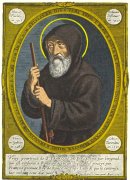
St. Francis of Paola

When they lived:

St. Francis of Paola, also known as Francis of Paola, was born on March 27, 1416, in Paola, a small town in Calabria, Italy. He lived during the late Middle Ages and the early Renaissance period.

Where they lived:

St. Francis of Paola spent much of his life in Italy, particularly in the region of Calabria. He founded the Order of Minims, a religious order focused on asceticism and humility, which gained prominence during his lifetime and beyond.

Notable world events during the time of their life:

  • Fall of Constantinople (1453): St. Francis of Paola witnessed the pivotal moment in world history when the Byzantine Empire fell to the Ottoman Turks, leading to significant geopolitical shifts and influencing the Renaissance in Europe.
  • Invention of the Printing Press (c. 1440s): The advent of Johannes Gutenberg’s movable-type printing press revolutionized communication, making information more accessible and accelerating the spread of ideas, including religious ones, across Europe.
  • European Exploration (late 15th century): During St. Francis of Paola’s later years, Christopher Columbus embarked on his historic voyage to the Americas in 1492, marking the beginning of European exploration and the expansion of the known world.
  • Italian Renaissance: St. Francis of Paola lived through the height of the Italian Renaissance, a period of remarkable artistic, cultural, and intellectual achievements. Notable figures like Leonardo da Vinci, Michelangelo, and Raphael were active during this time.

Their patronage:

St. Francis of Paola is renowned as the patron saint of mariners, sailors, and naval officers. This patronage is especially fascinating considering his humble origins in a small Italian town. He is also invoked for those seeking help in overcoming difficult or challenging circumstances, reflecting his own life of austerity and reliance on faith.

The Brotherhood

When St. Francis of Paola was thirteen years old, he joined the friary of the Franciscan order. This was after he had a vision of a Franciscan friar, and this was also to fulfill the vow that was made by his parents when he was ill.

After a year, he had completed his training, and with his parents, they went on a pilgrimage to Assisi in Rome and other places of devotion.

When they returned to Paola, he secured himself in a cave on his father’s estate and lived there in solitude; however, he later found an even more secluded cave on the sea coast where he lived, giving himself to prayer and solitude.

In 1435, two followers joined him in his retreat, and as a way of accommodating them, he had three cells and a chapel built. This was the beginning of a new order with humility as the hallmark of their brotherhood.

This brotherhood abstained from meat and any animal-derived foods. They also vowed poverty, obedience, and chastity. They adopted a life of extraordinary severity, living unknown and hidden from the world, and they thought it was a necessary means for spiritual growth. They also aimed at reviving the practice of fasting during Lent, which many had stopped practicing.

The number of his disciples gradually increased to about 1454, and St. Francis built a large monastery and church. When this church was being built, a lot of people were moved, such that even the nobles joined and carried stones for the building.

In 1474, he was permitted by Pope Sixtus IV to write a rule for his community and to assume the title of Hermits of St. Francis, which was later changed to Minims by Pope Alexander VI.

The Works

St. Francis also performed many miracles as answers to the people’s prayers, and this increased the people’s devotion. At one point, King Louis XI of France was ill, and he requested that St. Francis of Paola come and pray for him, but he initially refused, only to agree after being ordered by the Pope.

On his way to the king, he cured many who were sick of the plague. He was with the king until his death and became the tutor to the King’s heir. This new king, King Charles VIII, built two monasteries for the monks. This king held St. Francis in high esteem, as did his predecessor.

The king would not permit St. Francis to return to Italy because he did not want to lose his counsel and direction.

It is also believed that St. Francis of Paola had the gift of prophecy, which he foretold to several people. He also predicted a lot of events, including the capture of Otranto by the Ottoman Turks.

St. Francis of Paola is also said to have performed a lot of miracles, including using his cloak as a sail when he was refused passage by a boatman. He is also believed to have prayed for his nephew when he died, and the boy’s life was restored.

The Love for Animals

He is also reported to be compassionate towards animals and would occasionally give life to animals that would have been killed to be eaten. He at one point raised his pet lamb from the dead after it was killed for consumption. What is more fascinating is that the lamb had been eaten already, and he just went to the fire furnace where the fleece and bones had been thrown and called the pet’s name. The lamb then came out of the fire untouched.

At one point, one of the friars got a fish from the pond and had already prepared it, which was now in the frying pan, when St. Francis noticed that it was missing. He sent someone to go and get the fish, and the friar threw the fish on the ground, breaking it into pieces. St. Francis took the pieces and threw them into the water. He prayed, and the fish was restored to life.

Even after the deaths of animals, he continued to call them by their names, as he believed that they continued to exist even after their deaths.

The Legacy

St. Francis of Paola is considered the patron saint of boatmen, mariners, and naval officers. His liturgical feast day is celebrated on April 2nd, which is the day of his death.

St. Francis was canonized for his humility and discernment.

He founded several new monasteries in Calabria and Sicily.

He also established monasteries for nuns and the third order for people.

5 Interesting Facts About St. Francis of Paola

  • St. Francis of Paola had his first followers before he was 20.
    years old.
  • He lived in solitude in a cave on the coast for six years.
  • Relied exclusively on alms for survival.
  • St. Francis of Paola did not respect anyone based solely on their
    worldly rank, as at one point he rebuked the king.
  • St. Francis of Paola was never officially ordained as a priest.

Prayer to St. Francis of Paola

O most Holy Saint Francis, God gives wisdom to the simple and makes the wisest child wise. Pray that He grants me this reward He promises to the humble through your intercession. Help me always to make a good examination of my conscience and confession. Amen.

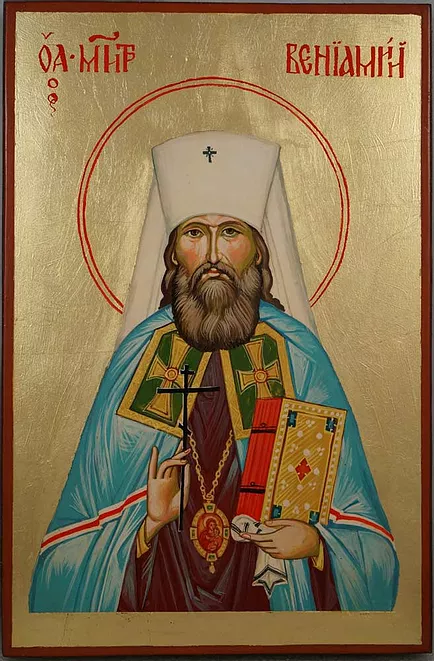
St. Benjamin

When They Lived:

St. Benjamin, also known as Benjamin of Persia, lived during the late 5th century. He was born around 410 AD and met his tragic end in the year 424 AD.

Where They Lived:

St. Benjamin’s life unfolded in the historical region of Persia, present-day Iran. He was part of the Christian community in Persia during a tumultuous period in the region’s history.

Notable World Events During the Time of Their Life:

  • Fall of the Western Roman Empire (476 AD): As St. Benjamin’s life overlapped with the decline of the Western Roman Empire, he witnessed the pivotal moment when the last Roman emperor was deposed. This event marked the end of an era and the beginning of the medieval period in Europe.
  • Council of Ephesus (431 AD): The Council of Ephesus, a significant event in the early Christian church, occurred during St. Benjamin’s lifetime. This ecumenical council aimed to address the Nestorian heresy and solidify the belief in the divine motherhood of Mary, thus shaping the trajectory of Christian theology.
  • Life of St. Patrick (c. 385–461 AD): While St. Benjamin lived in Persia, another notable figure, St. Patrick, was active in Ireland. St. Patrick’s missionary efforts and his role in spreading Christianity throughout Ireland highlight the global scope of the Christian faith during this period.
  • Founding of the Gupta Empire (c. 320–550 AD): In distant India, the Gupta Empire was flourishing during St. Benjamin’s lifetime. This era is often referred to as the “Golden Age of India” due to advancements in arts, sciences, and culture. The empire’s achievements had a global impact.
  • Attila the Hun’s Invasions (5th century): St. Benjamin lived during a time when the notorious Attila the Hun was making his mark in Europe. The fear and turmoil caused by these invasions would have resonated even in Persia, reflecting the interconnectedness of events across continents.
  • Death of Hypatia (415 AD): The tragic death of Hypatia, a renowned philosopher and mathematician in Alexandria, serves as a reminder of the challenges faced by intellectual and academic figures during St. Benjamin’s time. It underscores the importance of preserving knowledge and diverse perspectives.

Their Patronage:

St. Benjamin is recognized as the patron saint of those who are persecuted for their faith. His own life is a testament to his unwavering commitment to Christianity, even in the face of severe persecution. His story serves as an inspiration for individuals who find themselves in situations where their beliefs are challenged or threatened.

Imprisonment

Benjamin, who was a deacon, was imprisoned for a year, and the Eastern Roman Emperor Theodosius II, through an ambassador, facilitated his release. The ambassador agreed on Benjamin’s behalf that he would be released on the condition that he would abandon preaching and speaking about his Christian religion.

Benjamin, on the other hand, did not agree, as he strongly believed that it was his duty to evangelize and tell others about Christ. He continued to preach, which resulted in him being arrested again, and he was brought before the King.

The emperor then ordered that St. Benjamin be tortured. This was after he had asked St. Benjamin to deny Him, whom he worshiped, and St. Benjamin assertively refused.

Reeds were stuck under his nails, both on the toes and fingers, and they were drawn. The process was repeated with violence. The reeds were also inserted into some of his tender parts. A knotty stake was also thrust into his bowels, resulting in the tearing of his internal organs, and this was the final straw that resulted in him becoming a martyr for his Christian faith in the year AD 424.

He showed Christians that no matter how much pain they endured, they must continue proclaiming the gospel.

Benjamin’s feast day is celebrated on the 31st of March. He is known as the patron saint of preachers.

5 Interesting Facts About St. Benjamin

  1. St. Benjamin is considered a Martyr by the Roman Catholics, but he
    is not involved in the General Roman Calendar.
  2. St. Benjamin is also celebrated in the Eastern Orthodox Church on
    the 13th of October.
  3. He knew exactly what would happen to him, but he deliberately
    decided to continue preaching the gospel.
  4. The St. Benjamin medal usually depicts him while in jail while still
    holding on to his faith.
  5. When the reeds were driven into his nails, he took it as a child’s
    play, and this angered the king.

Prayer to St. Benjamin

Glorious Saint Benjamin, constant preacher and Martyr for the Faith,filled with compassion for those who invoke you, I kneel at your feet and humbly beg you to take my present need under your special protection. voucher to recommend it to our Lord Jesus. Please cease to intercede for me until my request is granted. Above all, obtain for me the grace to one day meet God face-to-face, and with you and Mary and all the angels and saints, praise Him through all eternity. Amen.

St. Rupert

When they lived:

St. Rupert, also known as Saint Rupert of Salzburg, lived during the late 7th and early 8th centuries. He was born around 660 AD and passed away in 710 AD.

Where they lived:

St. Rupert’s life was primarily centered around the region of Bavaria, which is now part of modern-day Germany and Austria. He is best known for his missionary work in the Bavarian region and the establishment of the city of Salzburg, which would later become a prominent ecclesiastical center.

Notable world events during the time of their life:

  • Spread of Christianity in Europe: St. Rupert’s life unfolded during a crucial period in European history when Christianity was rapidly spreading across the continent. The conversion of pagan tribes in Bavaria was a significant event during his lifetime, and St. Rupert played a pivotal role in this process.
  • Islamic Expansion: The 7th and 8th centuries were marked by the Islamic expansion into Europe. Events such as the Umayyad Caliphate’s conquest of Spain and the establishment of Muslim rule in the Iberian Peninsula had far-reaching implications for the Western world during St. Rupert’s lifetime.
  • Scientific Advancements: Although St. Rupert was primarily a religious figure, his era also saw some significant scientific advancements. Notably, the works of scholars like Bede in England and Isidore of Seville in Spain contributed to the preservation and transmission of knowledge during this period.
  • The Anglo-Saxon Kingdoms: St. Rupert’s time coincided with the Anglo-Saxon period in England. This era saw the emergence of powerful kingdoms like Northumbria and Mercia, each with its distinct culture and political dynamics.
  • Rise of the Carolingian Empire: During St. Rupert’s life, the Carolingian Empire, under figures like Charles Martel and Charlemagne, was on the ascent. This empire would later play a crucial role in the consolidation of Christian power in Europe.

Patronage:

St. Rupert is celebrated as the patron saint of the city of Salzburg, Austria, which he founded. He is also revered as the patron of the state of Bavaria, Germany, and his feast day is observed on the 24th of September. St. Rupert’s legacy extends beyond his missionary work; he is often invoked as the patron saint of salt miners due to the historical importance of salt in the region. Legend has it that he miraculously found salt deposits while evangelizing, cementing his association with this vital industry.

Additionally, St. Rupert’s story serves as an inspiring example of missionary zeal, peaceful conversion, and cultural exchange in a time when Europe was transitioning from its pagan roots to a predominantly Christian civilization. His efforts to establish the church in Bavaria and his role in shaping the history of Salzburg make him an intriguing figure to explore, both from a religious and historical perspective.

Beginning of Missionary Work

Rupert started his missionary work in Altotting, where he preached to the locals. Through hard work and dedication, he managed to convert a large population along the Danube River. He sailed down the river, reaching the Bulgarian border with the Pannonian lands, which were under the rule of the Avar Khaganate.

He lived in Lorch, the former Roman city of Lauriacum, where an early church already existed. Rupert abandoned his plans to work in the territories of the Pannonian Avars because of the hostile, warlike conditions in the borderlands. He moved to the ruined city of Juvavum and established his base, which he named Salzburg.

Existing Christian traditions gave him a proper foundation to establish the Salzburg Cathedral. This work was completed by his successor, Vergilius. He reestablished the monastic community at St. Peter’s Abbey. Rupert also established the Benedictine nunnery of Nonnberg, and his niece Erentrude became its first abbess. He introduced higher education and other reforms that promoted the development of the local salt works.

Rupert’s missionary work spread into the Alps, where he founded the first monastic cell at present-day Bischofshofen. His energetic dedication to establishing churches and monasteries earned Rupert the name Apostle of Bavaria and Austria. He left his mark as a successful evangelist of the region which includes Bavaria, the homeland of PopeBenedict XVI.

Bavaria in Rupert’s days was neither fully pagan nor solidly Catholic. Although missionaries evangelized the region in the past, the local religion tended to mix portions of the Christian faith with pagan beliefs and practices.

Death of Rupert

He died on Easter Sunday, around the year 710. However, other sources state that he returned to his hometown of Worms, where he died in the year 717.

Patronage

Rupert is the patron saint of the state of Salzburg and several settlements, such as Sankt Ruprecht in Styria and Sentrupert in Slovenia. He is also the patron of salt miners.

5 Interesting Facts About St. Rupert

  • St. Rupert’s mortal remains were transferred to Salzburg Cathedral by
    Bishop Vergilius on September 24, 774.
  • Rupert served as both the bishop of Salzburg and the abbot of the
    Benedictine monastery he established. This traditional pairing of the
    Two roles were passed on by St. Rupert’s successors until the late 10th
    century.
  • Rupert was born into a noble and royal family of the Franks, but he
    was far nobler in faith and devoutness.
  • He died on Easter Sunday after preaching and celebrating Mass.
  • His feast day is celebrated by the Eastern Orthodox Church on March
    27.

Prayer to St. Rupert

Dear Lord Jesus, Your holy bishop, Saint Rupert, built many sacred places and enabled many to learn about You and their faith through the nuns and monks that resided in these holy institutions. Through the intercession of Saint Rupert, we pray that we will build up the faith through our actions and love of others. Amen.

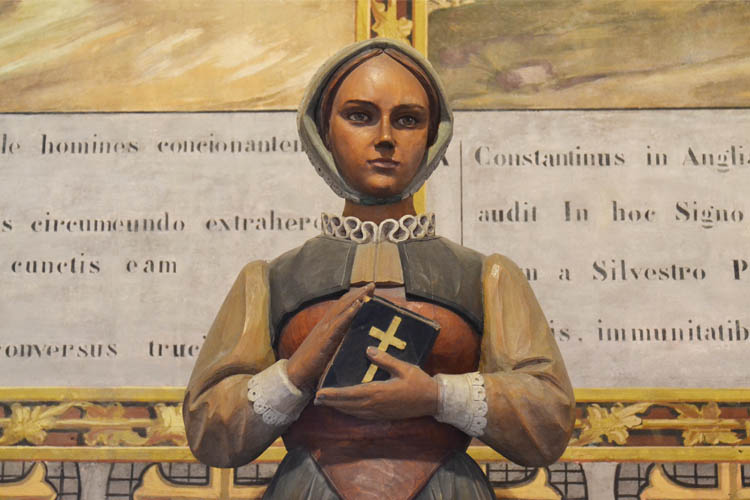
St. Margaret Clitherow

When They Lived

St. Margaret Clitherow lived from 1556 to 1586.

Where They Lived

St. Margaret Clitherow lived in York, England.

Notable World Events During Their Life

  • Spanish Armada (1588): The iconic naval battle between the Spanish Armada and the English fleet.
  • Scientific Revolution: Advancements in science by figures like Copernicus, Galileo, and Kepler.
  • Exploration and Colonization: Establishment of the Roanoke Colony and global exploration.
  • Shakespearean Era: Flourishing arts and literature, including the works of Shakespeare.
  • Thirty Years’ War (1618-1648): A major European conflict reshaping the continent.

Patronage

St. Margaret Clitherow is the patron saint of martyrs, difficult marriages, and businesswomen. Her life story is
a testament to her unwavering faith and strength, making her an inspiration for those facing challenges in their
lives. Margaret’s commitment to her Catholic faith during a time of religious upheaval highlights her dedication
to her beliefs, even in the face of persecution and adversity. Her story serves as a reminder of the power of
conviction and the importance of standing up for one’s principles.

Early Life

Margaret Clitherow was born in York, Yorkshire, England, in 1556. She had five siblings. Her father was Thomas Middleton. He was a reputable businessman and also managed a wax factory. In 1564, he became Sheriff of York. Margaret lost her father when she was 14 and was raised by her mother, Jane Middleton. She grew up to be a charming and unique young woman. She got married to John Clitherow, the city’s chamberlain and a wealthy meat seller. Her marriage with Thomas produced three exceptional children, and they were all raised in The Shambles.

Conversion to Catholicism

Margret Citherow became a Roman Catholic in 1574. Although her husband was part of the established church, he didn’t oppose her decision as his brother was a Catholic priest. There was a law at that time that mandated that a fine be paid for missing service. John Clitherow ensured he always paid for his wife. After some time, she was imprisoned for not attending service and released shortly after. She was jailed twice after her first incarceration.

Her zeal for the Catholic faith was intense, and she was a fearless lady willing to risk her life to protect and provide shelter to Catholic priests, who were at that time illegal. She carried this out passionately, despite the capital punishment she could face for engaging in such activities. As this was against a law made in 1584.

She provided two chambers for these priests, where they lived and celebrated the mass secretly. Most fugitive priests North of England found safety and solace in her homes.

Her Oldest son, Henry, had traveled abroad to be trained as a Catholic priest. This sparked a lot of questioning and interrogation. Her husband was able to provide a genuine response to these interrogations. However, in 1586, during a search, a little boy got so scared that he pointed at the location where the priests hid, which led to their arrests.

Trial and Death

Margaret Clitherow was arrested for harboring Catholic priests. To save her family from testifying, she refused a trial. She vehemently affirmed that she didn’t commit any crime, so there was no point trying her. She was sentenced to death. She was killed in a very gruesome manner. Heavy rocks placed on a door board were pressed down on her back so that the heavy and sharp rocks pressed her down and broke her back. Her execution was carried out in 1586 on Lady Day.

Legacy

Margaret is revered as the patroness of the Catholic Women’s League. There are so many churches and institutions across America and Europe bearing her name. Churches and schools alike in England and America take her name. She is also the co-patroness of the Latin Mass Society. This organization set up the annual pilgrimage to York to honour her.

Veneration

Pope Pius XI beatified Margaret in 1929. On October 25th, 1970, together with forty other martyrs from both England and Wales, she was canonized by Pope Paul VI. Her Shrine is located at 35, 36, The Shambles.

5 Interesting Facts About St. Margaret Clitherow

  • Her Feast day is March 26th.
  • In Prison, she learned how to speak Latin to participate actively in
    Latin mass.
  • She gave birth to her third child, Williams, while in Prison.
  • She was executed while pregnant with her fourth child.
  • She is nicknamed the Pearl of York.

Prayer to St. Margaret Clitherow

Dear Lord Jesus, give us the courage and grace not only to live holy lives but to be willing to die holy deaths, as St. Margaret of Clitherow did. We thank you, dear Lord, for the examples of your holy saints. May we follow in their footsteps. In Your holy name, we pray. Amen.

Source: https://catholicexchange.com/saint-margaret-of-clitherow

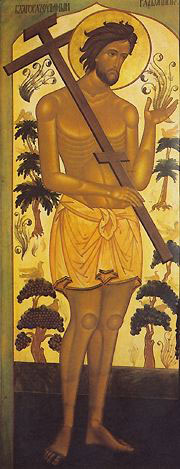
St. Dismas

When They Lived:

St. Dismas, also known as the “Good Thief,” is believed to have lived during the 1st century AD, around the time of Jesus Christ. His exact birth and death dates are not recorded, but his significant encounter with Jesus occurred during the crucifixion, making him a contemporary of Jesus.

Where They Lived:

St. Dismas’ life is associated with the region of Judea, which was part of the Roman province of Palestine. He is most famously known for his presence on Golgotha, the hill where Jesus was crucified, which is traditionally believed to be located near Jerusalem.

Notable World Events During Their Time:

  1. The Crucifixion of Jesus (c. 30-33 AD): This event is pivotal in St. Dismas’ story as he is one of the two thieves crucified alongside Jesus. The crucifixion itself is one of the most significant events in Christian history.
  2. The Roman Occupation of Judea: During this period, the Roman Empire exerted control over the region, leading to various conflicts and tensions. This political backdrop provides context to the events surrounding Jesus’ crucifixion.
  3. The Zealot Uprising (6-66 AD): The Zealots, a Jewish resistance movement, began their struggle against the Roman occupation in Judea. This uprising started a few years after the crucifixion and shaped the political atmosphere in the region.
  4. The Great Fire of Rome (64 AD): A devastating fire swept through Rome during the reign of Emperor Nero. This event led to significant changes in the city’s architecture, urban planning, and even influenced the early Christian community’s perception.
  5. The Destruction of the Second Temple (70 AD): The Second Temple in Jerusalem, a central religious and cultural symbol for the Jewish people, was destroyed by the Romans, marking a critical moment in Jewish history and impacting the development of Christianity.

Their Patronage:

St. Dismas is most notably recognized as the patron saint of repentant criminals, prisoners, and those facing a death sentence. His life serves as a powerful example of redemption and the transformative impact of genuine repentance, reminding us of the boundless mercy and forgiveness that can be obtained even at the eleventh hour. His story offers hope to individuals facing difficult circumstances and serves as a reminder of the profound love and forgiveness offered by Christianity. St. Dismas’ unique position as the “Good Thief” at the crucifixion makes him an extraordinary figure, transcending traditional sainthood in a way that captures the essence of compassion, forgiveness, and the promise of salvation.

Difficulty to Track

Writing a biography about a saint requires thorough research, reading, and cross-referencing with other sources. What if there are no existing sources for us to know about a saint’s life? That sure is a very difficult task! This is the case with St. Dismas.

The only valid information that we could get about Dismas comes from the Gospels. All four Gospels recount that when the Lord Jesus Christ was condemned and crucified, there were two others who were crucified with Him:

“Two revolutionaries were crucified with him, one on his right and the other on his left.” (Matthew 27:38)

“With him, they crucified two revolutionaries, one on his right and one on his left.” (Mark 15:27)

“Now two others, both criminals, were led away with him to be executed. When they came to the place called the Skull, they crucified him and the criminals there, one on his right, the other on his left.” (Luke 23:32-33)

“There they crucified him, and with him two others, one on either side, with Jesus in the middle.” (John 19:18)

The Gospels all agree that there were two others who were crucified with Jesus. However, all of the Gospels did not indicate the names of these two. Instead, they were called “criminals” or “revolutionaries”. So, the name “Dismas” was given by writers or from stories and legends. The name first appeared in the 4th-century Gospel of Nicodemus, an apocryphal work. The same document also gave a name to the other criminal. He was named Gestas.

Contrition Brought Him redemption.

The Gospel of Luke dedicates some verses that recount the conversation between Jesus and Dismas (see Luke 23:39–43). Dismas became quite sober during their crucifixion. In the midst of his agony, he had recognized both his wrongdoings and who Jesus was. He was filled with regret and humility. This brought him  new hope and faith. After Gestas reviled and mocked Jesus, even demanding that He do something about their situation, it was Dismas who stepped in and defended Jesus. It was him who reminded Gestas that they had done evil and that they deserved the punishment they were suffering. Clearly, Dismas pointed out that Jesus was innocent and therefore undeserving of the gruesome punishment of crucifixion.

“Stealing” Heaven

As his heart and mind transformed, Dismas came to know that he was beside a Man of love, forgiveness, and power. Though undeserving and ashamed, Dismas decided to risk a request to Jesus: that He remember him when Jesus comes to His kingdom. Jesus responded with much assurance: “Amen, I say to you, today you will be with me in Paradise.” (Luke 23:43). The next thing that we know about Dismas and his fellow criminals is that their legs were broken to hasten their deaths (see John 19:32).

Dismas’ example reminds us that despite being a great sinner, with humility and contrition, there is still hope and encouragement for all. The Memorial of St. Dismas falls on March 25, coinciding with the Feast of the Annunciation of the Lord.

5 Interesting Facts About St. Dismas

  1. St. Dismas is the patron saint of condemned prisoners, death row prisoners, dying people, funeral directors, penitent criminals, prison chaplains, prisoners, prisoners on death row, prisons, and reformed thieves.
  2. St. Dismas is also referred to as “The Good Thief” or “The Repentant Thief”.
  3. The name “Dismas” in Greek means “sunset”, “to the west” or simply “dying”.
  4. A legend from the Arabic Gospel of the Infancy says that Dismas and Gestas actually had a run-in with the Holy Family when they were fleeing to Egypt. Apparently, according to the story, Dismas bribed Gestas with forty drachmas to not harm the Holy Family. The story continued that the Child Jesus prophesied that Dismas and Gestas would be crucified with Him in Jerusalem someday and that Dismas would accompany Him to Paradise.
  5. The majority of Bible scholars agree that Dismas and Gestas were revolutionaries or rebels, not mere thieves. The capital punishment of crucifixion was reserved for the most horrible crimes of the time, one of which was rebellion and treason.

Prayer to St. Dismas

Lord Jesus, help us to be merciful as You are merciful. Let us see that all are Your children, and remember that we are not to judge. When we look at one such as Dismas, let us see an opportunity to offer hope and salvation. Let us witness the good news of salvation to the sinner and never judge anyone as unworthy or hopeless. Just as Dismas repented at the last moments of his life on earth, let us see that this is great hope for all and grant that we never grow weary in our efforts to bring the light of salvation to all. Amen.

St. Toribio Alfonso de Mogrovejo

When they lived:

St. Toribio Alfonso de Mogrovejo, also known as Saint Turibius of Mogrovejo, lived from November 16, 1538, to March 23, 1606. He was a prominent figure in the late 16th century.

Where they lived:

St. Toribio Alfonso de Mogrovejo lived primarily in two regions:

  1. Spain: He was born in the city of Mayorga, in the region of Castile, Spain. This is where his early life and education took place.
  2. Peru: Toribio de Mogrovejo is most renowned for his work as the Archbishop of Lima, Peru. He lived and worked there for the majority of his life, dedicating himself to the betterment of the Church and the indigenous people of the region.

Notable world events during the time of their life:

  • Spanish Conquest of the Inca Empire (1532-1572): During St. Toribio’s lifetime, the Spanish conquistadors, led by figures like Francisco Pizarro, were actively colonizing South America. This period marked significant clashes of cultures and the conversion of indigenous populations to Christianity.
  • Council of Trent (1545-1563): The Council of Trent was a crucial event in the Catholic Church during St. Toribio’s time. It aimed to address and reform various aspects of the Church, including its teachings, practices, and hierarchy.
  • Scientific Revolution (16th-17th centuries): While not directly related to St. Toribio, this era saw a surge in scientific discoveries and the development of the scientific method by figures like Galileo Galilei and Johannes Kepler. These advancements laid the groundwork for modern science.
  • Renaissance (14th-17th centuries): The Renaissance was a cultural and intellectual movement that encompassed art, literature, and philosophy. Although it began before St. Toribio’s birth, its influence persisted during his lifetime, contributing to the shaping of European culture.
  • Exploration and Colonization: The late 16th century was marked by European exploration and colonization worldwide. Figures like Christopher Columbus and Ferdinand Magellan had already set the stage, and this era saw continued expansion into the Americas, Africa, and Asia.

Patronage:

St. Toribio Alfonso de Mogrovejo is the patron saint of several causes and groups:

  • Archdiocese of Lima: He is the patron saint of the Archdiocese of Lima, where he served as Archbishop. He is revered for his tireless efforts to improve the Church and the lives of the indigenous people in Peru.
  • Latin American Bishops: St. Toribio is also considered a patron saint for Latin American bishops. His dedication to his pastoral duties, missionary work, and advocacy for social justice sets an inspiring example for contemporary clergy.
  • Indigenous Peoples: He is revered for his strong advocacy for the rights and well-being of indigenous populations. St. Toribio worked tirelessly to protect their rights and provide them with spiritual and material support.
  • Legal Profession: Due to his background in law and his emphasis on justice, St. Toribio is also considered a patron saint of the legal profession, especially in Peru.

St. Toribio Alfonso de Mogrovejo’s life and work continue to inspire individuals and groups around the world, making him a significant figure in both religious and historical contexts.

Early Life

The Spanish saint, Toribio Alfonso de Mogrovejo, also known as Turibius of Mogrovejo, was born to Luis Alfonso de Mogrovejo and Ana de Robles Imoran on November 16th, 1538. The location of his birth was Valladolid, Habsburg, Spain. As a young child, Toribio was known to have strongly upheld a devotion to the Blessed Virgin, so much so that no week went by without him fasting in honor of the Blessed Mother. His inquisitiveness to know more led to his studies at Valladolid College at the age of twelve, where he studied humanities. In the years that followed his graduation, Toribio joined his uncle, Juan de Mogrovejo, as a professor in Salamanca’s college, where his duty was to teach law. Years later, he returned as a student at the college in Coimbra, after which he came back to Salamanca. Years after his uncle’s death, because of how knowledgeable Toribio seemed to be, King Philip II assigned him the duty of Grand Inquisitor in the year 1571 at the Inquisition Court in Granada, where he served for five years.

Dedication and Devotion

King Philip II used his influence after Toribio had served as Grand Inquisitor to nominate him as Lima archbishop, given that the position was vacant at the time. Being grounded in canon law, Toribio tried to make the King see the reasons he could not take on the position—that it was one left for people who were ordained priests or kings only. Unfortunately, however, Toribio’s knowledge of canon law did not save him from what fate was deciding for him. His points were overruled by the pope, and subsequently, arrangements began to come up for his ordination before the official announcement of his filling the office. In 1578, Toribio was ordained into the priesthood, and by May of the following year, he was made an Archbishop. Toribio, after that, received his episcopal consecration in the year 1580, carried on by the Archbishop of Seville, Cristobal Rojas Sandoval.

Just after his ordination, Toribio kicked off his ministry by setting out on foot to Lima, where he baptized and taught people about Christ. Being that he was journeying through the archdiocese on foot, Toribio experienced a whole lot of ups and downs, from foot burns to fevers to threats from aggressive tribes to the wild beasts he’d had to face, too. But he didn’t relent. He instead went on to construct roads, hospitals, chapels, schools, and convents. He also established a seminary, which would be the very first of its kind in the entire Western Hemisphere. He fought to make sure that those priests of questionable behavior were brought to order, and though this earned him a title among them, it turned out for the good of all. The saint was also triumphant, among many other things, in including evangelism as a central theme in his episcopal career.

Legacy

Among the many legacies that St. Toribio Alfonso de Mogrovejo left behind after his passing are the schools, convents, hospitals, roads, chapels, etc. of his establishments. He also had a voice that stood for only what was upright. Such could be seen in his reformation of the diocesan priests. His commitment to including evangelism as a core aspect of his episcopal career could also be measured as one of his legacies. All in all, his influence and impact on life are a great legacy to look back on today.

Death and Canonization

Toribio Alfonso de Mogrovejo passed away on March 13th, 1606, at precisely 3:30 p.m. from a fever. This had happened as he’d predicted. Such was the case during the period of a pastoral visit in Pacasmayo. Toribio was canonized as a saint in 1726, on December 10th, precisely by Pope Benedict XIII.

Feast Day

A liturgical feast in honor of St. Toribio Alfonso de Mogrovejo used to be celebrated on April 27th, but currently it is done on March 23rd.

Prayer to St. Toribio Alfonso de Mogrovejo

Lord, through the apostolic work of Saint Turibius and his unwavering love of truth, you helped your church grow. May your chosen people continue to grow in faith and holiness. Grant this through our Lord Jesus Christ, your Son, who lives and reigns with you and the Holy Spirit, one God, forever and ever. Amen.

Source:https://www.365rosaries.blogspot.com/2011/03/march-23-saint-toribio-alfonso-de.html?

St. Lea

When they lived: St. Lea lived during the late 4th century and early 5th century, specifically from around 350 to 384 AD.

Where they lived: St. Lea was born and lived in Rome, which was a bustling center of culture, politics, and religion during her time.

Notable world events during the time of their life:

  • Fall of the Western Roman Empire (476 AD): St. Lea’s lifetime witnessed the decline and eventual fall of the Western Roman Empire. This event marked a significant turning point in European history, leading to the fragmentation of the Roman territory and the rise of various successor kingdoms.
  • Sack of Rome by the Visigoths (410 AD): Around 410 AD, Rome was captured and looted by the Visigoths, an event that shook the Roman world and had profound implications for the perception of the city’s invincibility.
  • Council of Constantinople (381 AD): The Second Ecumenical Council, held in Constantinople, affirmed key doctrines of Christianity.
  • Founding of the City of Venice (421 AD): The founding of Venice in 421 AD marked the beginning of a unique and influential city-state that would become a hub of trade, culture, and power in the Mediterranean region.
  • Life and Work of St. Augustine (354-430 AD): St. Augustine, a prominent theologian and philosopher, lived during a similar time as St. Lea.

Their patronage: St. Lea is known as the patron saint of widows and mothers who have lost children. Her life and devotion to her faith serve as an inspiration to those who have faced loss and adversity.

Early Life

St. Lea was born in Rome, Italy. All that is known of the female saint was gathered from her very close friend, Saint Jerome, a scholarly monk. St. Lea lived almost a low-key life, and only a few pieces of information can be gathered about her. After her short-lived marriage ended with the death of her husband, St. Lea put down all of the wealth and riches in her possession to pursue the work of the Lord. It was unusual—a wealthy widow preferring to live a simpler, less wealthy life. She got into the convent of consecrated virgins the city had, where, for many years to come, she would be honored as the convent’s prioress. Her name is believed to have been a derivation of the Hebrew female name Leah, which means weary,” or the Akkadian name, which means “ruler,” or still the Chaldean name, which means “mistress”.

Call to Dedication and Devotion

After she had joined the convent upon the death of her husband, St. Lea invested in supporting the convent house, which was run by Saint Mary, who would later grow, as many other people would, to be fond of her. She was dedicated to serving as a menial servant until years later, when she became a group’s superior. Regardless of how much wealth she owned, she was still well known to be humble, obedient, and of remarkable penance. In a note to St. Marcella, St. Jerome exhaustively speaks of St. Lea’s virtue when she died in the year 384. There, he’d noted that St. Lea was blessed and that following her remarkable work on earth while she was still alive, heaven was the sure end for her. St.Jerome did not fail to mention how much of a servant St. Lea was, selfless to the core, to see someone else have something they needed. Given the fact that she was so wealthy she could get a very high-class life, St. Jerome mentioned that she preferred to be dressed in rags, preferred to go hungry, cared less how old her hair was becoming, and cared less if she had even had something to eat for herself because someone around her needed more care than her.

Morals to be learned from the life of St. Lea include that irrespective of how much wealth one has, there should be in their hearts a place for humility, selflessness, and submission to authority. In addition to that, as St. Jerome mentioned at the closure of his letter to St. Mary, Christians shouldn’t be seeking Christ while at the same time seeking the pleasures of the world.

Legacy

The only known legacies of St. Lea at the moment are those of those whose lives she blessed during her existence. Her devotion and dedication to God’s sanctuary and people are also legacies left by this female saint. By living an honest, straightforward, and humble life, St. Lea has thought about and continues to teach people how not to value the place of material wealth over Christ’s purpose for life.

A plus to these is the honor she’s received from the convent of her residence, where she was named the convent’s prioress.

Death

St. Lea breathes her last breath in the year 383.

Feast Day

Every March 22nd, St. Lea’s feast day is celebrated.

Prayer to St. Lea

Lord, amid the things of this world, let us wholeheartedly be committed to heavenly things in imitation of the example of evangelical perfection You have given us in St. Lea. Amen.

Source:https://www.divine-redeemer-sisters.org/saint-of-the-day/march/22-st-lea-widow

Bl. John of Parma

Bl. John of Parma

When they lived:

Bl. John of Parma, also known as Blessed John of Parma, lived from 1209 to 1289.

Where they lived:

John of Parma was born in Parma, Italy, and spent much of his life within the Franciscan Order, traveling to various locations in Europe.

Notable world events during the time of their life:

  • The Mongol Empire: During John of Parma’s lifetime, the Mongol Empire, led by figures like Genghis Khan and later Kublai Khan, rapidly expanded its territory, impacting vast regions of Asia, Europe, and the Middle East.
  • The Albigensian Crusade: The early 13th century saw the Albigensian Crusade in Southern France, a military campaign by the Catholic Church against the Cathars, a dualistic religious sect. This conflict resulted in significant religious and social changes in the region.
  • The Seventh Crusade: In 1248, King Louis IX of France launched the Seventh Crusade to the Holy Land, an attempt to recapture Jerusalem and other territories from Muslim control. Despite initial successes, the Crusade ultimately ended in failure.
  • The Medieval Inquisition: The 13th century marked the establishment of the Medieval Inquisition by Pope Gregory IX, aiming to suppress heresy within the Catholic Church and wider society. This led to various trials and persecutions of religious dissenters.
  • The Magna Carta: In 1215, during John of Parma’s early years, the Magna Carta was signed in England, a significant document that limited the power of the monarchy and laid the groundwork for modern constitutional law.
  • The Italian Renaissance: Towards the end of John of Parma’s life, the Italian Renaissance was starting to take shape, leading to a flourishing of art, literature, and scientific advancements.

Their patronage:

Bl. John of Parma is considered a patron saint of Franciscan students and scholars. His life was marked by a deep devotion to learning and intellectual pursuits within the Franciscan Order, making him a fitting intercessor for those seeking knowledge and wisdom.


Early Life

Blessed John of Parma was born circa 1209 in Parma, Italy. It was recorded that his family name was Buralli.

Blessed John was said to have been of noble descent. There is not much information about his parents or siblings.

Blessed John was trained and taught by his uncle, who was at the time a cleric at St. Lazarus Church. He was such an intelligent young man that, after completing his basic education, he was appointed tutor of philosophy.

He was pious and sought more spiritual knowledge. This caused him to join the Order of the Friars Minor at the age of 25. He dedicated his time and body to practicing religion.

Blessed John was humble and practiced poverty to help rid him of an annual anchor.

He was appointed priest and became a teacher at notable institutions like the Universities of Naples, Bologna, and finally Paris.

In July 1247, Blessed John was elected Minister General. This was partly influenced by Pope Innocent IV, who had taken a special liking to him.

Blessed John served for ten years until February 2, 1257.

Dedication and Devotion

All the activities carried out by Blessed John were documented thanks to a man called Salimbene. Salimbene worked and went everywhere with Blessed John.

Blessed John was hardworking and needed to see the whole of the Order. He went around from one community to the next on foot and mostly dressed poorly. He was said to always have been escorted by just one or two friars.

His first stop was England, where he was welcomed by King Henry III. There, he was impressed by the state of the Order and so traveled on to France.

In France, he was welcomed by King Louis IX. From then on, he passed through Burgundy and Provence. Finally, in September 1248, he set out for Spain.

In Spain, at the request of Pope Innocent, Blessed John hosted the Chapter of Metz. It was at this Chapter that he set up a new document to guide the order.

It was during this time that trouble began brewing between the mendicants and the University of Paris.

Blessed John fought for peace between both parties. Afterward, he wrote a letter that would be released in Milan in 1255. This letter was asking for peace between the warring Dominican and Franciscan Orders.

Legacy

Due to these disputes, Blessed John’s authority was undermined. This,and some other reasons caused by political challenges, caused Blessed John to leave his post.

It is recorded that Pope Alexander II might have been a key player in the resignation of Blessed John. Salimbene tried to convince Blessed John not to resign, but without success.

Blessed John resigned his office, certain that he could do nothing more to help the Order. He appointed Bonaventure as his replacement before disappearing into the hermitage.

Blessed John withdrew to the village of Greccio. There he lived inisolation. He lived there peacefully until he was once again summoned for a hearing due to some accusations made against him.

Blessed John was acquitted of these charges and once more returned to solitude. There he prayed, fasted, and meditated.

Death and Canonization

At the age of 80, in 1274, Blessed John made a decision to go and minister in Greece. He was permitted by Pope Nicolas IV.

Blessed John died in a monastery on the 19th of March, 1289.

Pope Pius VI announced his beatification in 1777. He was canonized pre-Congregation.

Blessed John is celebrated on the 20th of March.

5 Interesting Facts About Blessed John of Parma

  1. Did you know that Blessed John was one of the first Ministers of the
    orders of Friars Minor?
  2. Did you know that Blessed John is also said to have studied in
    Paris?
  3. Did you know that Blessed John was such a good evangelist that even
    the powerful traveled to hear him speak?
  4. Did you know that Blessed John was the first Minister General to
    visit the whole Order?
  5. Did you know that miracles were said to have been recorded at
    Blessed John’s tomb?

Prayer to Blessed John of Parma

You stayed true to your faith by advocating for the successful return of a simple way of living through the Franciscan order advocated by Saint Francis. May we stay true to our beliefs, especially regarding our faith in God, and seek to bring his works to others, especially the elderly in need. Amen.

Source:[https://clicktopray.org/blessed-john-of-parma-45952/]{.ul}

St. Joseph

When They Lived:

St. Joseph, also known as Joseph the Worker, lived during the first century AD, believed to be born around 1 BC and passing away around 18 AD.

Where They Lived:

St. Joseph’s life primarily unfolded in Nazareth, a small town in Galilee, which was a region in ancient Palestine.

Notable World Events During Their Time:

  • Roman Occupation: The land of Palestine was under Roman occupation, with various Roman governors and procurators.
  • Birth of Jesus: The nativity story revolved around Joseph and Mary seeking refuge in Bethlehem.
  • Death of Herod the Great: A significant transition in the political landscape of Palestine.
  • Expansion of the Roman Empire: St. Joseph’s experiences were shaped by Roman culture and governance.
  • Development of Judaism: A period of significant theological and cultural growth.
  • Scientific Advances: Continuing discoveries contributing to expanding human knowledge.

Their Patronage:

St. Joseph is recognized as the patron saint of various aspects of life:

  • Workers and Laborers
  • Fathers and Families
  • The Dying
  • Craftsmen and Engineers
  • Social Justice Causes

Early Life

Saint Joseph is one of the most popular and revered saints in Christianity. Venerated as the earthly father of Jesus Christ, what little is known about him is taken from his appearance in the Bible.

Saint Joseph has since been studied by various historians. However, these studies were made difficult by the fact that he existed even before Jesus Christ was born.

There are various books, facts, and hearsay about him.

There have been many difficulties in theologians and historians being able to place the birth of Saint Joseph. Many historians fix his date of birth to be circa 100 B.C.E.

Saint Joseph first made an appearance in the Bible in the book of Matthew, the New Testament.

In the book of Matthew, Saint Joseph is said to be a descendant of King David. What he did earlier in his career is up for argument. Even his account of his life before meeting the Virgin Mary varies.

Some historians claim Saint Joseph had children from a former Marriage. So accounts Claim that Joseph was a virgin before he met the Blessed Mary.

Dedication and Devotion

Saint Joseph was said to have lived in Nazareth. He was described in the Bible as being a “tekton”. This was taken by literal accounts to mean carpenter.

However, the literal translation of the word was said to mean technical, placing Saint Joseph as a maker of things. Like other information about this saint, this little piece of information has been debated for years.

Joseph was betrothed to Mary, whom he had met as a virgin. After discovering she was pregnant with a child, the Bible describes him as wishing to secretly divorce Mary in order to save her reputation.

After making up his mind, however, he had a dream where he was instructed by an angel to stay with Mary and the Child. He was told that the child was a product of the Holy Spirit.

A man who believed in God, Saint Joseph trusted this vision and stayed married to Mary.

After Mary gave birth to Jesus Christ in Bethlehem, Joseph was recorded in the Bible to once again have a vision. In this vision, an angel warned him about returning home.

It was shown to him that King Herod of Judea bore malevolent thoughts toward his child. Fearing for their lives, Saint Joseph led his family to Egypt.

They lived there for some years before the angel once again appeared to him to break the news of Herod’s death.

Saint Joseph settled in Nazareth with his family. There, he taught Jesus the art of Carpentry.

It is noted that the last time Saint Joseph appeared in the Bible (Luke 2:41–49) was when Jesus went missing. Joseph found young Jesus teaching in the temple.

It is recorded in the Bible that when told by his parents that they had been searching for him, Jesus replied, “Why were you searching for me? Did you not know that I must be in my Father’s house”.

He was, however, mentioned once more in John 6:41–42 when Jesus Christ was being discussed by the Jews: “Is this not Jesus, the son of Joseph, whose father and mother we know? How can he now say, ‘I came down from heaven?”.

Legacy

Saint Joseph is famously associated with the accounts of Jesus Christ. He is venerated across all Christian denominations as the father of Jesus Christ.

Because of the lack of proper documentation, it is not clear what he spent the rest of his life doing.

It is still argued today whether Saint Joseph had any children except Jesus Christ. Some historical accounts venerate him as a Perpetual Virgin.

These accounts assume that Saint Joseph and the Virgin Mary remained chaste throughout their marriage.

There are lots of writings intended to fill up the space left open by the missing accounts of Saint Joseph.

Death and Canonization

Saint Joseph’s death is not recorded in the Bible.

Some accounts claim that he passed away before Jesus started his ministry. Others claim that Saint Joseph passed away peacefully at the age of 111. This is supported by various 17th-century writings.

He was named the patron of the universal church by Pope Pius IX in 1870.

Saint Joseph is celebrated by Western Christianity on the 19th of March. He is also commemorated on the third Wednesday after Easter Sunday and on the 1st of May.

5 Interesting Facts About St. Joseph

  • Did you know that Saint Joseph is the Patron Saint of many things
    including Fathers, Immigrants, Craftsmen, and Cebu?
  • Did you know that Saint Joseph’s supposed father is Jacob?
  • Did you know that Saint Joseph was named the patron saint of several
    countries like America, Croatia, Belgium, and Peru?
  • Did you know that there is no recorded quote from Saint Joseph in the
    Holy Bible?
  • Did you know that some accounts record Saint Joseph dying in Jesus
    Christ’s and the Virgin Mary’s arms

Prayer to St. Joseph

Hail, Guardian of the Redeemer,Spouse of the Blessed Virgin Mary! To you, God entrusted his only Son; in you, Mary placed her trust; with you, Christ became man. Blessed Joseph, to us, too, show yourself a father and guide us in the path of life. Obtain for us grace, mercy, and courage, and defend us from every evil. Amen.

Source:[https://portlanddiocese.org/prayers-st-joseph]{.ul}