St. William of Bourges

When they lived:

Saint William of Bourges was born in 1155 and lived through the 12th century, passing away in 1209.

Where they lived:

Saint William was primarily associated with the town of Nevers in France. He was known for his dedication to the Church and his efforts to promote spiritual growth in the region.

Notable world events during the time of their life:

  • Third Crusade (1189-1192): One of the most significant events during St. William’s lifetime was the Third Crusade. Led by prominent figures like Richard the Lionheart and Saladin, this crusade aimed to recapture the Holy Land from Muslim control. While St. William wasn’t directly involved, this event had a profound impact on the Christian world and the region.
  • Medieval Renaissance: The 12th century witnessed the revival of learning and culture in Europe, often referred to as the “12th-century Renaissance.” This intellectual awakening laid the foundation for later developments in science, philosophy, and theology. St. William’s life coincided with this period of renewed interest in knowledge.
  • Birth of Gothic Architecture: During St. William’s time, Gothic architecture began to flourish. The construction of iconic cathedrals like Chartres Cathedral and Notre-Dame de Paris represented remarkable achievements in engineering and design, emphasizing the spiritual importance of the era.
  • Al-Idrisi’s Geography: In the realm of science and exploration, the Muslim geographer Al-Idrisi created his famous world map in the 12th century, showcasing a comprehensive understanding of the world’s geography. This work contributed to further exploration and the exchange of knowledge between East and West.
  • Birth of the University: The University of Bologna, founded in 1088, became a model for higher education during St. William’s time. The rise of universities marked a shift toward organized education and the systematic pursuit of knowledge.

Their patronage:

Saint William of Bourges is the patron saint of pregnant women, midwives, and people in difficult labor. His devotion to aiding women during childbirth and his deep compassion for those in pain earned him this special patronage. It’s a testament to his unwavering commitment to helping others and his enduring legacy in the realm of compassion and care.

St. William’s life was intricately woven into the tapestry of the 12th century, a period marked by both religious fervor and intellectual enlightenment. His story is not only one of spiritual devotion but also a reminder of the dynamic and transformative era in which he lived, where faith and knowledge intertwined to shape the course of history.

Early Life

St. William (also known as Guillaume de Donjeon) was born around 1140 in Nevers, France.

His father initially intended for Guillaume to join the army. However, Guillaume took the ecclesiastical way of life instead. His ecclesial tutoring was handled by his uncle, the Soissons archdeacon Pierre (Peter the hermit). William eventually abandoned worldly pursuits and joined the Order of Grandmont.

He stayed with the order for some time and followed their practices with immense dedication. When he discovered that the members were no longer cordial with each other, he left and joined the Cistercians. At the Pontigny Abbey in France, he donned the habit and was soon made Prior. He was appointed Abbot of Fontaine-Jean Abbey in 1184. Also in 1200, he was made abbot of Chaalis Abbey.

Saint William nurtured a genuine and true dedication to the Blessed Sacrament. For this reason, he was often at the altar, meditating on the true meaning of the Sacrament.
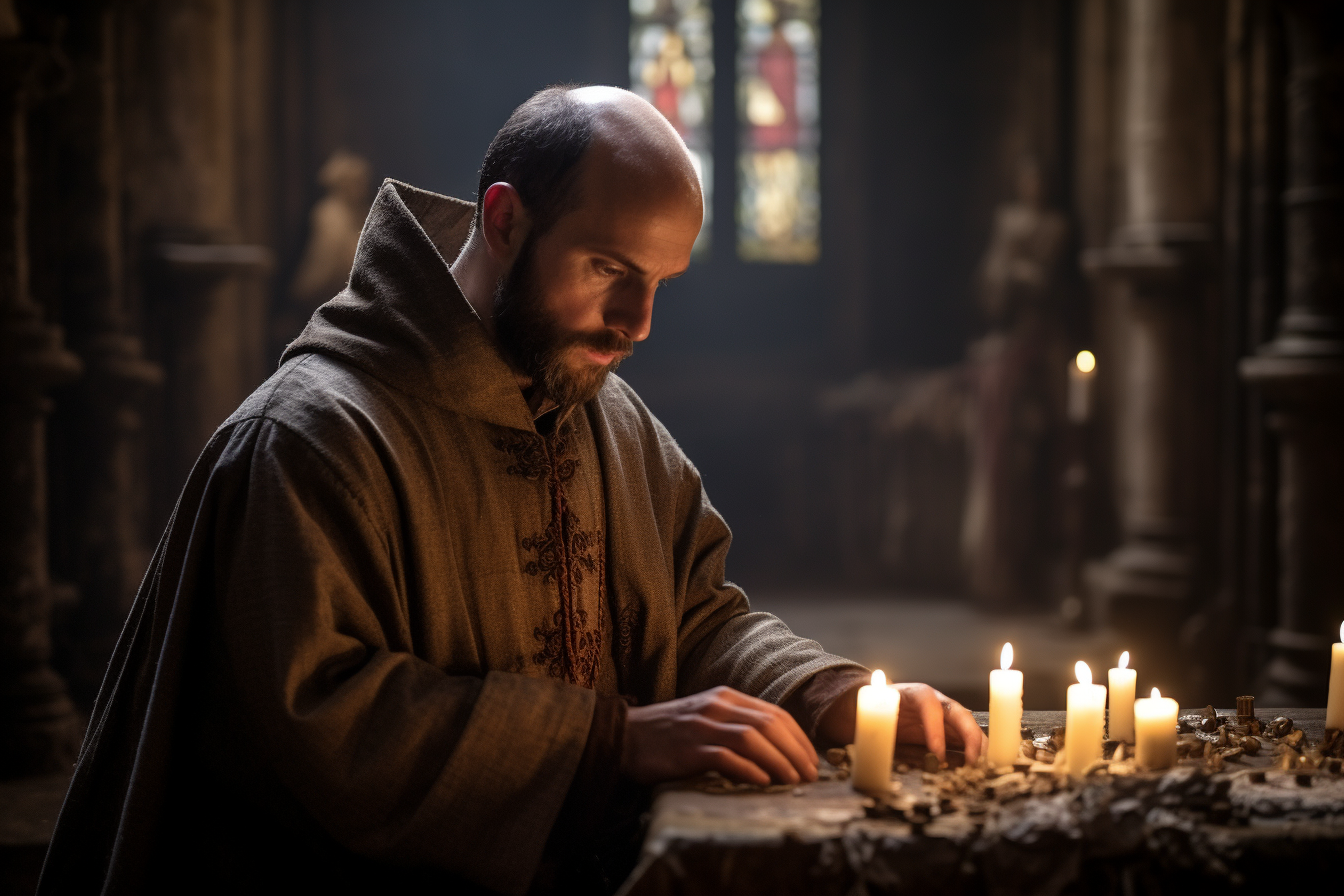
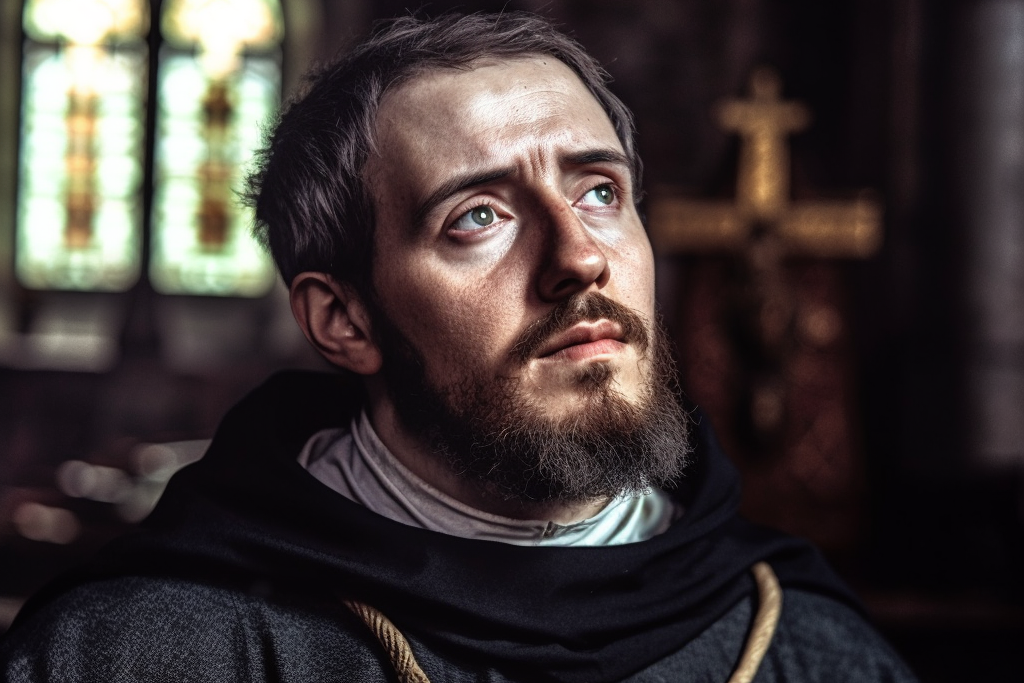
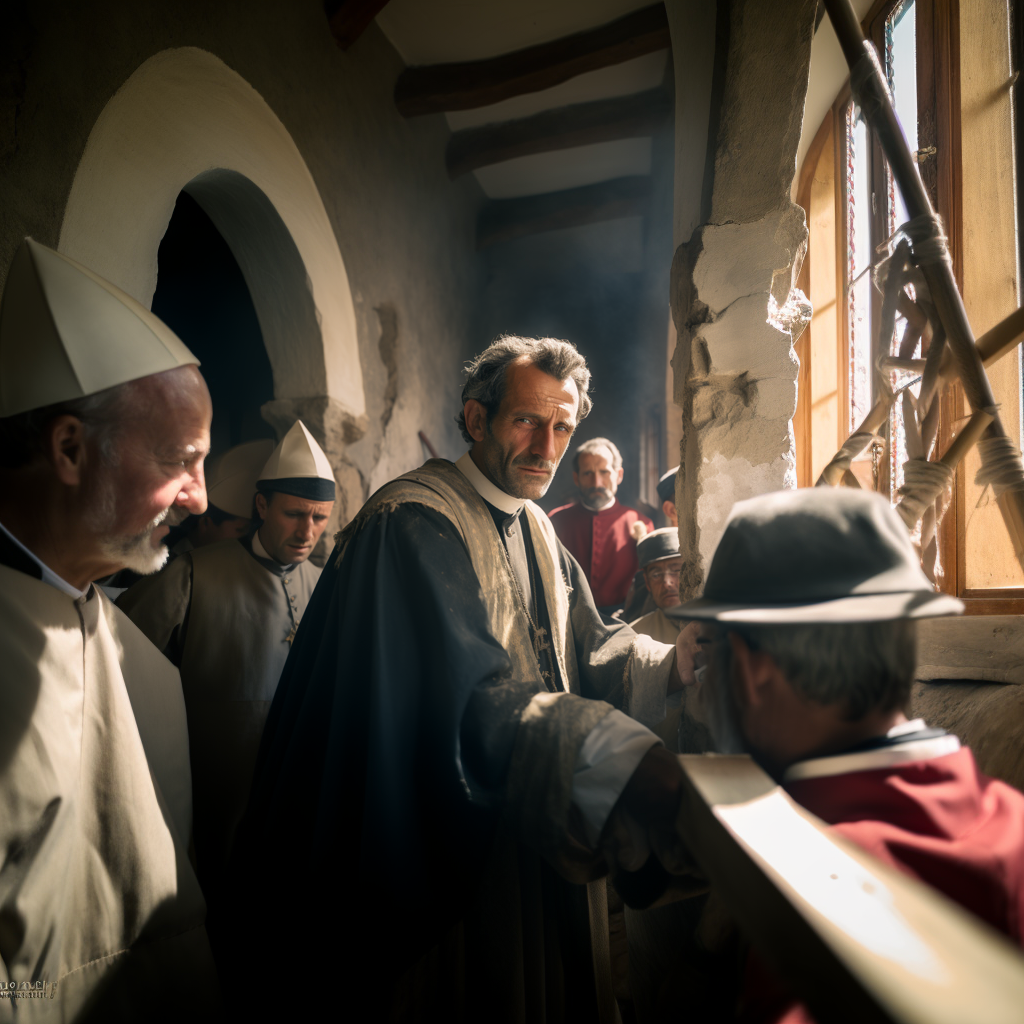
St. William of Bourges kneeling before the alter in the monastery praying

Call to Dedication and Devotion

In 1200, William was appointed Archbishop of Bourges. He was reluctant to accept this new appointment because it meant abandoning his solitary life of meditation and prayer. Pope Innocent III, as well as other religious superiors, encouraged him to take the position. William agreed but continued his asceticism practices throughout the rest of his life. He always wore a shirt made from hair beneath his bishop’s habit and completely gave up meat.

Legacy

Bishop William oversaw the ongoing building of the Gothic Cathedral of Saint Stephen that had been started by his predecessor in 1195. He paid visits to the poor and sick regularly. He did not forget the imprisoned as well. He also stood up for the rights of the clerics against government intrusion.

Death and Canonization

Saint William of Bourges died in 1209 at midnight while meditating at the foot of the altar. He died at the age of 59.

Before his death, he had been making plans to visit the Albigensians as part of his missionary work. In his will, he asked that his body be buried in ashes while wearing his hair shirt. His remains are currently interred in the Basilica reliquary chapel.

Pope Honorius III declared the canonization of Saint William on May 17, 1218.

The feast of Saint William is celebrated on the 10th of January.

Saint William is the patron saint of Gunsmiths.

Miracles

Some people claim that Saint William carried out eighteen miracles while he was alive and another eighteen after he died.

5 Interesting Facts About St. William of Bourges

  • Did you know Saint William is the patron saint of the University of Paris?
  • Saint William once issued an interdict against Innocent III for divorcing his wife. This action made King Philip II very angry at him.
  • Did you know Saint William was born into an old family of illustrious counts? This makes his devotion to Piety all the more remarkable.
  • Saint William was one of the most sought-after confessors in France.
  • Did you know Saint William never wore any extra clothes during the winter or lesser clothes during the summer? His dedication to a life of austerity was truly absolute.

Prayer to St. William of Bourges

St. William, we ask that you watch over us and pray that we may combat pride and remain aware that all we have and all we are are from God. Pray for us, dear St. William, that we serve Him in love and humility, praising Him always for His mercy and kindness. Amen.

Source: [https://catholicexchange.com/st-william-of-bourges] {.ul}

St. Thorfinn

When they lived: St. Thorfinn of Norway lived during the 11th century, specifically from 1070 to 1115 AD.

Where they lived: St. Thorfinn lived in Norway, primarily in the northern regions of the country, during a time when Norway was still a collection of small kingdoms and chiefdoms.

Notable world events during the time of their life:

  • The Norman Conquest of England (1066): St. Thorfinn’s lifetime saw one of the most significant events in medieval European history. William the Conqueror, Duke of Normandy, invaded England and established Norman rule, forever altering the course of English history.
  • The Investiture Controversy (1075-1122): In the midst of Thorfinn’s life, the Investiture Controversy raged in Europe. This conflict between the papacy and secular rulers, particularly the Holy Roman Emperor, revolved around the appointment of bishops and church officials. It had profound implications for the relationship between church and state.
  • The First Crusade (1096-1099): During St. Thorfinn’s lifetime, the First Crusade took place. Christian armies from Western Europe embarked on a holy mission to recapture Jerusalem from Muslim control. This marked the beginning of a series of Crusades that would shape European history and interactions with the Middle East.
  • The Domesday Book (1086): In 1086, just a few years before Thorfinn’s birth, the Domesday Book was completed in England. This detailed survey of landholdings and resources provided invaluable insights into the socioeconomic conditions of medieval England.

Their Patronage: St. Thorfinn is the patron saint of Arctic Norway, particularly the regions of Tromsø and Finnmark. His life and sanctity are associated with the enduring Christian faith in the face of challenging northern climates and the spread of Christianity in the remote parts of Norway.

St. Thorfinn’s story is a remarkable blend of faith, resilience, and the historical context of his time. His dedication to Christianity in the harsh northern landscapes of Norway, set against the backdrop of significant world events, makes for a compelling narrative of a lesser-known medieval saint.

Early Life

Thorfinn was born in the city of Trondelag around the 1200s. It is suspected that he may have been a Cistercian monk before he was made Bishop of the Ancient Diocese of Hamar in medieval Norway. Only a few details can be gathered about Thorfinn, even if he’d been a popular saint to a reasonable extent. He lived a really low-profile life. St.Thorfinn is known to have lived a just life and to have stood up for only what was right. He is remembered as a good man whose goodness was joined with strength. A poem was written about him by Father Walter and left at his gravestone. He was named as a witness to the agreement of Tonsborg in the year 1277, which led to his being sent one hundred miles by King Eric.

Call to Dedication and Devotion

Because he was identified as a witness to the agreement of Tonsborg, he was exiled by King Eric (who was referred to at the time as Priesthater”), with claims that Thorfinn had supported the Archbishop of Nidaros by being a witness to the agreement. This support was in the case of the dispute that had occurred as a result of the state’s interference with the matters of the Church. On exile, Thorfinn found home in Flanders, in a Cistercian abbey. This act of injustice vested in him did not prevent him from continually doing good and standing for what was right.

St. Thorfinn leaving his hometown in exile

It is believed that in his earlier years, St. Thorfinn had been a Cistercian monk before becoming the Bishop of Hamar. He had carried out both duties in service to humanity and God, most importantly. He was driven by love and passion for God to do good works.

Legacy

Knowing that his death was drawing near, the saint drafted a will in which he distributed his properties between his family and the church.

The Saint wasn’t intrigued by the pursuit of fame and recognition for his acts of goodness, generosity, patience, and aversion to evil; he was more focused on pleasing the Lord.

Death

Upon his return from exile, St. Thorfinn fell deeply ill and passed away as a result in the year 1285. His grave, discovered fifty years later, smelt pleasantly, and Father Walter’s poem to him, which hung on the gravestone, still felt very fresh. This miraculous display proclaimed Thorfinn’s holiness, and devotions to him soon spread around the Cistercian Church and Norway.

Feast Day

The feast day of St. Thorfinn is usually celebrated on the 8th day of January.

3 Interesting Facts About St. Thorfinn

  • St. Thorfinn was exiled by King Eric for deciding to stand with the
    Archbishop of Nidaros over an argument with the king.
  • On exile, St. Thorfinn took shelter in the abbey of Cistercia, and
    did not stop doing good.
  • Did you know that fifty years after his death, St. Thorfinn’s grave,
    which had been long forgotten still smelled pleasantly, and the
    sheet on which Father Walter had written his poem to the saint
    still appear fresh?

Prayer to St. Thorfinn

All-powerful and ever-living God, you called Saint Thorfinn to guide your people by his word and example. With him, we pray to you: watch over the pastors of your Church and the people entrusted to their care, and lead them to salvation. We ask this through our Lord Jesus Christ, your Son, who lives and reigns with you and the Holy Spirit, one God, forever and ever. Amen.

Source:[https://www.vitaesanctorum.wordpress.com/2014/01/08/st-thorfinn-bishop/amp/]{.ul}

St. Raymond of Pennafort

When they lived:

St. Raymond of Penafort, also known as Sant Ramon de Penyafort in Catalan, lived during the late 12th and early 13th centuries. He was born in 1175 and passed away in 1275.

Where they lived:

St. Raymond of Penafort lived primarily in Spain, with much of his life spent in Catalonia. He was closely associated with the city of Barcelona.

Notable world events during the time of their life:

  • Third Crusade (1189-1192): This major event in Christian history took place during Raymond’s early years. European monarchs like Richard the Lionheart and Philip II of France led their armies to the Holy Land, aiming to retake Jerusalem from Saladin.
  • Albigensian Crusade (1209-1229): Raymond witnessed the beginning of this brutal crusade against the Cathars in southern France. It was a significant religious and political conflict during his lifetime.
  • University of Paris Founded (1150): Although predating his birth, the University of Paris became a renowned center for education and intellectual development during Raymond’s lifetime. It played a pivotal role in the development of medieval scholasticism.
  • Fourth Lateran Council (1215): This important ecumenical council convened by Pope Innocent III addressed various aspects of church doctrine and organization. It had a profound influence on the Catholic Church’s structure and teachings.
  • Magna Carta (1215): While not directly related to Raymond’s work, the sealing of the Magna Carta in England marked a significant step towards the limitation of royal power and the establishment of legal rights, influencing the development of constitutional governance.
  • Invention of the Magnetic Compass (c. 1180s): The magnetic compass, which revolutionized navigation, was developed during Raymond’s lifetime. This innovation had far-reaching consequences for exploration and trade.

Their patronage:

  • Canon Lawyers: Raymond himself was a prominent canon lawyer, and his expertise in this field led to his canonization. He is often invoked by those studying or practicing canon law.
  • Mariners: This patronage relates to his association with the magnetic compass and its impact on navigation. Sailors and those involved in maritime activities seek his protection.
  • Confessors: St. Raymond of Penafort is celebrated for his work as a confessor, guiding individuals in the sacrament of confession. He is seen as a model of pastoral care and reconciliation.
  • Spanish Lawyers and Catalonia: Given his Spanish heritage and his time in Catalonia, he is revered as a patron of Spanish lawyers and the Catalan people.
  • Conversion of Jews and Muslims: St. Raymond is sometimes invoked for the conversion of non-Christians due to his historical efforts to engage in theological dialogues and missionary work.

St. Raymond of Penafort’s life spanned a time of great historical significance, marked by religious crusades, intellectual developments, and advancements that would shape the world for centuries to come. His multifaceted patronage continues to resonate with various aspects of modern life, making his legacy enduring and multifaceted.

Early Life

Raymond of Pennafort was born around the mid-1170s in a small town called Vilafranca del Penedes to a noble bloodline of the Aragon royalties. He trained in Canon and Civil Law at the University of Bologna. He went on to become a teacher of canon law at age twenty in 1195 up until 1210, when he moved to Bologna, staying there for twelve years.

In Bologna, he was made head of the department of law at the university, serving the duty for three years. Coming to the knowledge of the Dominican Order here in the later years, Raymond developed so much interest in the course. His interest in the Dominican Order was spurred by listening to the Blessed Reginald’s preaching.

Upon reaching the age of sixty, he was retired and was reassigned the post of Archbishop of Tarragona, which he turned down, preferring to pursue other courses such as ensuring the wellbeing of the poor and needy.

Dedication and Devotion

Saint Raymond of Pennafort, from a very tender age, was in love with and showed great devotion to the Blessed Mother. He was dedicated, among several other things, to helping Christian captives in the Crusade era. He was also instrumental in the organization of the Church’s legal code, and as such, he was frequently met by people to explain some canonical concepts.

At the age of twenty, Raymond was made a teacher of Philosophy in Barcelona, given that he appeared to exercise great intelligence in the gift of philosophy. He showed great compassion to those who were suffering from one problem or another and to the poor, too.

In the year 1222, Raymond became a member of the Dominican Order, spending almost his entire life there. In Barcelona, Raymond had helped form the Order of Our Lady of Mercy with the vision of ransoming people who had been held in Muslim territory.

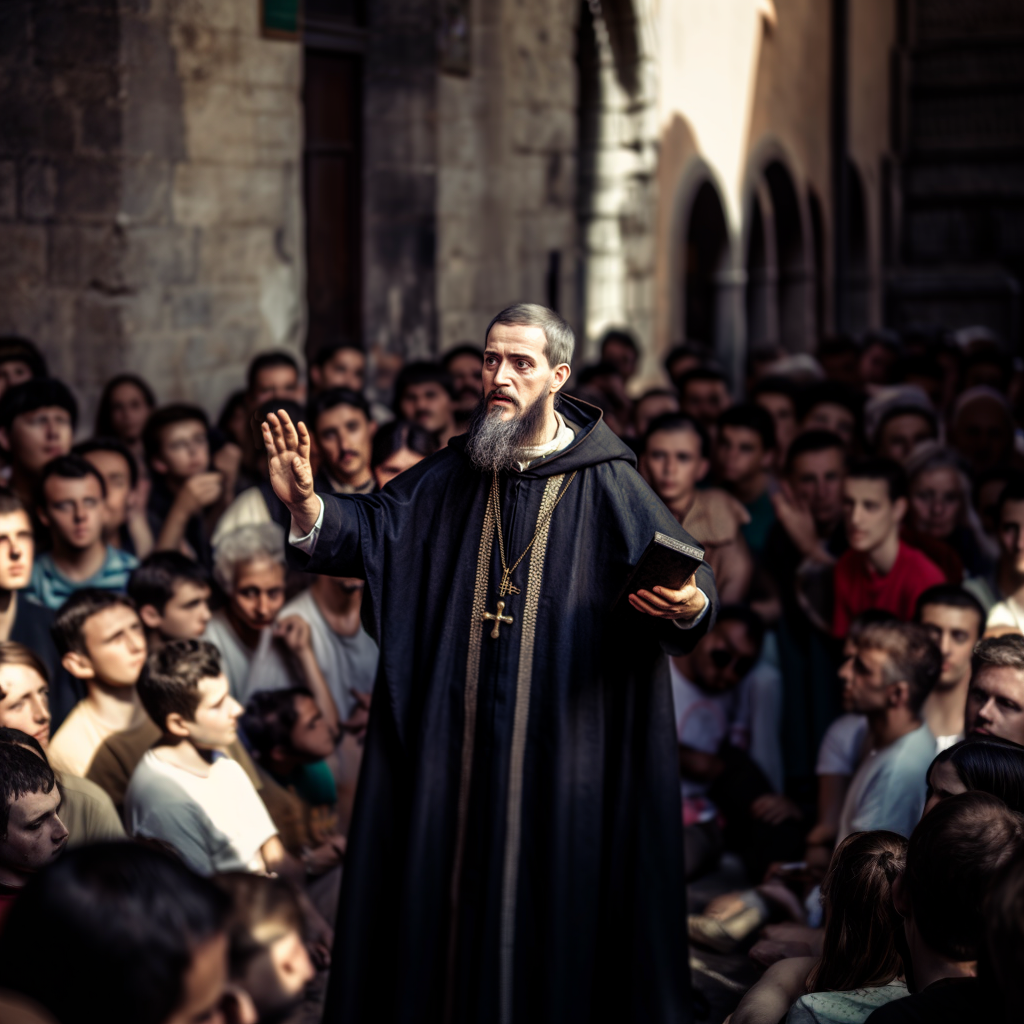
St. Raymond preaching to raise funds in support of the people kept captive by the Muslims

Legacy

Saint Raymond wrote the Summa de casibus poenitentiae, a book of cases for confessors, and also established the Order of Our Lady of Mercy.

The saint performed really great work in the conversion of some Jews and Muslims to Christianity.

At the University of Santo Tomas, there is a building named in his honor, The St. Raymond Pennafort Building.

Death and Canonization

Saint Raymond died on the 6th day of January 1275 and was canonized in 1601.

Feast Day

January 7th is marked as the feast day of St. Raymond, which took hold in the year 1968. Before now, the date was the 23rd of January, as it was inserted in the General Roman Calendar in the year 1671.

4 Interesting Facts About St. Raymond of Pennafort

  1. Did you know that St. Raymond was called by Pope Gregory IX in the year 1230 to examine conscience cases?
  2. St. Raymond was assigned to be the master general of the Dominican Order in 1238.
  3. Did you know that St. Thomas Aquinas was able to write his Summa contra gentiles because St. Raymond urged him to?
  4. Did you know that St. Raymond is the patron saint of canon lawyers?

The Litany of St. Raymond of Pennafort

Lord, have mercy. Lord, have mercy. Christ, have mercy. Christ, have mercy. Lord, have mercy. Lord, have mercy. Christ, hear us. Christ, graciously hear us. St. Raymond of Penafort, pray for us. Master of Preachers, Patron of Lawyers, Father of Confessors, Counselor of Penitents, Apostle of Gentiles, Evangelist to Israelites, Ransomer of Captives, Teacher of the Learned and the Ignorant, Friend of Princes and Paupers, Protector of Sailors, Comforter of the Aged, Defender of Marriage, Champion of Religious Rights, Advocate of Reason, Guardian of Justice, Promoter of Freedom, Worker of Miracles,… Son of the Blessed Virgin Mary, Son of St. Dominic, Son of the Church, Holy Priest of Jesus Christ, Lamb of God, Who takes away the sins of the world, Spare us, O Lord. Lamb of God, Who takes away the sins of the world, Graciously hear us, O Lord. Lamb of God, Who takes away the sins of the world, Have mercy on us. Let us pray. Glorious Saint Raymond of Penafort, wise and holy patron, come to the aid of those entrusted to your care and all who flee to your protection. Intercede for us in our need and help us, through your prayers, example, and teaching, to proclaim the truth of the Gospel to all we meet. And when we have reached the fullness of our years, we beseech you to guide us home to heaven, to live in peace with you, Our Mother Mary, and Our Lord Jesus Christ. Amen.

Source: [https://www.straymonds.org/litany-and-prayer-to-st.-raymond-of-penafort-2/] {.ul}

St. Andre Bessette

The Miraculous Journey of St. André Bessette: A Life Defined by Faith and Resilience

When They Lived:

St. André Bessette, born Alfred Bessette, lived from August 9, 1845, to January 6, 1937. His remarkable life spanned a period of profound societal changes and transformative events.

Where They Lived:

St. André Bessette spent the majority of his life in Montreal, Quebec, Canada. He is closely associated with the Congregation of Holy Cross, specifically the College of Notre Dame in Montreal and the Oratory of St. Joseph, a monumental basilica that became his spiritual legacy.

Notable World Events During Their Life:

  • American Civil War (1861-1865): St. André’s early years coincided with the turmoil of the American Civil War. The conflict over slavery and states’ rights had far-reaching implications for the entire North American continent.
  • Completion of the Suez Canal (1869): The opening of the Suez Canal connected the Mediterranean Sea to the Red Sea, revolutionizing global trade and travel by providing a shortcut between Europe and Asia.
  • Invention of the Telephone (1876): Alexander Graham Bell’s invention of the telephone radically transformed communication, bringing distant voices closer and paving the way for rapid technological advancements.
  • First Electric Light Bulb (1879): Thomas Edison’s development of the practical incandescent light bulb illuminated the world in a new way, sparking a revolution in indoor lighting and power distribution.
  • World War I (1914-1918): St. André lived through the tumultuous years of World War I, witnessing the devastating impact of a global conflict on societies and individuals.
  • Russian Revolution (1917): The fall of the Russian monarchy and the rise of communism in Russia had profound ideological and geopolitical consequences that reverberated around the world.
  • Women’s Suffrage Movement: St. André’s life coincided with the rising wave of the women’s suffrage movement, which fought for women’s right to vote and paved the way for greater gender equality.

Their Patronage:

St. André Bessette is widely recognized as the patron saint of those who are sick, marginalized, and in need of healing. His deep compassion for the suffering and his dedication to serving others, especially through his work as a porter at the College of Notre Dame and later at the Oratory of St. Joseph, earned him this role. Despite facing personal health challenges and living during a time of great social change, St. André’s unshakable faith and unwavering commitment to helping others make his life story an inspiration for people of all walks of life.

St. André Bessette’s life embodies the power of faith, resilience, and compassion. His story is a testament to how an individual can make a significant impact on the world, not only through grand achievements but also through simple acts of kindness and empathy. Whether it was offering comfort to the sick, praying for the afflicted, or embracing those on the fringes of society, St. André’s legacy continues to shine as a beacon of hope and a reminder of the transformative power of unwavering dedication to others.

Early Life

Andre Bessette was born on the 9th of August, 1845, near Montreal to a French-Canadian couple. His parents sadly passed away when he was 12 years old. He was adopted, and as he grew, he tried his hands at several professions. First, he worked as a farmhand, then as a shoemaker, baker, blacksmith, and factory worker in the civil war, all of which he could barely sustain due to his health challenges.

When Bessette turned 25, he applied to join the Congregation of Holy Cross. He was refused admission after a year’s novitiate because of his poor health. Eventually, after an extension and with a recommendation from Bishop Bourget, he was finally admitted into the Congregation.

Dedication and Devotion

At Notre Dame College in Montreal, he worked as a doorkeeper, messenger, barber, gardener, laundry worker, and sacristan. In his small room, he prayed on his knees most nights, next to the statue of Saint Joseph on his windowsill. He firmly believed that one day Saint Joseph would be specially honored on Mount Royal.

Whenever Brother Andre heard someone was sick, he would visit the person to pray for them and offer good cheer. He would take some oil from a lamp burning within the college chapel and rub it gently on their bodies while he prayed to St. Joseph for their healing.

When an epidemic broke out at a college nearby, Brother Bessette volunteered to help nurse the ill, and not a single person died. From then on, the sick began to crowd at his doorstep, asking to be healed. This made the diocesan authorities and his superiors uneasy, while doctors labeled him a quack. Through all this, Bessette maintained over and over that he was not the cause of the cure but just a vessel for Saint Joseph.

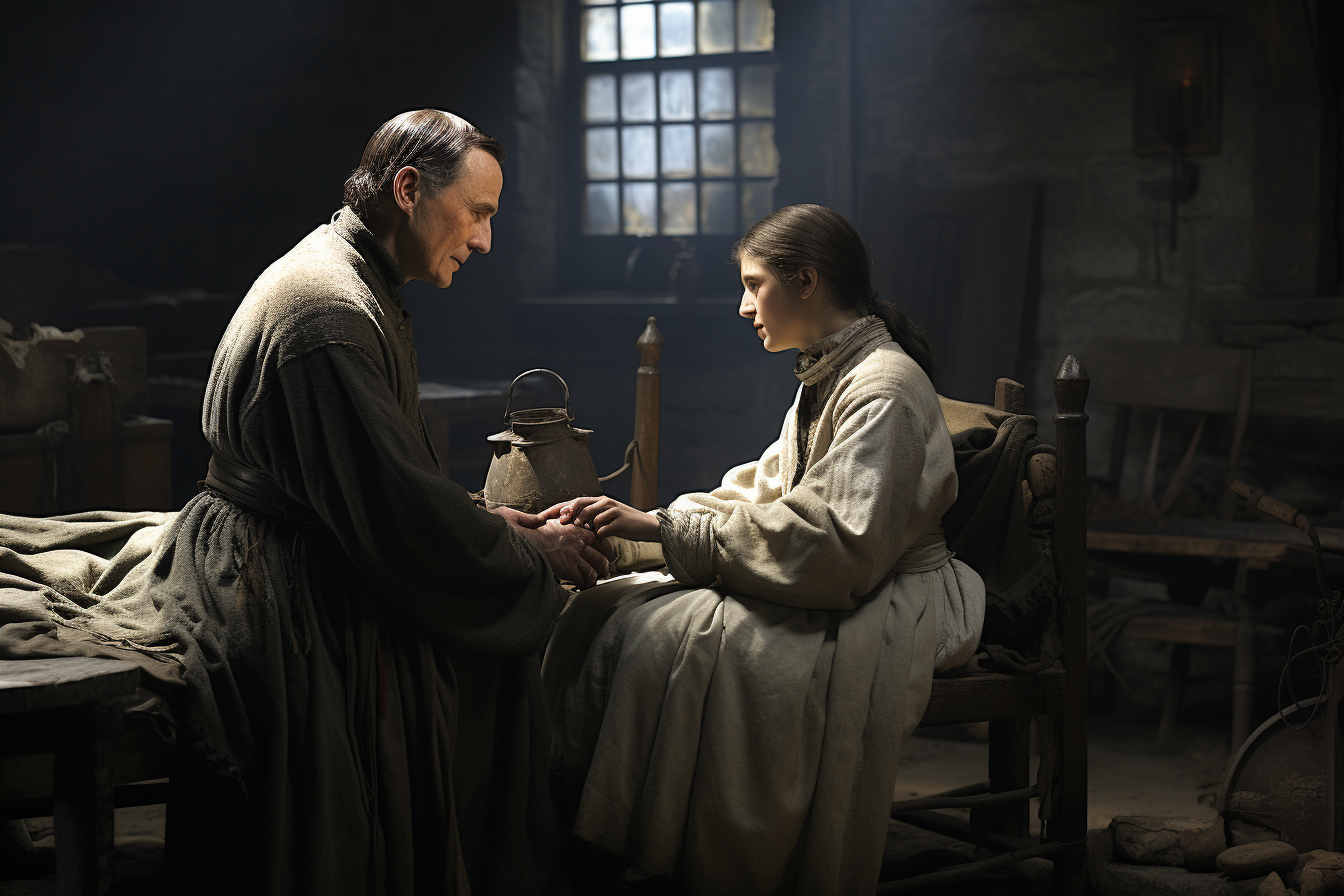
St. Andre Bessette serving a sick woman bed ridden

Legacy

In 1904, he requested permission from the Archbishop of Montreal to build a chapel to Saint Joseph on the mountain close to the college. The Archbishop granted permission on the basis that Brother André would build only what he could afford.

Part of the money Andre had was from the nickels and dimes he had saved from giving haircuts to the college boys over the years. The remainder came from a small donation plate he had placed in a picnic shelter on the mountain top, close to the statue of St. Joseph. Put together, the money amounted to a few hundred dollars. Undeterred by the little funding, he put the money into building a tiny wood shelter.

Three years later, Brother Andre returned to the Archbishop to request more building permission. He had gathered some more money from donations and wanted to expand the shelter. Once permission was given, Brother André added a roof, walls, and a pilgrim shelter and paved the mountain road. He lived there full time, caring for and healing as many people as he could.

Death and Canonization

Brother Andre Bessette died at the age of 91 on January 6th, 1937, in Montreal and was buried in the beautiful Oratory on Mount Royal after a life of service to humanity and devotion to St. Joseph.

He was beatified in 1982 and canonized in 2010. The feast of St. André-Bessette is held on the 6th of January every year.

5 Interesting Facts About St. André Bessette

  1. Did you know that when St. André was alive, he received over 50,000
    letters annually and needed the help of four secretaries to handle
    the outpouring of letters?
  2. Saint Andre Bessette was popularly called the “Miracle Man of
    Montreal”.
  3. Did you know that Saint André is one of the most popular Canadian
    saints?
  4. When Saint Andre passed away, nearly one million people came to the
    oratory to mourn him and pay their last respects.
  5. Did you know there are five different Catholic churches named after
    St. Andre Bessette is located respectively in Pennsylvania and New York.
    Hampshire, Michigan, Ontario, and Oregon?

Prayer to St. André Bessette

Lord, you have chosen Brother André to spread devotion to Saint Joseph and to dedicate himself to all those who are poor and afflicted. Grant through his intercession the favor that we now request… [State your intention(s) here…]Grant us the grace to imitate his piety and charity so that, with him, we may share the reward promised to all who care for their neighbors out of love for you. We make this prayer in the name of Jesus the Lord. Amen.

Source:[https://www.catholicdoors.com/prayers/novenas/p03756.htm]{.ul}

St. Roger

Editors note: There is very little known about St. Roger. Creative license has been taken to fill in some details on his life.

Introduction

In a quiet corner of southern Italy, along the windswept shores of the Adriatic Sea, lies the ancient village of Cannae. Though now but a sleepy hamlet, its storied history reaches back through the mists of time to the days when Hannibal defeated the legions of Rome on the bloody banks of the Aufidus River. And in this unassuming place, over nine centuries past, lived a man whose faith and benevolence would echo through the ages.

Early Life

Roger of Cannae was born in the 11th century, in the year 1060 AD, during a turbulent time when Norman adventurers carved out new kingdoms from the scattered remnants of the old Roman empire. As a boy, Roger would have gazed up at the imposing castle built atop Monte di Spirito Santo, keeping watch over the village below. He would have heard tales of the great battle between Carthage and Rome, of bold warriors clashing shield against shield, tales now faded into legend.

But while most boys his age aspired to be knights and men-at-arms, young Roger felt a different calling. In the quiet solitude of the village chapel, he sought a life of contemplation and service to God. As a young man, he joined the local monastery, finding meaning in study and prayer. Patient and dutiful, Roger distinguished himself with his devotion to the scriptures and his kindness towards all living things. Many were the times his brothers would find him in the vegetable garden, a dove perched gently on his shoulder as he went about his chores.

Rise to Bishop

In time, word of Roger’s patience and wisdom spread beyond the cloistered walls of the monastery. When the bishopric of Cannae fell vacant, the people called for the monk Roger to take up the mantle of leadership. Though hesitant at first, Roger accepted the call, becoming bishop of the small but spiritually vibrant community.

Turmoil and Rebuilding

The 11th century was a time of tumult and change, as Norman and Italian leaders vied for power and influence. In 1083, Cannae itself was attacked and burned during the conquests of Robert Guiscard. Many priceless relics and artifacts were lost in the ensuing chaos. But Roger rallied his flock, providing solace and succor as they rebuilt their homes and chapels.

Where some saw only destruction, Roger saw an opportunity to create an even more welcoming and compassionate community. He opened his home to travelers seeking rest and refreshed the spirits of the downtrodden. The old bishop’s house became a living testament to Christian charity.

St. Roger setting out to rebuild his community as bishop with his fellow priests

A Life of Service

Roger saw that true power lay not in earthly splendor and riches but in service to one’s fellow man. He tended diligently to the needs of his people, securing food for the hungry and shelter for the poor. Yet he himself lived humbly, praying each night on a simple straw mat.

As bishop, Roger was often called upon to help resolve conflicts between warring families or quarreling clergy. With patient wisdom and empathy, he was able to soothe angered hearts and find compromise where none seemed possible.

During morning Mass, when bright sunbeams streamed through the stained glass windows, the sweet choral singing seemed to give voice to the divine presence Roger so humbly embodied. In the dark of night, families huddled safely in their homes would see the lone candle burning in Roger’s spartan quarters as he worked tirelessly to guide his community.

Legacy

Over decades of service, Roger became a venerated figure, known for his charity, wisdom, and devotion. As old age crept in, the former monk continued his work, sustained by an abiding faith. When at last he felt Death’s hand on his shoulder, Roger surrendered himself, like the setting sun slipping below the sea. His earthly labors ended on December 30, 1129.

Though Roger desired no monuments or memorials, the people of Cannae could not let his memory fade. In 1276, his remains were moved to the city of Barletta, where a great shrine was erected so that future generations might draw inspiration from his life.

In Cannae today, though centuries have swept past, something of Roger’s spirit endures. A quiet strength seems to emanate from the weathered stones of the village chapel. The candlelight glow of the stained glass fills the air with unspoken mysteries. And if you listen closely on still nights, you can almost hear whispered voices through the olive groves, as if carried on the winds of time.

The Eagle of Cannae, as he came to be known, has flown back to the heavens. But his earthly example, encapsulated in small acts of kindness, remains an eternal testament to the power of faith and compassion. For in Roger’s eyes, all people were equal under the sight of God. By serving the needs of his fellow man, Roger achieved a humble immortality – his legacy woven into the very fabric of humanity.

St. Elizabeth Ann Seton

When She Lived:

Saint Elizabeth Ann Seton was born on August 28, 1774, and she passed away on January 4, 1821.

Where She Lived:

Elizabeth Ann Seton lived primarily in the United States, with significant periods in New York and Maryland. She was born in New York City and later lived in Emmitsburg, Maryland, where she founded the first American congregation of religious sisters, the Sisters of Charity.

Notable World Events During Her Life:

  • American Revolution (1775-1783): Elizabeth Ann Seton was a young child during the American Revolution, a period marked by the Thirteen Colonies’ struggle for independence from British rule. The war had significant impacts on the social and political landscape of the United States.
  • Napoleonic Wars (1803-1815): Seton lived during the tumultuous Napoleonic Wars, which had far-reaching consequences across Europe and beyond. These conflicts reshaped the geopolitical landscape and had economic and social ramifications worldwide.
  • Lewis and Clark Expedition (1804-1806): While Elizabeth Ann Seton didn’t directly participate in this historic expedition, it’s worth noting that it occurred during her lifetime. Meriwether Lewis and William Clark’s exploration of the American West opened up new frontiers and expanded knowledge of the continent.
  • Industrial Revolution: Seton witnessed the early stages of the Industrial Revolution, a period of rapid industrialization, technological advancement, and urbanization. These changes brought both opportunities and challenges to society, transforming the way people lived and worked.

Her Patronage:

St. Elizabeth Ann Seton is the patron saint of several important causes:

  • Catholic Schools: She established the first Catholic parochial school in the United States, laying the foundation for Catholic education in the country.
  • Widows: Seton herself was a widow with five children when she converted to Catholicism and became a nun. Her life serves as an inspiration to widows and single parents.
  • Homeless People: She showed great compassion for the less fortunate, particularly the poor and the homeless. Her charitable work continues to inspire efforts to help those in need.
  • Loss of Parents: As someone who lost her mother at a young age, she is also considered a patron for those who have lost their parents.


Early Life

Elizabeth Ann Bayley Seton was born in New York on August 28th, 1774. She was the second child born to her parents. When Elizabeth’s mother died after giving birth to her third child, her stepmother often took Elizabeth along with her for charitable rounds. They visited the poor frequently and offered them food and other necessities.

Despite having a high social background, Elizabeth led a simple, quiet life. As she got a bit older, the Bible became her regular source of comfort, instruction, and guidance.

Marriage and Loss

In 1794, Elizabeth married William Seton. The first years of their marriage were blissful and full of good fortune. However, the bliss was abruptly cut short by a string of deaths and partings with loved ones.

Her father was the first to go, leaving the young couple alone to care for the family and its business. Then her husband fell ill, and his business failed. He had to file a bankruptcy petition, and as a final move to save William’s health, the couple left for Italy, where they had friends.

Sadly, William passed away in Italy from tuberculosis. The sole consolation Elizabeth held on to was that her beloved had found God just before his death.

Call to Dedication and Devotion

These numerous losses due to death and distance drew Elizabeth closer to God. The acquiescence and acceptance of God’s Will would become an essential and defining theme in her spiritual life. In due course, her profound concern for the spiritual wellbeing of her friends and family led her to the Catholic Church in Italy. Over a period of months, she was guided in the Catholic way by her Italian friends. Her courtesy, patience, and kindness endeared her to all.

Legacy

In 1805, Elizabeth became an official member of the Catholic Church. She founded the first free Catholic school in America with help from two women in her sisterhood, the Sisters of Charity. Then On March 25, 1809, Elizabeth Seton took her vows of chastity, obedience, and poverty. From then on, she was known as Mother Seton.

Even when she was stricken with tuberculosis, she kept on offering guidance to her children. In 1812, ‘The Rule of the Sisterhood’ was officially ratified. It followed the same rule St. Vincent de Paul had composed for his ‘Daughters of Charity’ in France.

By 1818, the sisters had established two orphanages and another school in addition to their first school. Today, there are six groups of sisters that can trace their origins to the first sisterhood formed by Mother Seton.

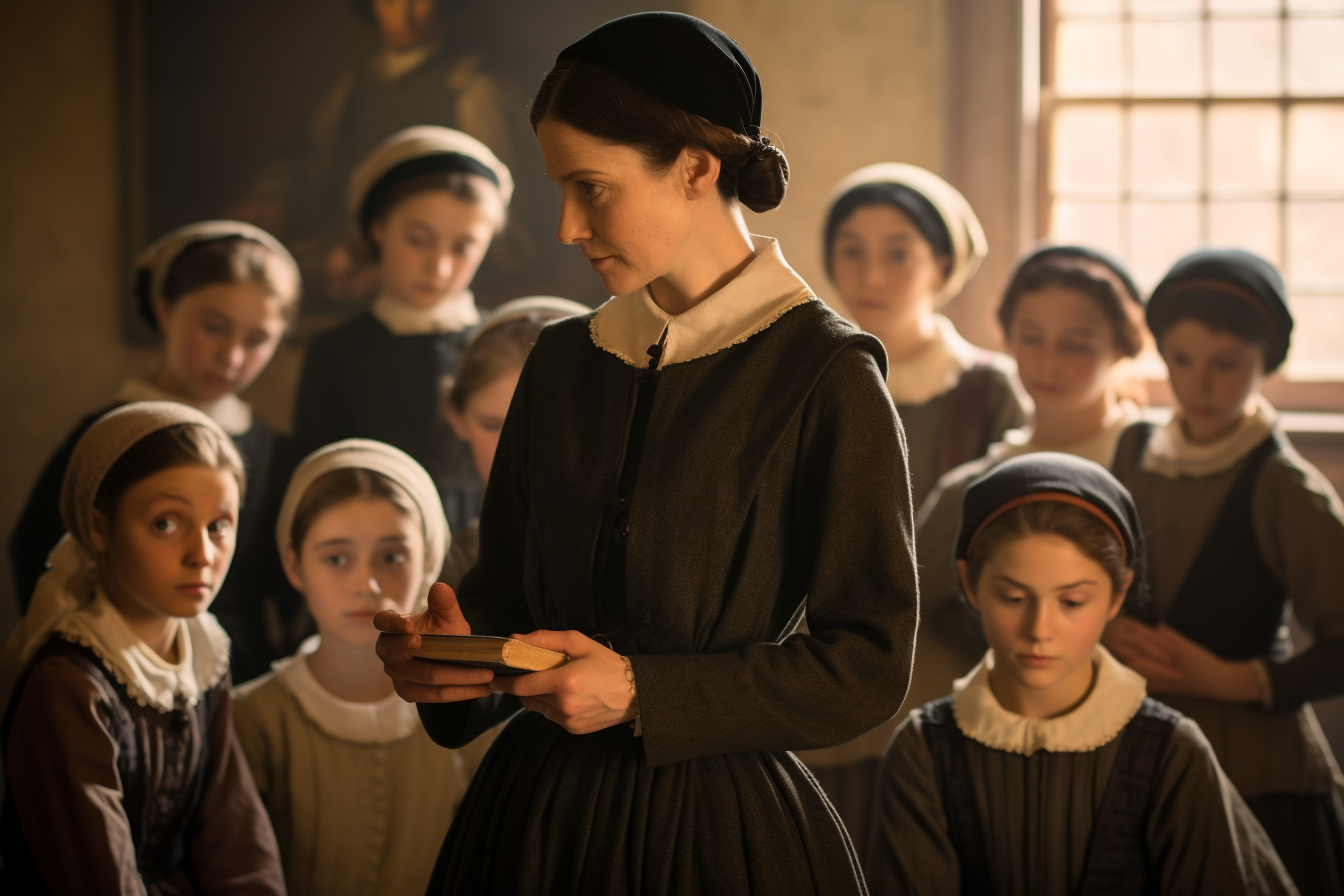
St. Elizabeth Ann Seton teaching to a group of Children

Death and Canonization

During the last three years of her life, Elizabeth was certain God was going to call her home, and this filled her with immense joy. Mother Seton passed away at the age of 46 on the 4th of January, 1821, in Emmitsburg, Maryland, United States. She is buried in the National Shrine of Saint Elizabeth Ann Seton in Emmitsburg, Maryland.

She was beatified by Pope John XXIII on March 17, 1963, and canonized on September 14, 1975, by Pope Paul VI.

5 Interesting Facts About St. Elizabeth Ann Seton

  1. Did you know the feast day of Mother Seton is January 4th?
    also coincides with the eleventh day of Christmastide as well as
    the anniversary of her death?
  2. While alive, Mother Seton’s favorite prayer was the 23rd Psalm.
  3. Did you know Saint Seton was inducted into the National Women’s
    Hall of Fame in 1979?
  4. Did you know there are over 40 churches named after St. Seton?
    states of the United States, as well as in Canada and Italy?
  5. Mother Seton is known as the patron saint of widows and seafarers.

A Prayer for St. Elizabeth Ann Seton

Lord God, thank you for blessing Saint Elizabeth Ann Seton with great faith, hope, joy, and charity. I pray that her timeless example will guide me. I look at her humility to help me accept your will for my life. Let her grateful heart remind me to thank you for the joys and challenges of life. May her courage and perseverance inspire me to serve others, our church, and our country. Thank you, God, for Elizabeth Bayley Seton ,a loving and glorious saint who is always by our side. Elizabeth Ann Seton, pray for us. Amen.

source:[http://www.srcharitycinti.org/news_events/EASprayer.htm]{.ul}

St. Argeus

St. Argeus – Patron Saint of Scholars and Seekers of Knowledge

When he lived:

St. Argeus, the enigmatic figure of history, lived during the fascinating period of the 5th century AD.

Where he lived:

St. Argeus hailed from the captivating ancient city of Alexandria, Egypt. The city, known for its rich history, diverse culture, and renowned scholars, provided a vibrant backdrop for the life of this mysterious saint.

Notable world events during the time of his life:

  1. The Fall of the Roman Empire (476 AD): The 5th century witnessed the final collapse of the Western Roman Empire, an event that reshaped the course of history. Barbarian invasions, political unrest, and internal conflicts culminated in the deposition of the last Roman emperor, Romulus Augustulus, marking the end of an era.
  2. The Great Fire of Constantinople (532 AD): The splendid and mighty city of Constantinople, the capital of the Eastern Roman (Byzantine) Empire, faced a catastrophic disaster when a massive fire engulfed the city. This event was a turning point in the reign of Emperor Justinian I and led to the reconstruction of the city, giving rise to new architectural wonders like the Hagia Sophia.
  3. The Council of Ephesus (431 AD): A significant event in the early Christian Church, the Council of Ephesus, convened in 431 AD, addressed theological controversies, including the Nestorian heresy. This council affirmed the Virgin Mary’s title as the “Theotokos” (God-bearer) and solidified the importance of her role in Christian theology.
  4. The Huns and the Fall of Attila (453 AD): The formidable Hunnic Empire, led by the infamous Attila the Hun, posed a constant threat to the Roman and Byzantine Empires. The death of Attila in 453 AD brought an end to the invasions, but the aftermath reshaped the geopolitical landscape of Europe.
  5. The Birth of the Gupta Empire (320-550 AD): In the Indian subcontinent, the Gupta Dynasty rose to prominence, marking a “Golden Age” of cultural, scientific, and economic achievements. During this time, advancements in mathematics, astronomy, and art flourished, making the Gupta period a significant chapter in human history.

His patronage:

St. Argeus, the patron saint of scholars and seekers of knowledge, is believed to offer guidance and inspiration to those who pursue wisdom and understanding. Whether it be scholars seeking insights in the ancient city of Alexandria or curious minds exploring the world during the dynamic 5th century, St. Argeus’ patronage remains a beacon of hope for those on a quest for enlightenment. Students, academics, and anyone thirsting for knowledge can find solace and support in this enigmatic figure from the past. Embracing the spirit of St. Argeus, we are reminded to be curious, to explore, and to seek answers to the mysteries that surround us. As history continues to unfold, the legacy of St. Argeus lives on, inspiring generations to unlock the secrets of the world and to unravel the complexities of existence.

St. Argeus reading and writing at a table in his study

Detailed information about Saint Argeus is unavailable. Saint Argeus is defined by church traditions with little or no proof of originality.

Saint Argeus was said to have been a Christian martyr. Tradition never tells his story alone. It always chooses to involve his brothers, Narcissus and Marcellinus.

There are no records of what Argeus did in his early life. There is also no record of when he was born or who his parents were.

Traditions allow us to easily tell stories about who this man is. Most times, these traditions vary so entirely that it is impossible to tell which story is real.

One tradition states that Saint Argeus didn’t choose to join the army. He and his brothers Narcissus and Marcellinus were enlisted in the army during the time of Licinius.

Refusing to serve Licinius in the army due to their faith, they were arrested and taken to a hearing. Found guilty, they were then subjected to death.

A different tradition claims that Saint Argeus and his brothers were soldiers under Emperor Licinius. Licinius had made it a rule for all his men to carry sacrifices to the pagan gods he served.

Being devout Christians, Saint Argeus and his brothers refused. This annoyed Emperor Licinius so much that he commanded that all three men be put to death.

Saint Argeus was beheaded in 320 A.D. He was killed at Tomi, Exinius Pontus, and Moesia.

He is said to be commemorated by the Catholic Church on January 2.

St. Clarus

When they lived:

Saint Clarus the Hermit is believed to have lived during the 5th century.

Where they lived:

Saint Clarus is associated with various locations in Europe, including France and Switzerland. He is particularly venerated in the Swiss Alps region.

Notable world events during the time of their life:

  • Fall of the Western Roman Empire (476 CE): The Western Roman Empire fell in 476 CE, marking a significant event in the transition from ancient to medieval times.
  • Invasion of the Huns and Barbarian Migrations: During this period, various barbarian groups, including the Huns, invaded different parts of Europe, leading to significant political and cultural changes.
  • Council of Ephesus (431 CE): This early Christian council affirmed the beliefs about the nature of Christ and played a crucial role in shaping Christian doctrine.
  • Life of Saint Patrick (c. 385–461 CE): Saint Patrick, the patron saint of Ireland, lived during a similar timeframe and is known for his missionary work and contributions to Christianity in Ireland.

Patronage:

Saint Clarus is often invoked as the patron saint against eye diseases and for good weather, particularly by those involved in farming and agriculture. His connection to the Swiss Alps also makes him a patron of mountain regions and those who live in isolated environments.


Early Life

More popularly known as St. Clarus, the hermit. Also called St. Clair. St. Clarus was born into an English noble house in Rochester, England, the United Kingdom, and was a saint of the seventh century. Unfortunately, not much information about St. Clarus’s birth, family, and upbringing was stated.

But one thing that stands out is that he left his rich, noble pedigree to pursue a life of solitude, prayer, and devotion.

Life of Devotion

St. Clarus went on to become a priest and joined the Benedictine monks. He traveled to France and settled in Vexin, near Naqueville, near Rouen, where he lived as a hermit (someone living in solitude away from society as a religious discipline).

He devoted his life to teaching and preaching the truths of salvation to people. St. Clarus preached Christianity by word and example.

He was never afraid of standing for the gospel and was consumed by his passion for God.

St. Clarus living as a hermit. He has a candle lit by his side as he prepares to say his evening devotions

Death

Like many other saints, St. Clarus paid the ultimate price for his faith and belief in God. St. Clarus’s death came at the hands of an unnamed wealthy noblewoman.

History has it that this woman, obviously of high standing in society, became obsessed with St. Clarus and made advances on him. To escape her advances, he fled into a nearby forest.

Spurned by his rejection of her, she went seeking revenge. This unnamed noblewoman sent two ruffians after him into the forest. When the ruffians found him, they beheaded him.

St. Clarus died a Martyr of Chastity, courage, and discipline for his faith. His date of death was said to be around 875 AD.

After St. Clarus’s death, a shrine was erected in his honor on the very spot where his blood was shed. This shrine has become a pilgrimage center for people far and near.

His feast day is on November 4.

References

Father Alban Butler. “Saint Clarus, Martyr.” Lives of the Fathers,Martyrs, and Principal Saints, [1866] {.ul}. CatholicSaints.Info, November 3, 2013. Web. 30 July 2021. [https://catholicsaints.info/butlers-lives-of-the-saints-saint-clarus-martyr] {.ul}

[https://catholicreadings.org/saint-clarus-the-hermit-saint-of-the-day-november-4/]{.ul}

5 Interesting Facts About St. Clarus

  • The French village where his death took place was given his name.
    immortalize him (Saint-Calir-Sur-Eph), and a shrine built on his
    blood to mark what he stood for.
  • Did you know his name means bright or Clear and is made use of by
    the Romans in the sense of famous
  • In a wall painting in the chapel of the English College in Rome, you
    will find a representation of St. Clarus (one of the few English
    saints bestowed the honor.
  • St. Clarius shares a similar story with the biblical Joseph by
    fleeing from powerful women who made advances on them.
  • You should know that he is honored with singular veneration in the
    dioceses of Rouen, Beauvais, and Paris.

Prayer to St. Clarus

Although there is no official prayer to saint Clarus, these beautiful words extracted from the Old Hermit’s Almanac and authored by Edward M.Hays on saint Clarus is a good form of worship. “Rub your eyes and ask St. Clarus to make you long-sighted so you can see the bigger picture in life. Just as myopia causes distant objects to be blurred, the myopia of the spirit causes you to lack discernment in planning ahead.”

St. Aileran

Saint Aileran: An Enigmatic Figure from Ancient Ireland

When they lived:

Saint Aileran, also known as Ailerán or Ailerán the Wise, lived during the early medieval period in Ireland. He was born around 530 AD and passed away around 605 AD. His life coincided with a time of great intellectual and spiritual ferment in the region.

Where they lived:

Aileran lived in Ireland, a land renowned for its rich history, vibrant culture, and deep-rooted Christian traditions. He was part of the monastic community that thrived in Ireland during the early Middle Ages, making significant contributions to scholarship and spirituality.

Notable world events during the time of their life:

  • The Migration Period (ca. 300-700 AD): During Aileran’s life, Europe witnessed a period of significant migrations, with various Germanic tribes, Huns, and other groups moving across the continent. These migrations had profound socio-political implications, shaping the future of Europe’s kingdoms and societies.
  • The Gregorian Mission and the Conversion of England (597 AD): In 597 AD, Pope Gregory I sent Saint Augustine of Canterbury to England to convert the Anglo-Saxons to Christianity. This mission marked a crucial turning point in English history, paving the way for the spread of Christianity across the British Isles.
  • The Sui Dynasty and the Grand Canal Construction (ca. 581-618 AD): In China, the Sui Dynasty unified the country and initiated ambitious construction projects, most notably the Grand Canal. The Grand Canal connected major rivers, facilitating transportation, trade, and cultural exchange, becoming a symbol of ancient China’s engineering prowess.
  • The Founding of Constantinople (330 AD): Although this event predates Aileran’s birth, the impact of Constantinople’s founding endured throughout his life. The city served as the capital of the Byzantine Empire and played a crucial role in the development of Christianity, theology, and the preservation of classical knowledge.
  • The Gupta Golden Age in India (ca. 320-550 AD): Aileran’s lifetime coincided with the Gupta Empire’s golden age in India. This period marked significant advancements in mathematics, astronomy, literature, and art, contributing to India’s cultural and intellectual prosperity.

Their patronage:

Saint Aileran is revered as the patron saint of scholars, historians, and intellectuals. He is often celebrated for his wisdom and contributions to Irish monastic scholarship. Aileran’s writings, which include theological treatises, commentaries on biblical texts, and historical works, are considered invaluable treasures of early medieval Irish literature.

St. Aileran reading a biblical text

Life and Dedication

Saint Ailerán is also known as Ailerán Sapientis, Ailerán of Clonard, and Sapiens the Wise.

Nothing is known about Saint Ailerán’s early life. There is no data that states the place of birth or the date of birth of this Saint.

Saint Ailerán was a seventh-century man who was popular for being a successful and respected scholar at the school of Clonard in Ireland. He was a devoted Monk and biographer who not only read great books but wrote some as well.

Saint Ailerán was not originally from Clonard. He was attracted to the city due to the great things he had heard about Saint Finian.

He was so liked in Clonard that he was made Rector in 650.

Legacy

Saint Ailerán was well-versed in Greek and Latin. He also possessed extensive knowledge of the writings of great men like Origen, Philo,Saint Jerome, and Saint Augustine, among others.

Due to this, he was very knowledgeable about the history of Christian theologians and patristics.

Many great works have been attributed to Saint Ailerán, and many of these works have survived till today. Some of these jobs include the Fourth Life of Saint Patrick, a Latin litany, and a mystical interpretation of The Ancestry of Our Lord Jesus Christ.

Many of his manuscripts are considered very important today. Some of his works were edited and printed in Benedictine editions. Although Saint Ailerán was not a part of the Benedictine order, his works were considered incredible and deserved to be seen.

Saint Ailerán also wrote biographies of several great people, like Saint Brigid, Saint Fechin, and Saint Patrick.

Death and Canonization

Saint Ailerán died on the 29th of December, 664. He died of the disease that was called the Yellow Plague. His death is recorded in the Annals of Ulster.

Saint Ailerán was canonized Pre-congregation. He is commemorated on December 29, the day of his death.

St. Stephen

When they lived:

St. Stephen, also known as Saint Stephen the First Martyr, is believed to have lived in the first century AD, during the early years of Christianity. The exact dates of his birth and death are not recorded.

Where they lived:

St. Stephen lived in Jerusalem, a crucial center for early Christianity. Jerusalem was part of the Roman Empire during his time, and it held great religious and cultural significance.

Notable world events during the time of their life:

  • The Roman Empire: St. Stephen’s lifetime coincided with the height of the Roman Empire’s power and expansion.
  • The Life of Jesus Christ: His life overlapped with the ministry and crucifixion of Jesus Christ.
  • The First Jewish-Roman War (66-73 AD): This devastating conflict had a profound impact on Jerusalem and the surrounding regions.
  • Spread of Christianity: St. Stephen’s life coincided with the early spread of Christianity throughout the Roman Empire.
  • Scientific Discoveries: While not directly related to St. Stephen, this era witnessed advancements in various scientific fields.
  • Roman Emperors: St. Stephen lived during the reigns of several Roman emperors, including Augustus, Tiberius, and Nero.

Their patronage:

St. Stephen is the patron saint of several groups and causes:

  • Patron of Deacons: St. Stephen is regarded as the patron saint of deacons, a role of service within the Christian church.
  • Stone Masons: His patronage extends to stone masons, symbolizing his stoning death.
  • Horses: In some regions, St. Stephen is also considered the patron saint of horses.

St. Stephen’s life is a testament to the early struggles of Christians and the enduring legacy of faith in the face of adversity. His story continues to inspire people around the world, and his patronage is a reminder of his enduring significance in various aspects of life.

Early Life

St. Stephen was a deacon who was the first martyr and was later declared a saint. Born in 5 AD and believed to have died sometime between 33 and 36 AD, he is celebrated on different days based on location. In Armenian Christianity, he is celebrated on the 25th of December; in the West, he is celebrated on the 26th of December; and in Eastern Christianity, he is celebrated on the 27th of December.

St. Stephen is believed to have been born a Jew, and there is not much information about his background.

His Work

St. Stephen was a deacon in the early church in Jerusalem, and he was considered an archdeacon because he was the oldest amongst the deacons. According to the Acts of the Apostle, he angered a lot of members of synagogues with his teachings.

He was one of the seven Greek-speaking Hellenistic Jews who were selected to participate in the fair distribution of welfare to the Greek-speaking Jews.

St. Stephen moving through a crowd on his way to serve

St. Stephen was also known for having great faith and being full of the Holy Spirit, as he was able to perform miracles in various synagogues of Hellenistic Jews. He performed miracles in Asia and Cilicia. He also had debates in these synagogues, as the members would challenge his teachings, but he was able to baste them in these debates.

Road to Martyrdom.

Due to the fact that he was able to baste his opponents during debates,it angered them as they were humiliated, and this resulted in them making false testimonies against them. They dragged him to appear before the Sanhedrin, which was the supreme legal court of Jewish elders.

The accusations that were leveled against him included that he was preaching against the temple and the Mosaic Law. During that trial, he presented a speech on the history of Israel, and he established that God does not dwell in one place, the temple. In his speech, he also spoke about Israel’s disobedience to God.

All this resulted in him being accused of being blasphemous during his trial as he publicly denounced the Jewish authorities who were judging him. He denounced them by stating that they were resisting the Holy Spirit, and he also called out their ancestors for persecuting prophets and those who predicted the coming of the Righteous One.

All this resulted in him being stoned to death as the crowd could not contain their anger after listening to his speech. However, during that time, St. Stephen looked upwards and cried, telling them about an open heaven he was seeing and the Son of Man who was standing on the right hand of God.

As he was being stoned, he prayed that the Lord would receive his spirit and for his killers to be forgiven. He then went down on his knees and fell asleep”. During the whole ordeal, he is reported as being undisturbed with a face that looked like that of an angel.

After he was stoned, it is reported that there were Godly men who buried him and mourned him deeply, but the location of where he was buried was not specified.

It is believed that his speech, comprising almost the whole of Acts Chapter 7, is indicative of his personality, with some modern-day scholars laying the charge of anti-Judaism against the speech.

After the death of St. Stephen, the remaining disciples fled to distant lands, with many of them fleeing to Antioch.

The Legacy

St. Stephen is known as the saint of bricklayers and stonemasons.

In 415, a priest named Lucian had a dream that revealed the location of St. Stephen’s remains, and these remains were taken to the Church of Hagia Sion on December 26, 415. In 439, these remains were moved again to the church north of the Damascus Gate.

He is considered a saint in the Catholic, Anglican, Oriental Orthodox, Lutheran, and Church of The East.

Most of his artistic presentations usually show him as a young man without a beard, with a tonsure, wearing a deacon’s vest.

5 Interesting Facts About St. Stephen

  1. Saul, who later became the Apostle Paul, was present when St. Stephen
    was stoned to death.
  2. The only source of St. Stephen’s information is the Acts of the Apostles in
    the New Testament
  3. Most artistic presentations of St. Stephen show him wearing a crown.
    symbolizing martyrdom.
  4. The exact site of where St. Stephen was stoned is not mentioned in
    the Acts of the Apostles, and there are two places claimed by two
    archeologists.
  5. There are numerous speeches from St. Stephen in the Acts of
    Apostles.

Prayer to St. Stephen

We give you thanks,O Lord of glory, for the example of the first martyr, who looked up to heaven and prayed for his persecutors to Your Son Jesus Christ, who stands at Your right hand, where He lives and reigns with You and the Holy Spirit, One God, in glory everlasting. Amen.